Browse · MathNet
Print66th Belarusian Mathematical Olympiad
Belarus geometry
Problem
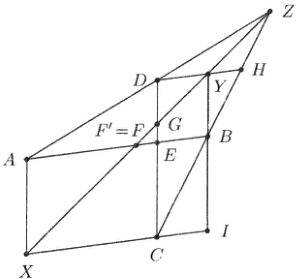
Let be the intersection point of the segments and . Points and are marked in the plane such that the quadrilaterals and are parallelograms. Prove that the lines , , and are either pairwise parallel or concurrent. (M. Karpuk, A. Voidelevich)
Solution
Let the segment meet the segments and at and , respectively. Since and , the triangles and are similar. Therefore we have . In the same way we conclude that .
Suppose that the lines and are parallel. Then the triangles and are similar, so that . Hence, By Thales' theorem, . Thus, we prove that the lines , , and are pairwise parallel.
Further, let and intersect; let be their intersection point (without loss of generality, let be the intersection point of the rays and ). Let the line meet the segment at . Show that , which yields that the points and coincide, i.e., the lines , , are concurrent, as required. Let be the intersection point of the lines and , and be the intersection point of the lines and . Then since , we have . Since and , the quadrilateral is a parallelogram, and the triangles and are similar. Therefore as required.
Suppose that the lines and are parallel. Then the triangles and are similar, so that . Hence, By Thales' theorem, . Thus, we prove that the lines , , and are pairwise parallel.
Further, let and intersect; let be their intersection point (without loss of generality, let be the intersection point of the rays and ). Let the line meet the segment at . Show that , which yields that the points and coincide, i.e., the lines , , are concurrent, as required. Let be the intersection point of the lines and , and be the intersection point of the lines and . Then since , we have . Since and , the quadrilateral is a parallelogram, and the triangles and are similar. Therefore as required.
Techniques
Concurrency and CollinearityDistance chasing