Browse · MathNet
PrintChinese Mathematical Olympiad
China geometry
Problem
Find the minimal integer such that there exist points on a plane with no three being colinear, such that for every , the midpoint of the segment is contained in the segment for some . Here, .
Solution
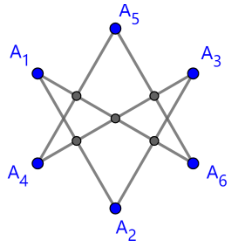
Solution: First, we prove that satisfies the condition. Let be the vertices of a regular hexagon in consecutive order. Let . Then, these 6 points satisfy the conditions. See the figure below.
We now prove that does not satisfy the given conditions. Clearly, does not satisfy the condition because for any in the statement, we require .
When , if satisfy the conditions, then and must bisect each other, and and must bisect each other, which is impossible.
Therefore, we only need to consider the case when . Suppose satisfy the conditions. For any , we require in the statement. We consider two cases.
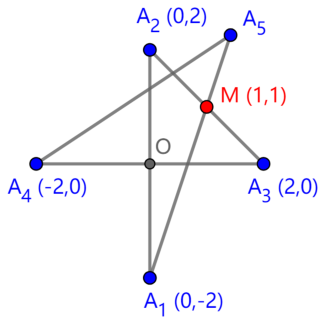
Case 1: Two of the line segments , bisect each other. By symmetry, we assume that and bisect each other. Note that applying an affine transformation to the plane does not affect the conclusion, we can assume that and are perpendicular bisectors and have equal length. Let be their intersection point, and let us establish a Cartesian coordinate system with as the origin. Let . Then the midpoint of must lie on either or . Without loss of generality, we assume that lies on . Note that the slope of is 3, so we can assume that the coordinates of are , where . See the figure below.
Now consider the midpoint of . If it lies inside the segment , then implies . However, in this case are collinear, a contradiction. If lies inside the segment , then also yields , which is a contradiction.
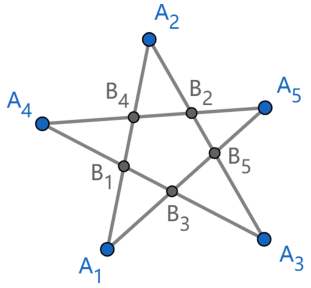
Case 2: None of the segments , bisect each other. Without loss of generality, assume that the midpoint of lies on . Then the midpoint of lies on , the midpoint of lies on , the midpoint of lies on , and the midpoint of lies on . This implies that connecting in sequence yields a five-pointed star.
By the Law of Sines, where the subscripts are understood modulo 5. This is a contradiction.
Therefore, the minimum we seek is 6.
We now prove that does not satisfy the given conditions. Clearly, does not satisfy the condition because for any in the statement, we require .
When , if satisfy the conditions, then and must bisect each other, and and must bisect each other, which is impossible.
Therefore, we only need to consider the case when . Suppose satisfy the conditions. For any , we require in the statement. We consider two cases.
Case 1: Two of the line segments , bisect each other. By symmetry, we assume that and bisect each other. Note that applying an affine transformation to the plane does not affect the conclusion, we can assume that and are perpendicular bisectors and have equal length. Let be their intersection point, and let us establish a Cartesian coordinate system with as the origin. Let . Then the midpoint of must lie on either or . Without loss of generality, we assume that lies on . Note that the slope of is 3, so we can assume that the coordinates of are , where . See the figure below.
Now consider the midpoint of . If it lies inside the segment , then implies . However, in this case are collinear, a contradiction. If lies inside the segment , then also yields , which is a contradiction.
Case 2: None of the segments , bisect each other. Without loss of generality, assume that the midpoint of lies on . Then the midpoint of lies on , the midpoint of lies on , the midpoint of lies on , and the midpoint of lies on . This implies that connecting in sequence yields a five-pointed star.
By the Law of Sines, where the subscripts are understood modulo 5. This is a contradiction.
Therefore, the minimum we seek is 6.
Final answer
6
Techniques
Cartesian coordinatesTrigonometryDistance chasingTriangle trigonometry