Browse · MathNet
PrintTHE Tenth ROMANIAN MASTER OF MATHEMATICS
Romania geometry
Problem
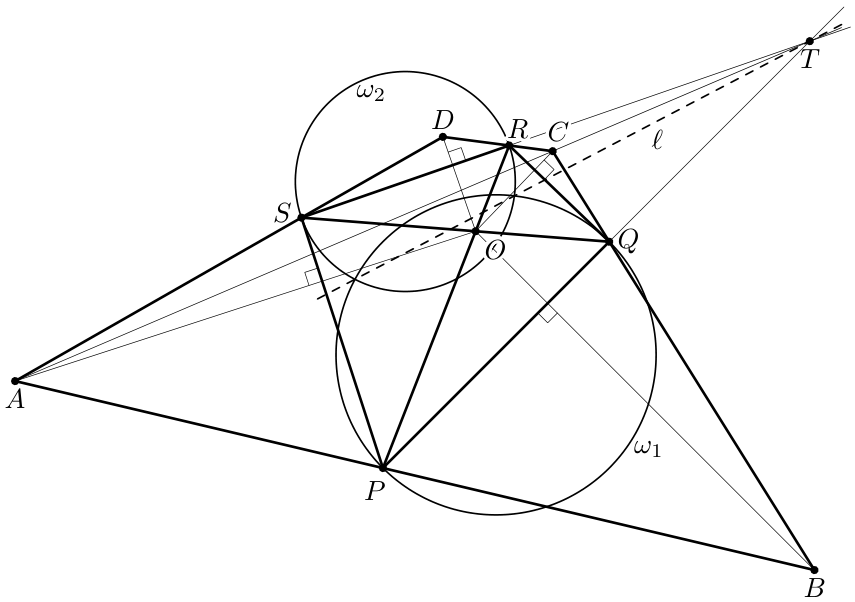
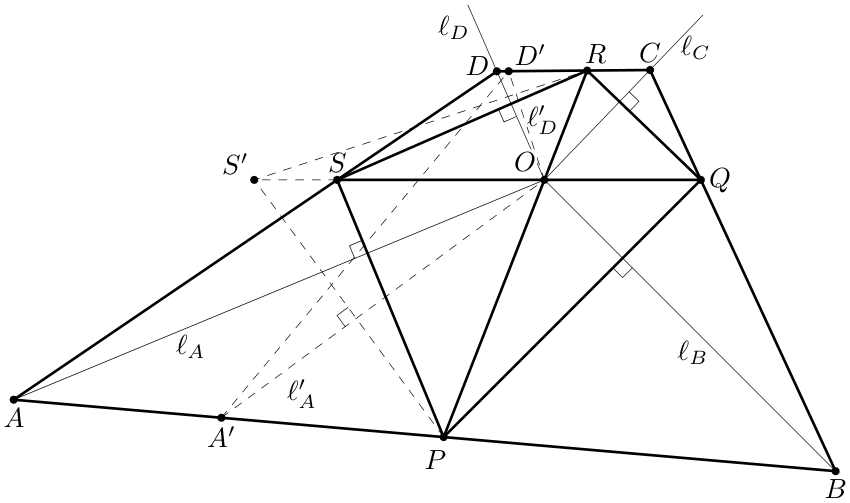
Let be any convex quadrangle and let be points on the segments , and , respectively. It is given that the segments and dissect into four quadrangles, each of which has perpendicular diagonals. Show that the points are concyclic.
Nikolai Beluhov, Bulgaria
Nikolai Beluhov, Bulgaria
Solution
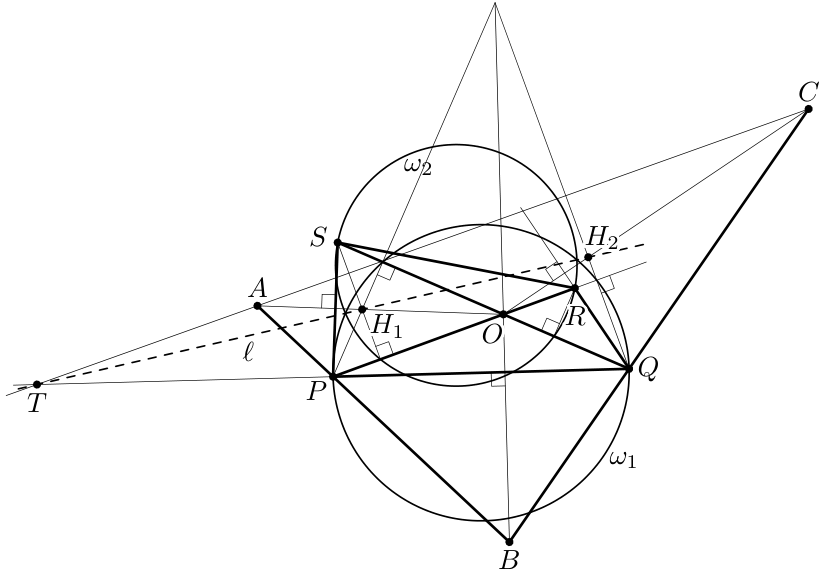
Lemma 1. Let be a convex quadrangle whose diagonals cross at . Let and be the circles on diameters and , respectively, and let be their radical axis. Finally, let , and be points outside this quadrangle so that: the point (respectively, ) lies on the segment (respectively, ); and , , and . Then the three lines , and are concurrent or parallel.
Proof. Assume first that the lines and are not perpendicular. Let and be the orthocentres of the triangles and , respectively; notice that and do not coincide. Since is the radical center of the circles on diameters , and , it lies on . Similarly, lies on , so the lines and coincide. The corresponding sides of the triangles and meet at , and the orthocenter of the triangle (which lies on ). By Desargues' theorem, the lines and are concurrent or parallel. The case when may be considered as a limit case, since the configuration in the statement of the lemma allows arbitrarily small perturbations. The lemma is proved.
Back to the problem, let the segments and cross at , let and be the circles on diameters and , respectively, and let be their radical axis. By the Lemma, the three lines , and are concurrent or parallel, and similarly so are the three lines , and . Thus, if the lines and are distinct, all four lines are concurrent or pairwise parallel. This is clearly the case if the lines and are not parallel, since crosses and at the orthocentres of and , and these orthocentres are distinct from and . In this case, denote the concurrency point by . If is not ideal, then since lies on , so is cyclic. If is ideal (i.e., all four lines are parallel), then the segments and have the same perpendicular bisector (namely, the line of centers of and ), and is cyclic again.
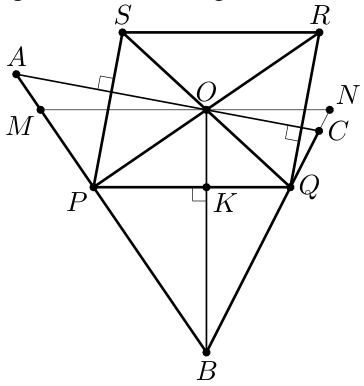
Assume now and parallel. By symmetry, and may also be assumed parallel: otherwise, the preceding argument goes through after relabeling. In this case, we need to prove that the parallelogram is a rectangle. Suppose, by way of contradiction, that . Let the line through and parallel to meet at , and at . Since , the angle is acute and the angle is obtuse, so the angle is obtuse, the angle is acute, lies on the segment , and lies on the extension of the segment beyond . Therefore: , since the angle is obtuse; , since where is the projection of onto ; and , since the angle is obtuse. Consequently, .
Similarly, yields : a contradiction. Consequently, and is a rectangle. This ends the proof.
---
Alternative solution.
Second solution. (Ilya Bogdanov) To begin, we establish a simple, but useful lemma.
Lemma 2. If is a point on the side of a triangle , then Proof. Write , and divide by to get the required identity. A similar statement holds if the point lies on the line ; the proof is obtained by using signed areas and directed lengths.
We now turn to the solution proper and prove the kind of converse below.
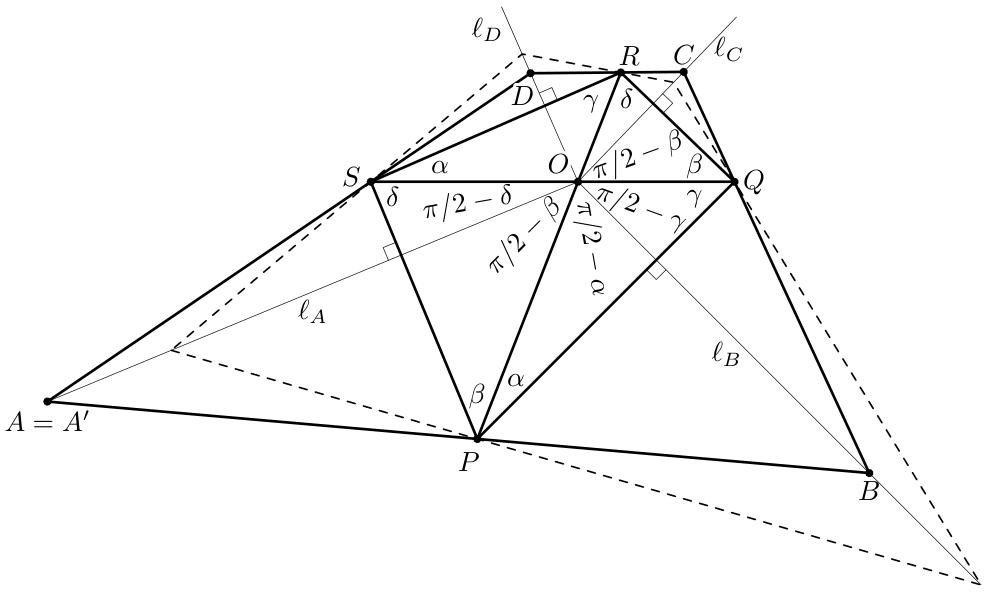
Claim. Let be a cyclic quadrangle with ; assume that no its diagonal is perpendicular to a side. Let , and be the lines through perpendicular to , respectively. Choose any point and successively define , and . Then .
Proof. We restrict ourselves to the case when the points , and lie on , and on the same side of as their points of intersection with the respective sides of the quadrilateral . Again, a general case is obtained by suitable consideration of directed lengths. Write and apply Lemma 2 to the lines , and to get Adding the two equalities on the left and subtracting the two on the right, the required equality (i.e., , in view of ) is equivalent to Let denote the circumdiameter of , so and . Thus the required relation reads The latter holds since is cyclic.
Finally, we use the Claim to complete the proof. Assume that is not cyclic, e.g., that , where . Mark the point on the ray so that . Notice that no diagonal of is perpendicular to a side, so the quadrangle satisfies the conditions of the claim. Let and be the lines through perpendicular to and , respectively. Then and cross the segments and , respectively, at some points and . By the Claim, the line passes through . This is impossible, because the segment crosses the segment at some interior point, while lies on the extension of this segment. This contradiction completes the proof.
Proof. Assume first that the lines and are not perpendicular. Let and be the orthocentres of the triangles and , respectively; notice that and do not coincide. Since is the radical center of the circles on diameters , and , it lies on . Similarly, lies on , so the lines and coincide. The corresponding sides of the triangles and meet at , and the orthocenter of the triangle (which lies on ). By Desargues' theorem, the lines and are concurrent or parallel. The case when may be considered as a limit case, since the configuration in the statement of the lemma allows arbitrarily small perturbations. The lemma is proved.
Back to the problem, let the segments and cross at , let and be the circles on diameters and , respectively, and let be their radical axis. By the Lemma, the three lines , and are concurrent or parallel, and similarly so are the three lines , and . Thus, if the lines and are distinct, all four lines are concurrent or pairwise parallel. This is clearly the case if the lines and are not parallel, since crosses and at the orthocentres of and , and these orthocentres are distinct from and . In this case, denote the concurrency point by . If is not ideal, then since lies on , so is cyclic. If is ideal (i.e., all four lines are parallel), then the segments and have the same perpendicular bisector (namely, the line of centers of and ), and is cyclic again.
Assume now and parallel. By symmetry, and may also be assumed parallel: otherwise, the preceding argument goes through after relabeling. In this case, we need to prove that the parallelogram is a rectangle. Suppose, by way of contradiction, that . Let the line through and parallel to meet at , and at . Since , the angle is acute and the angle is obtuse, so the angle is obtuse, the angle is acute, lies on the segment , and lies on the extension of the segment beyond . Therefore: , since the angle is obtuse; , since where is the projection of onto ; and , since the angle is obtuse. Consequently, .
Similarly, yields : a contradiction. Consequently, and is a rectangle. This ends the proof.
---
Alternative solution.
Second solution. (Ilya Bogdanov) To begin, we establish a simple, but useful lemma.
Lemma 2. If is a point on the side of a triangle , then Proof. Write , and divide by to get the required identity. A similar statement holds if the point lies on the line ; the proof is obtained by using signed areas and directed lengths.
We now turn to the solution proper and prove the kind of converse below.
Claim. Let be a cyclic quadrangle with ; assume that no its diagonal is perpendicular to a side. Let , and be the lines through perpendicular to , respectively. Choose any point and successively define , and . Then .
Proof. We restrict ourselves to the case when the points , and lie on , and on the same side of as their points of intersection with the respective sides of the quadrilateral . Again, a general case is obtained by suitable consideration of directed lengths. Write and apply Lemma 2 to the lines , and to get Adding the two equalities on the left and subtracting the two on the right, the required equality (i.e., , in view of ) is equivalent to Let denote the circumdiameter of , so and . Thus the required relation reads The latter holds since is cyclic.
Finally, we use the Claim to complete the proof. Assume that is not cyclic, e.g., that , where . Mark the point on the ray so that . Notice that no diagonal of is perpendicular to a side, so the quadrangle satisfies the conditions of the claim. Let and be the lines through perpendicular to and , respectively. Then and cross the segments and , respectively, at some points and . By the Claim, the line passes through . This is impossible, because the segment crosses the segment at some interior point, while lies on the extension of this segment. This contradiction completes the proof.
Techniques
Quadrilaterals with perpendicular diagonalsCyclic quadrilateralsRadical axis theoremDesargues theoremTrigonometryAngle chasing