Browse · MathNet
PrintI OBM
Brazil geometry
Problem
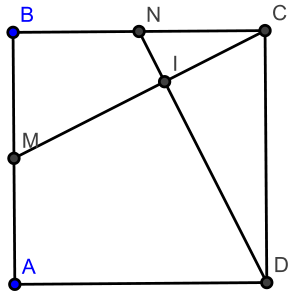
(i) is a square with side . is the midpoint of , and is the midpoint of . The lines and meet at . Find the area of the triangle .
(ii) The midpoints of the sides , , , of the parallelogram are , , , respectively. Each midpoint is joined to the two vertices not on its side. Show that the area outside the resulting 8-pointed star is the area of the parallelogram.
(iii) is a triangle with and centroid . Show that the area of is of the area of .
(iv) Is (ii) true for all convex quadrilaterals ?
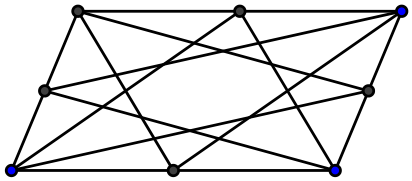
(ii) The midpoints of the sides , , , of the parallelogram are , , , respectively. Each midpoint is joined to the two vertices not on its side. Show that the area outside the resulting 8-pointed star is the area of the parallelogram.
(iii) is a triangle with and centroid . Show that the area of is of the area of .
(iv) Is (ii) true for all convex quadrilaterals ?
Solution
(i) is similar to , so area area
(ii) If we stretch the plane parallel to one of sides of the square then all areas are increased by the same factor and hence the ratio is unchanged. If we now shear parallel to one of the sides, areas are unchanged, so the ratio remains . Thus the result holds for parallelograms. The area outside the star is made up of 8 small triangles, each area , so it is .
(iii) Let the median be . Then and have the same base , so . This is trivial, but this is a hint for part (iv).
(iv) If we take and close together, then we get the same figure as in (iii) and so the ratio tends to . Hence the result is not true for all convex quadrilaterals.
(ii) If we stretch the plane parallel to one of sides of the square then all areas are increased by the same factor and hence the ratio is unchanged. If we now shear parallel to one of the sides, areas are unchanged, so the ratio remains . Thus the result holds for parallelograms. The area outside the star is made up of 8 small triangles, each area , so it is .
(iii) Let the median be . Then and have the same base , so . This is trivial, but this is a hint for part (iv).
(iv) If we take and close together, then we get the same figure as in (iii) and so the ratio tends to . Hence the result is not true for all convex quadrilaterals.
Final answer
(i) 1/20; (ii) 2/5 of the area of the parallelogram; (iii) 1/3 of the area of ABC; (iv) No, it is not true for all convex quadrilaterals.
Techniques
TrianglesQuadrilateralsCartesian coordinatesTransformationsAngle chasingTriangle centers: centroid, incenter, circumcenter, orthocenter, Euler line, nine-point circle