Browse · MathNet
PrintChina National Team Selection Test
China geometry
Problem
There are 63 points on a circle with radius 10. Let be the number of triangles whose sides are longer than 9 and whose vertices are chosen from the 63 points. Find the maximum value of .
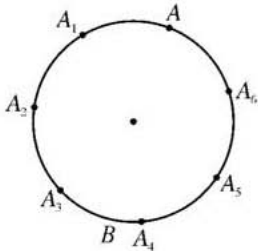
Solution
Let be the center of circle , is the length of a regular -gon inscribed in . Then , .
(1) Let be a regular 6-gon inscribed in , then . So we can choose a point in such that . Then (), and It follows that ().
In each of , choose 11 points, and in each of , choose 10 points. We obtain a set which has 63 points on the circle . It is easy to see for the value of is , where So the maximum value of is not less than .
(2) We prove that the maximum is . We need three lemmas.
Lemma 1 For on circle , we call the arc “an arc of ”, if is the midpoint of arc , and . Now for every given points on circle , there is a point , such that there are points of the given points on the “arc of ”.
Proof: Let be one of the given points, and an “arc of ” be . Now suppose are on the arc (not including ), and (see the figure). So .
If there is a point (of the given points) on , then all the points (of the given points) on are on “an arc of ”. So the given points are on “arcs of ” (including “arc of ”). This shows that there are points of the given points on an “arc of ”, where is one of the given points.
Lemma 2 Take the arc arbitrary on the circle with radius 10, where is of the perimeter. Then take any points on the arc ( are non-negative integers and ). Prove that number of lines from the given points whose lengths are more than 9 is at most
Proof: Divide in five equal parts, where the corresponding points are (see the figure), then the length of is exactly of the perimeter (), and the distance of any two points is not more than . Suppose there are given points on the arc , then the number of lines from the given points whose lengths are more than 9 is at most where Since there are finitely many non-negative integer groups (), the maximum value of exists. Now we prove that when the maximum is attained the inequality must hold.
In fact, if there exist () such that when the maximum is attained, we can suppose . Then let and the corresponding integer is , we will have Contradiction!
Therefore, when reaches the maximum value, the number of is and the number of is . Thus, the number of lines from the given points whose lengths are more than 9 are at most
Lemma 3 Take arbitrary points on the circle with radius 10 to form set , where ( are non-negative integers, ). Assume that there are triangles whose vertices are from and each side is longer than 9. Prove
Proof: We shall prove by mathematical induction.
When , . It is true.
Suppose when , it is true and set ( are non-negative integers, ). Then From Lemma 1, when , the given points must include the point , where at least given points are in the . And the distances of such points to are . Hence, there are at most given points whose distances to are more than 9, and such points are all in the other without . From Lemma 2, the lines from such points whose lengths are more than 9 are at most (From Lemma 2, when , it is , which is also true.) Thus, the number of triangles whose vertex is and each side is larger than 9 is not more than Without , there are given points. Let there be triangles whose vertices are from the points and each side is larger than 9, then using mathematical induction, we get Furthermore which means the case is also true.
On the other hand, when , then and can be simplified to , which is also true.
Therefore, we have proved Lemma 3.
Now considering the original problem, we have It follows from Lemma 3, Thus, .
(1) Let be a regular 6-gon inscribed in , then . So we can choose a point in such that . Then (), and It follows that ().
In each of , choose 11 points, and in each of , choose 10 points. We obtain a set which has 63 points on the circle . It is easy to see for the value of is , where So the maximum value of is not less than .
(2) We prove that the maximum is . We need three lemmas.
Lemma 1 For on circle , we call the arc “an arc of ”, if is the midpoint of arc , and . Now for every given points on circle , there is a point , such that there are points of the given points on the “arc of ”.
Proof: Let be one of the given points, and an “arc of ” be . Now suppose are on the arc (not including ), and (see the figure). So .
If there is a point (of the given points) on , then all the points (of the given points) on are on “an arc of ”. So the given points are on “arcs of ” (including “arc of ”). This shows that there are points of the given points on an “arc of ”, where is one of the given points.
Lemma 2 Take the arc arbitrary on the circle with radius 10, where is of the perimeter. Then take any points on the arc ( are non-negative integers and ). Prove that number of lines from the given points whose lengths are more than 9 is at most
Proof: Divide in five equal parts, where the corresponding points are (see the figure), then the length of is exactly of the perimeter (), and the distance of any two points is not more than . Suppose there are given points on the arc , then the number of lines from the given points whose lengths are more than 9 is at most where Since there are finitely many non-negative integer groups (), the maximum value of exists. Now we prove that when the maximum is attained the inequality must hold.
In fact, if there exist () such that when the maximum is attained, we can suppose . Then let and the corresponding integer is , we will have Contradiction!
Therefore, when reaches the maximum value, the number of is and the number of is . Thus, the number of lines from the given points whose lengths are more than 9 are at most
Lemma 3 Take arbitrary points on the circle with radius 10 to form set , where ( are non-negative integers, ). Assume that there are triangles whose vertices are from and each side is longer than 9. Prove
Proof: We shall prove by mathematical induction.
When , . It is true.
Suppose when , it is true and set ( are non-negative integers, ). Then From Lemma 1, when , the given points must include the point , where at least given points are in the . And the distances of such points to are . Hence, there are at most given points whose distances to are more than 9, and such points are all in the other without . From Lemma 2, the lines from such points whose lengths are more than 9 are at most (From Lemma 2, when , it is , which is also true.) Thus, the number of triangles whose vertex is and each side is larger than 9 is not more than Without , there are given points. Let there be triangles whose vertices are from the points and each side is larger than 9, then using mathematical induction, we get Furthermore which means the case is also true.
On the other hand, when , then and can be simplified to , which is also true.
Therefore, we have proved Lemma 3.
Now considering the original problem, we have It follows from Lemma 3, Thus, .
Final answer
23121
Techniques
Optimization in geometryAngle chasingDistance chasingPigeonhole principleInduction / smoothing