Browse · MathNet
PrintSelection Examination
Greece geometry
Problem
Let be an acute angled triangle with . Its circumcircle is and let be the midpoints of and respectively. We draw externally two semicircles with diameters and , which intersect at and respectively. The lines and intersect the circumcircle at respectively. If the lines and intersect at , prove that:
a) the point is on the circumcircle of the triangle
b) the lines and intersect perpendicularly at the point and is the center of the circumcircle of the triangle .
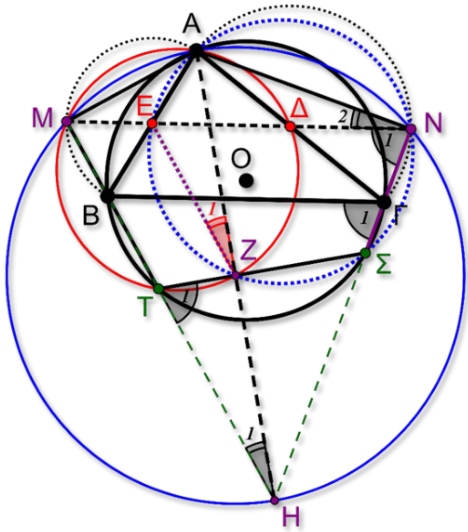
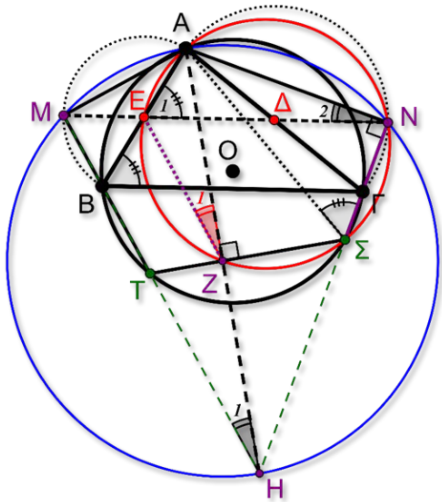
a) the point is on the circumcircle of the triangle
b) the lines and intersect perpendicularly at the point and is the center of the circumcircle of the triangle .
Solution
a. The angles and are right since they see the diameters and . Therefore the quadrilateral is cyclic, which is the desired result.
b. .
The line connects the midpoints of and , so is parallel to . Therefore:
From the quadrilateral we have: From the relations (1), (2), (3) we have:
From the quadrilateral we have: From the equality in combination with the previous ones we get that the quadrilateral is cyclic.
The quadrilateral is also cyclic, since . To this end, we have that and so . Since is the midpoint of , we conclude that is the midpoint of .
b. .
The line connects the midpoints of and , so is parallel to . Therefore:
From the quadrilateral we have: From the relations (1), (2), (3) we have:
From the quadrilateral we have: From the equality in combination with the previous ones we get that the quadrilateral is cyclic.
The quadrilateral is also cyclic, since . To this end, we have that and so . Since is the midpoint of , we conclude that is the midpoint of .
Techniques
Cyclic quadrilateralsAngle chasingTriangle centers: centroid, incenter, circumcenter, orthocenter, Euler line, nine-point circle