Browse · MathNet
Print15th Czech-Polish-Slovak Mathematics Competition
Czech Republic geometry
Problem
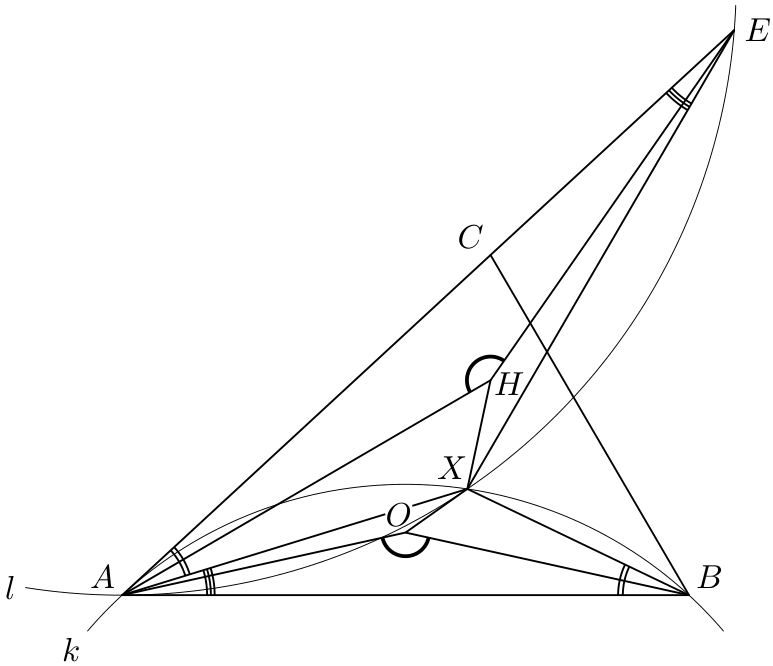
Let be an acute triangle, which is not equilateral. Denote by and its circumcenter and orthocenter, respectively. The circle passes through and touches the line at . The circle with center on the ray touches the line at . The circles and meet in (). Show that .
Solution
Let be the intersection point of the circle and the line (). Since lies in the half-plane and lies in the half-plane , the point lies inside of the angle (Fig. 4). Using the well known fact about the angle between a tangent and a chord of a given circle we get and . Therefore the triangles and are similar.
Denote by the measure of . We have , as is the central angle corresponding to the inscribed angle of measure in the circumcircle of the triangle .
The line passes through the centre of and is perpendicular to its chord , so it is in fact the axis of symmetry of the chord . Therefore , and
from the isosceles triangle with , we obtain , hence .
Fig. 4
The triangles and are both isosceles, and have the vertex angle of the same measure, so they are similar. We have two pairs of similar triangles with the same ratio of similitude . Since and lie on the same side of , and and lie on the same side of , the quadrilaterals and are similar.
Consider the rotation with centre which maps the ray onto the ray . With respect to the derived similarity, the ray is mapped onto the ray under this rotation. Therefore we have
The last identity follows from the fact that is the inscribed angle corresponding to the chord of , while is the angle between this chord and its tangent, and both and lie in the same half-plane determined by this chord.
These quadrilaterals may be degenerate – three of the four vertices may be collinear.
Remark. Instead of rotation, one may consider the spiral similarity which maps onto . Since it maps onto , it is clear that the rotating part of this map rotates all the lines by angle .
---
Alternative solution.
(Outline.) It is possible to solve the problem using coordinates. Let be the origin and lies on the -axis. Denote by the first coordinate of and let be the coordinates of . Routine calculations give
Here, and are the centres of and , respectively, and is the intersection point of the line and the line (these two lines are perpendicular to and , respectively, hence they form the angle of the same measure as ).
Instead of expressing the measure of , we will show that , and are concyclic, that is, the determinant
evaluates to zero. In fact, this is an easy exercise, provided we know basic tricks from linear algebra (adding a scalar multiple of one row to another row does not change the value of the determinant; the same is valid for columns; when checking only zero value, we can multiply any row/column by a nonzero scalar).
It remains to show that among the two possible values, and , of an inscribed angle corresponding to the chord of the circumcircle of the triangle , the latter always apply for . Also, the case or should be handled separately. One may use some kind of continuity arguments to show that we cannot "jump" from one value to another.
Denote by the measure of . We have , as is the central angle corresponding to the inscribed angle of measure in the circumcircle of the triangle .
The line passes through the centre of and is perpendicular to its chord , so it is in fact the axis of symmetry of the chord . Therefore , and
from the isosceles triangle with , we obtain , hence .
Fig. 4
The triangles and are both isosceles, and have the vertex angle of the same measure, so they are similar. We have two pairs of similar triangles with the same ratio of similitude . Since and lie on the same side of , and and lie on the same side of , the quadrilaterals and are similar.
Consider the rotation with centre which maps the ray onto the ray . With respect to the derived similarity, the ray is mapped onto the ray under this rotation. Therefore we have
The last identity follows from the fact that is the inscribed angle corresponding to the chord of , while is the angle between this chord and its tangent, and both and lie in the same half-plane determined by this chord.
These quadrilaterals may be degenerate – three of the four vertices may be collinear.
Remark. Instead of rotation, one may consider the spiral similarity which maps onto . Since it maps onto , it is clear that the rotating part of this map rotates all the lines by angle .
---
Alternative solution.
(Outline.) It is possible to solve the problem using coordinates. Let be the origin and lies on the -axis. Denote by the first coordinate of and let be the coordinates of . Routine calculations give
Here, and are the centres of and , respectively, and is the intersection point of the line and the line (these two lines are perpendicular to and , respectively, hence they form the angle of the same measure as ).
Instead of expressing the measure of , we will show that , and are concyclic, that is, the determinant
evaluates to zero. In fact, this is an easy exercise, provided we know basic tricks from linear algebra (adding a scalar multiple of one row to another row does not change the value of the determinant; the same is valid for columns; when checking only zero value, we can multiply any row/column by a nonzero scalar).
It remains to show that among the two possible values, and , of an inscribed angle corresponding to the chord of the circumcircle of the triangle , the latter always apply for . Also, the case or should be handled separately. One may use some kind of continuity arguments to show that we cannot "jump" from one value to another.
Techniques
Triangle centers: centroid, incenter, circumcenter, orthocenter, Euler line, nine-point circleTangentsRotationSpiral similarityAngle chasingCartesian coordinates