Browse · MathNet
PrintJapan Junior Mathematical Olympiad
Japan geometry
Problem
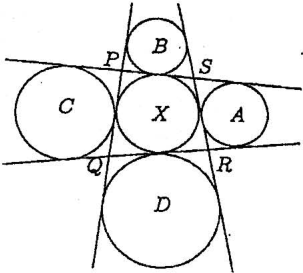
A circle is inscribed in a quadrilateral . Construct 4 circles , each of which is tangent to 3 of the 4 straight lines determined by the sides of the quadrilateral, as shown in the figure below. Suppose that the radii of the circles are , , , , respectively. Determine the radius of the circle .
Solution
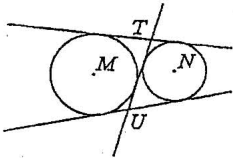
Let us consider the situation, as indicated in the figure below, where circles and straight lines which are outer tangent to both of the circles and inner common tangent line are involved.
Let and be the points of intersection of the common inner tangent line and outer common tangent lines to the circles. Denote by the centers of the circles and let be the corresponding radius, respectively. Let and be the foot of the perpendicular line to the line drawn from and , respectively, and put , . Since the line bisects one of the angles formed by the outer common tangent and inner common tangent to circles through , and the line does the same with respect to the other angle formed by these tangents, we see that holds. This fact, together with
implies that we have and therefore, we conclude that the triangles and are similar. Consequently, we obtain . Similarly, we get . It then follows that we have , and therefore, .
from which we obtain and Hence, we conclude that holds and since , , , we see that is the desired answer.
Let and be the points of intersection of the common inner tangent line and outer common tangent lines to the circles. Denote by the centers of the circles and let be the corresponding radius, respectively. Let and be the foot of the perpendicular line to the line drawn from and , respectively, and put , . Since the line bisects one of the angles formed by the outer common tangent and inner common tangent to circles through , and the line does the same with respect to the other angle formed by these tangents, we see that holds. This fact, together with
implies that we have and therefore, we conclude that the triangles and are similar. Consequently, we obtain . Similarly, we get . It then follows that we have , and therefore, .
from which we obtain and Hence, we conclude that holds and since , , , we see that is the desired answer.
Final answer
8
Techniques
Inscribed/circumscribed quadrilateralsTangentsAngle chasing