Browse · MATH
Printjmc
algebra intermediate
Problem
The graph below shows a portion of the curve defined by the quartic polynomial .
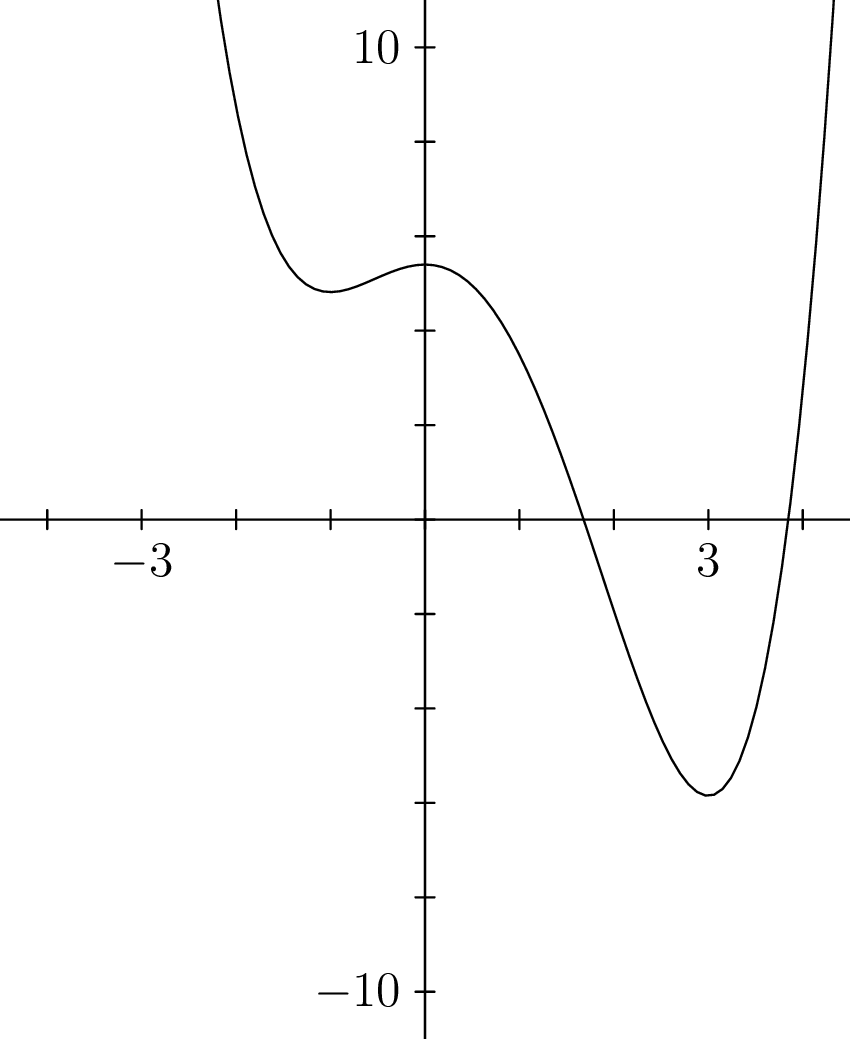
Which of the following is the smallest?
A. B. The product of the zeros of C. The product of the non-real zeros of D. The sum of the coefficients of E. The sum of the real zeros of
Which of the following is the smallest?
A. B. The product of the zeros of C. The product of the non-real zeros of D. The sum of the coefficients of E. The sum of the real zeros of
Solution
We claim that the product of the non-real zeros is the smallest.
(A) The value of is greater than 4.
(B) Since the leading coefficient in is 1, the product of the zeros of is which is greater than 4.
(D) The sum of the coefficient of is which is greater than 2.
(E) The quartic has a real root between 1 and 2, and it also has a root between 3 and 4. If there were any more real roots, then the quartic equation would have more than four roots, which is impossible, so these two real roots are the only real roots. The sum of these real roots is greater than 4.
(C) The product of all the zeros is which is less than 6. The product of the real zeros is greater than 3, so the product the non-real zeros must be less than
Thus, the answer is
(A) The value of is greater than 4.
(B) Since the leading coefficient in is 1, the product of the zeros of is which is greater than 4.
(D) The sum of the coefficient of is which is greater than 2.
(E) The quartic has a real root between 1 and 2, and it also has a root between 3 and 4. If there were any more real roots, then the quartic equation would have more than four roots, which is impossible, so these two real roots are the only real roots. The sum of these real roots is greater than 4.
(C) The product of all the zeros is which is less than 6. The product of the real zeros is greater than 3, so the product the non-real zeros must be less than
Thus, the answer is
Final answer
\text{C}