Browse · MathNet
PrintIranian Mathematical Olympiad
Iran geometry
Problem
A regular dodecahedron is a convex polyhedron such that its faces are regular pentagons. It has 20 vertices and 3 edges connected to each vertex. (As you see in the picture.)
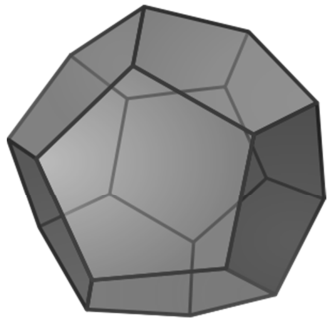
Suppose that we have marked 10 vertices of a regular dodecahedron. a) Prove that we can rotate the dodecahedron in such a way that the dodecahedron is mapped to itself and at most four marked vertices are mapped to a marked vertex. b) Prove that number 4 cannot be replaced with number 3 in the previous part.
Suppose that we have marked 10 vertices of a regular dodecahedron. a) Prove that we can rotate the dodecahedron in such a way that the dodecahedron is mapped to itself and at most four marked vertices are mapped to a marked vertex. b) Prove that number 4 cannot be replaced with number 3 in the previous part.
Solution
a) Now consider one of the marked vertices named . We have 10 marked vertices and each of them can lie on its locations in 3 distinct ways, so in rotations (other than the original state) a special vertex lie on the location of in original state, therefore totally times a marked vertex lie on a marked vertex of the original state. Now by the Pigeonhole principle less than of this coincidences is in one of the states and so we're done. □
b) It suffices to give an example that in each rotation at least 4 marked vertices lie on a marked vertex of original state. Mark the vertices of two opposite faces. Suppose that there exists a rotation with at most 3 coincidences. Consider this state is . So one of the marked faces in has at most one marked vertex of the original state, but each face has at least two marked vertices, contradiction. □
b) It suffices to give an example that in each rotation at least 4 marked vertices lie on a marked vertex of original state. Mark the vertices of two opposite faces. Suppose that there exists a rotation with at most 3 coincidences. Consider this state is . So one of the marked faces in has at most one marked vertex of the original state, but each face has at least two marked vertices, contradiction. □
Techniques
3D ShapesPigeonhole principleGroup Theory