Browse · MathNet
PrintSAUDI ARABIAN MATHEMATICAL COMPETITIONS
Saudi Arabia geometry
Problem
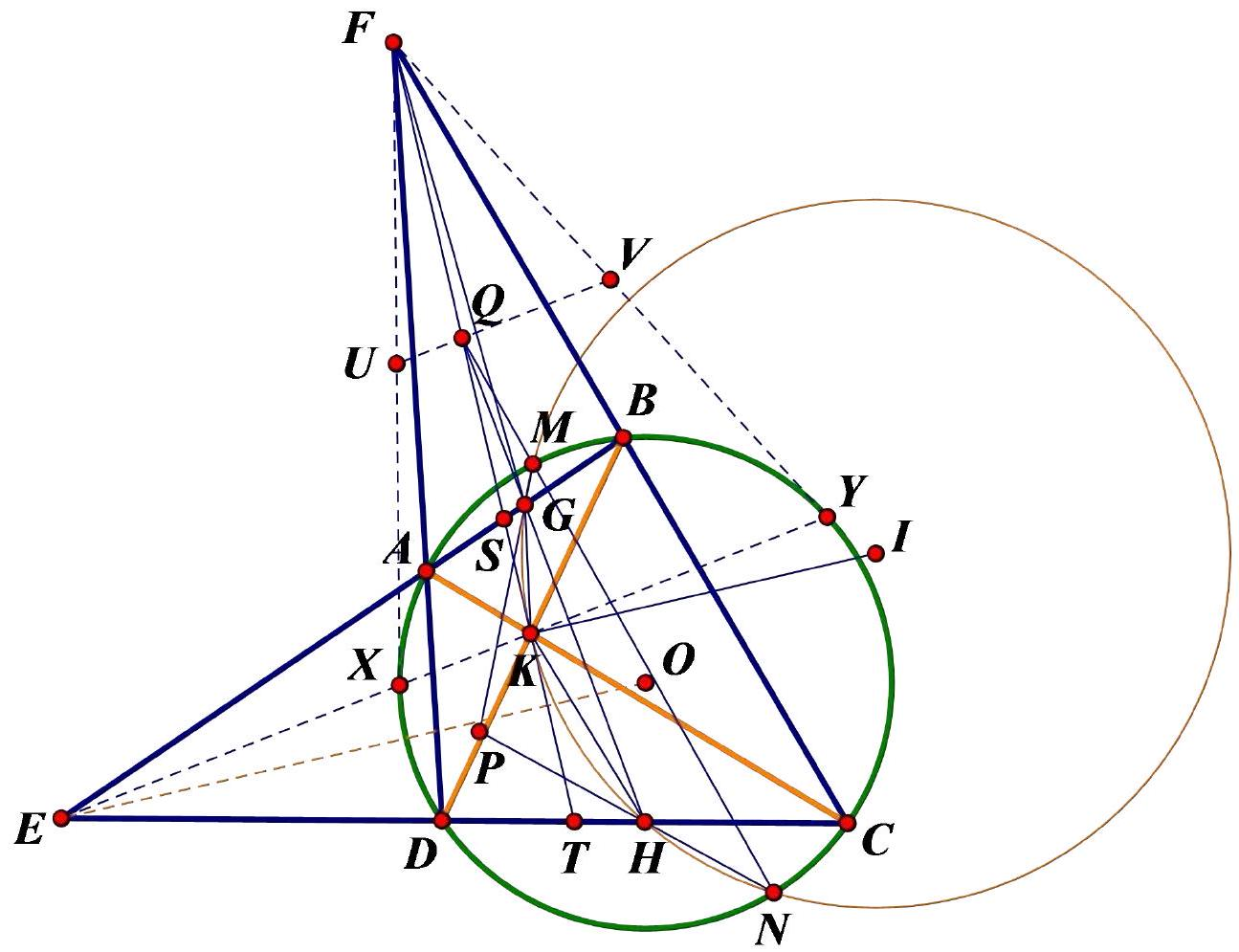
Let be a quadrilateral inscribed a circle (). Assume that and intersect at , and intersect at , and does not belong to the line . Let and be the midpoints of and respectively. Let () be the circumcircle of the triangle . Let () and intersect at such that is convex quadrilateral. Let be the intersection of and , be the intersection of and . 1. Prove that and are parallel. 2. Prove that is perpendicular to .
Solution
Denote as the intersection of , . Suppose that intersects , at , respectively. Since the harmonic points of complete quadrilateral, we have . Then . Similarly, . But then which implies that are concyclic.
Denote as the midpoint of then , , belong to the Gauss line of the complete quadrilateral . We shall prove that belongs to the radical axis of . It is easy to see that is the antipole of then denote then , are the tangent lines of . Let be midpoints of , . We consider the power of point to circle and degenerate circle . but then . This implies that belongs to the radical axis of . Similarly with the point then is the radical axis of . But which is the midline of triangle , then Then belongs to the radical axis of which means or . Thus implies that is the tangent line of . Hence, . Using the Brocard's theorem, we have is the orthocenter of triangle then . Combining all these results, we get .
2) Two lines pass through and intersect at and then is the intersection of , which means belongs to the antipole of . Note that is tangent to which means also belong to the antipole of the pole respect to circle . Then is the antipole of respect to the circle . This implies that .
Denote as the midpoint of then , , belong to the Gauss line of the complete quadrilateral . We shall prove that belongs to the radical axis of . It is easy to see that is the antipole of then denote then , are the tangent lines of . Let be midpoints of , . We consider the power of point to circle and degenerate circle . but then . This implies that belongs to the radical axis of . Similarly with the point then is the radical axis of . But which is the midline of triangle , then Then belongs to the radical axis of which means or . Thus implies that is the tangent line of . Hence, . Using the Brocard's theorem, we have is the orthocenter of triangle then . Combining all these results, we get .
2) Two lines pass through and intersect at and then is the intersection of , which means belongs to the antipole of . Note that is tangent to which means also belong to the antipole of the pole respect to circle . Then is the antipole of respect to the circle . This implies that .
Techniques
Cyclic quadrilateralsRadical axis theoremTangentsPolar triangles, harmonic conjugates