Browse · MathNet
Print60th Belarusian Mathematical Olympiad
Belarus geometry
Problem
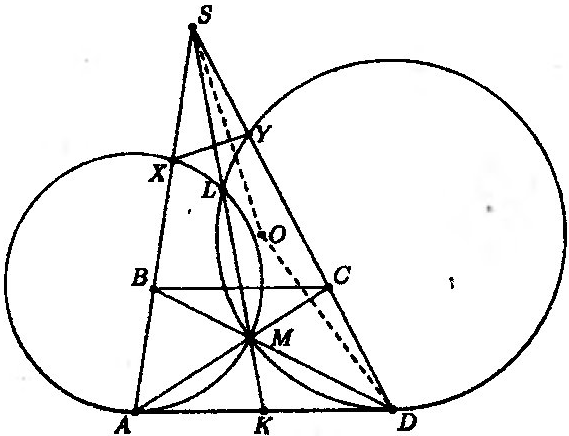
Given a trapezium with , . Let be the point of intersection of and . A circle passes through and touches at . A circle passes through and touches at . Let be the point of intersection of the lines and , be the point of intersection of the circle and the line , be the point of intersection of the circle and the line , be the circumcenter of the triangle . Prove that .
Solution
Draw the line , where is the second (different from ) point of intersection of and . (If touches at , then is the common tangent of these circles at .) Let be the point of intersection of the lines and . By the tangent-secant theorem, we have (or ) .
It is well-known fact that the midpoint of the base, of the trapezium, , the point of intersection of the trapezium diagonals, , and the point of intersection of the extensions of its lateral sides, , lie on the same line. Then . Hence , which gives the similarity of the triangles and . Thus . The angles and are respectively a central and an inscribed angle of the same circle, and both of them are subtended by the same chord . Hence . Therefore, which implies .
It is well-known fact that the midpoint of the base, of the trapezium, , the point of intersection of the trapezium diagonals, , and the point of intersection of the extensions of its lateral sides, , lie on the same line. Then . Hence , which gives the similarity of the triangles and . Thus . The angles and are respectively a central and an inscribed angle of the same circle, and both of them are subtended by the same chord . Hence . Therefore, which implies .
Techniques
TangentsRadical axis theoremMenelaus' theoremTriangle centers: centroid, incenter, circumcenter, orthocenter, Euler line, nine-point circleAngle chasing