Browse · MathNet
PrintVMO
Vietnam geometry
Problem
Given a circumcircle and two fixed points on ( is not the diameter of ). A point is moving on such that is an acute triangle. Let be the feet of the altitudes from of triangle . Let be an arbitrary circle passing through and .
a) Let touch at . Prove that .
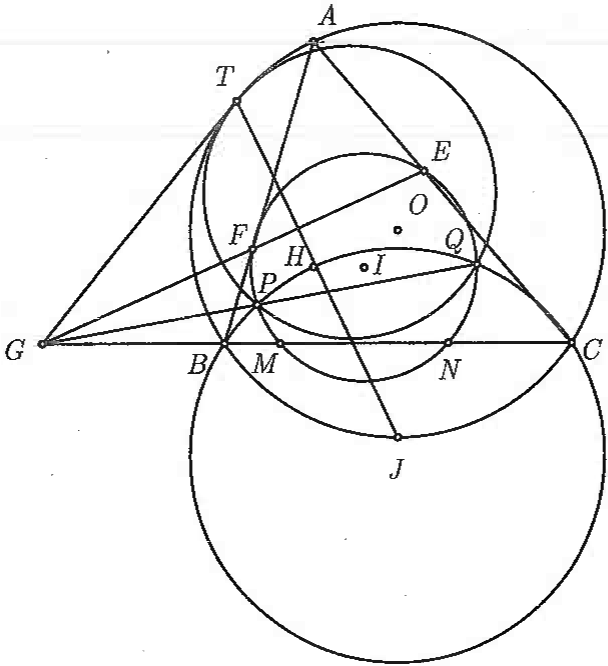
b) Suppose that intersects at and . Let be the orthocenter of triangle and be the intersections of and the circumcircle of triangle . Let be the circle passing through and touches at ( is on the same side with with respect to ). Prove that the interior angle bisector of passes through a fixed point.
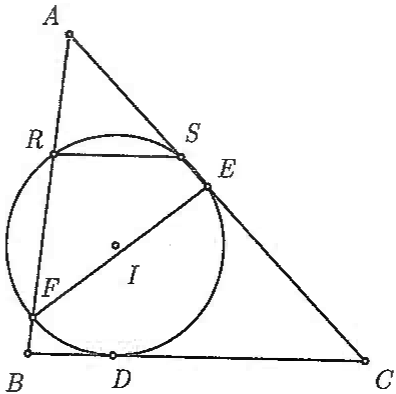
a) Let touch at . Prove that .
b) Suppose that intersects at and . Let be the orthocenter of triangle and be the intersections of and the circumcircle of triangle . Let be the circle passing through and touches at ( is on the same side with with respect to ). Prove that the interior angle bisector of passes through a fixed point.
Solution
In case , it is obvious that and the bisector of passes through the midpoint of the minor arc of (which is the fixed point that is revealed in part b), hence we only need to consider the case where .
a) Let be the second intersections of with respectively. Since lie on a circle with diameter , and quadrilateral is cyclic, we conclude by Reim's theorem.
By the assumption, touches at then which means .
b) Denoted by the intersection of and . We have The radical axis of and is , The radical axis of and is , The radical axis of and is .
Hence is the radical center of these circles, which means lies on . On the other hand, we have Let the radical axis of and be , The radical axis of and is , The radical axis of and is .
then , and concur at which means is the radical axis of and , hence touches and . Since is a cyclic quadrilateral, hence touches .
In conclusion, touches at , we conclude that are isogonal with respect to then the bisector of is coincident with the bisector of , which passes through , the midpoint of minor arc of .
a) Let be the second intersections of with respectively. Since lie on a circle with diameter , and quadrilateral is cyclic, we conclude by Reim's theorem.
By the assumption, touches at then which means .
b) Denoted by the intersection of and . We have The radical axis of and is , The radical axis of and is , The radical axis of and is .
Hence is the radical center of these circles, which means lies on . On the other hand, we have Let the radical axis of and be , The radical axis of and is , The radical axis of and is .
then , and concur at which means is the radical axis of and , hence touches and . Since is a cyclic quadrilateral, hence touches .
In conclusion, touches at , we conclude that are isogonal with respect to then the bisector of is coincident with the bisector of , which passes through , the midpoint of minor arc of .
Final answer
a) DB/DC = sqrt(cot B / cot C). b) The interior angle bisector of angle MTN always passes through the midpoint of the minor arc BC of the circumcircle O.
Techniques
TangentsRadical axis theoremCoaxal circlesCyclic quadrilateralsTriangle centers: centroid, incenter, circumcenter, orthocenter, Euler line, nine-point circleTriangle trigonometry