Browse · MathNet
PrintOpen Contests
Estonia counting and probability
Problem
Let and be positive integers. What is the biggest number of points that can be marked in the vertices of the squares of the grid in such a way that no three of the marked points lie in the vertices of any right-angled triangle?
Solution
All vertices of squares lie on horizontal and vertical lines. Suppose that at least points are marked in the grid. Because , the number of marked points is greater than . Hence by the pigeonhole principle, at least one horizontal line contains more than one marked point. Hence at most marked points are alone on their horizontal lines. Similarly, at most marked points are alone on their vertical lines. Thus there exists a marked point that lies neither alone on its horizontal line nor alone on its vertical line. But then there is a right-angled triangle with vertices at marked points. So at most points can be marked according to the conditions of the problem.
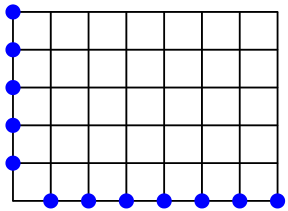
By marking all vertices of squares of the grid that lie at the left and lower edge of the grid except for the lower left corner we have marked exactly points (Fig. 13 depicts the choice for a grid). Any three of the marked points either lie on a common line or are the vertices of an obtuse triangle, so the construction satisfies the conditions of the problem.
Fig. 13
By marking all vertices of squares of the grid that lie at the left and lower edge of the grid except for the lower left corner we have marked exactly points (Fig. 13 depicts the choice for a grid). Any three of the marked points either lie on a common line or are the vertices of an obtuse triangle, so the construction satisfies the conditions of the problem.
Fig. 13
Final answer
n + m
Techniques
Pigeonhole principleColoring schemes, extremal arguments