Browse · MathNet
Print62nd Ukrainian National Mathematical Olympiad, Third Round, First Tour
Ukraine geometry
Problem
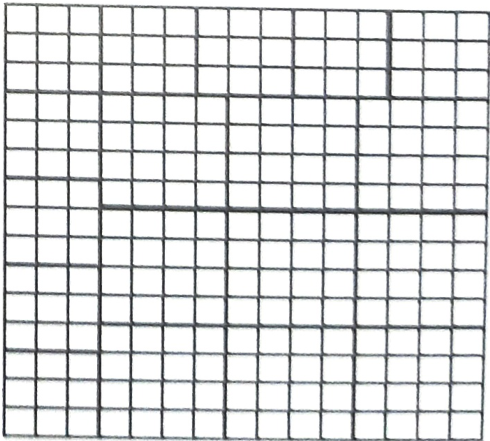
Find the smallest positive integer for which it's possible to cut the square into squares of two different sizes: squares of one size and more of other size.
Solution
The example of cutting into squares is provided in the fig. 10.
Suppose that there exists an example for . Denote the sides of the squares by , and of the large square as . Let's first show that it's possible to represent as the sum , where , at least in two different ways.
Clearly, at least one such representation has to exist. Let , then any vertical/horizontal line, not passing through any side of any square, intersects precisely squares with side and precisely squares with side .
Choose any and draw vertical lines on distances from the left side of the large square ( has to be such that no such line passes through any side of any of the squares). Each such line will intersect precisely squares with size , so the large square is intersected by precisely lines for any choice of , but it's possible only if . Similarly, . So, we got two representations of , contradiction.
Now that we know that such exist, so we get , so we can zoom in and let for some . So, from now on, are positive integers, and their largest common divisor .
Write the condition on the area: .
For this equation doesn't have a solution: as has a prime divisor of form , we get , so , so and are divisible by , but they are coprime.
For we can just check all pairs which satisfy the conditions above and see that for no of them the value of is a perfect square.
For the only such pair is . Then , but can be represented as in a unique way, so it's wrong.
For the only such pair is , then , but from the square we can't cut out squares , as each of them contains at least one of the cells .
For the only such pair – , then , but from the square we can't cut out squares , as each of them contains at least one of the cells .
Suppose that there exists an example for . Denote the sides of the squares by , and of the large square as . Let's first show that it's possible to represent as the sum , where , at least in two different ways.
Clearly, at least one such representation has to exist. Let , then any vertical/horizontal line, not passing through any side of any square, intersects precisely squares with side and precisely squares with side .
Choose any and draw vertical lines on distances from the left side of the large square ( has to be such that no such line passes through any side of any of the squares). Each such line will intersect precisely squares with size , so the large square is intersected by precisely lines for any choice of , but it's possible only if . Similarly, . So, we got two representations of , contradiction.
Now that we know that such exist, so we get , so we can zoom in and let for some . So, from now on, are positive integers, and their largest common divisor .
Write the condition on the area: .
For this equation doesn't have a solution: as has a prime divisor of form , we get , so , so and are divisible by , but they are coprime.
For we can just check all pairs which satisfy the conditions above and see that for no of them the value of is a perfect square.
For the only such pair is . Then , but can be represented as in a unique way, so it's wrong.
For the only such pair is , then , but from the square we can't cut out squares , as each of them contains at least one of the cells .
For the only such pair – , then , but from the square we can't cut out squares , as each of them contains at least one of the cells .
Final answer
9
Techniques
Combinatorial GeometryCounting two waysPigeonhole principleTechniques: modulo, size analysis, order analysis, inequalitiesQuadratic residues