Browse · MathNet
Print56th International Mathematical Olympiad Shortlisted Problems
counting and probability
Problem
In a company of people some pairs are enemies. A group of people is called unsociable if the number of members in the group is odd and at least , and it is possible to arrange all its members around a round table so that every two neighbors are enemies. Given that there are at most unsociable groups, prove that it is possible to partition the company into parts so that no two enemies are in the same part.
Solution
We will prove the following more general statement.
Claim. Let be a graph with chromatic number . Then contains at least unsociable groups.
Recall that the chromatic number of is the least such that a proper coloring exists. In view of , the claim implies the problem statement.
Let be a graph with chromatic number . We say that a proper coloring (1) of is leximinimal, if the -tuple is lexicographically minimal; in other words, the following conditions are satisfied: the number is minimal; the number is minimal, subject to the previously chosen value of ; ; the number is minimal, subject to the previously chosen values of .
The following lemma is the core of the proof.
Lemma 1. Suppose that is a graph with odd chromatic number , and let (1) be one of its leximinimal colorings. Then contains an odd cycle which visits all color classes .
Proof of Lemma 1. Let us call a cycle colorful if it visits all color classes.
Due to the definition of the chromatic number, is nonempty. Choose an arbitrary vertex . We construct a colorful odd cycle that has only one vertex in , and this vertex is .
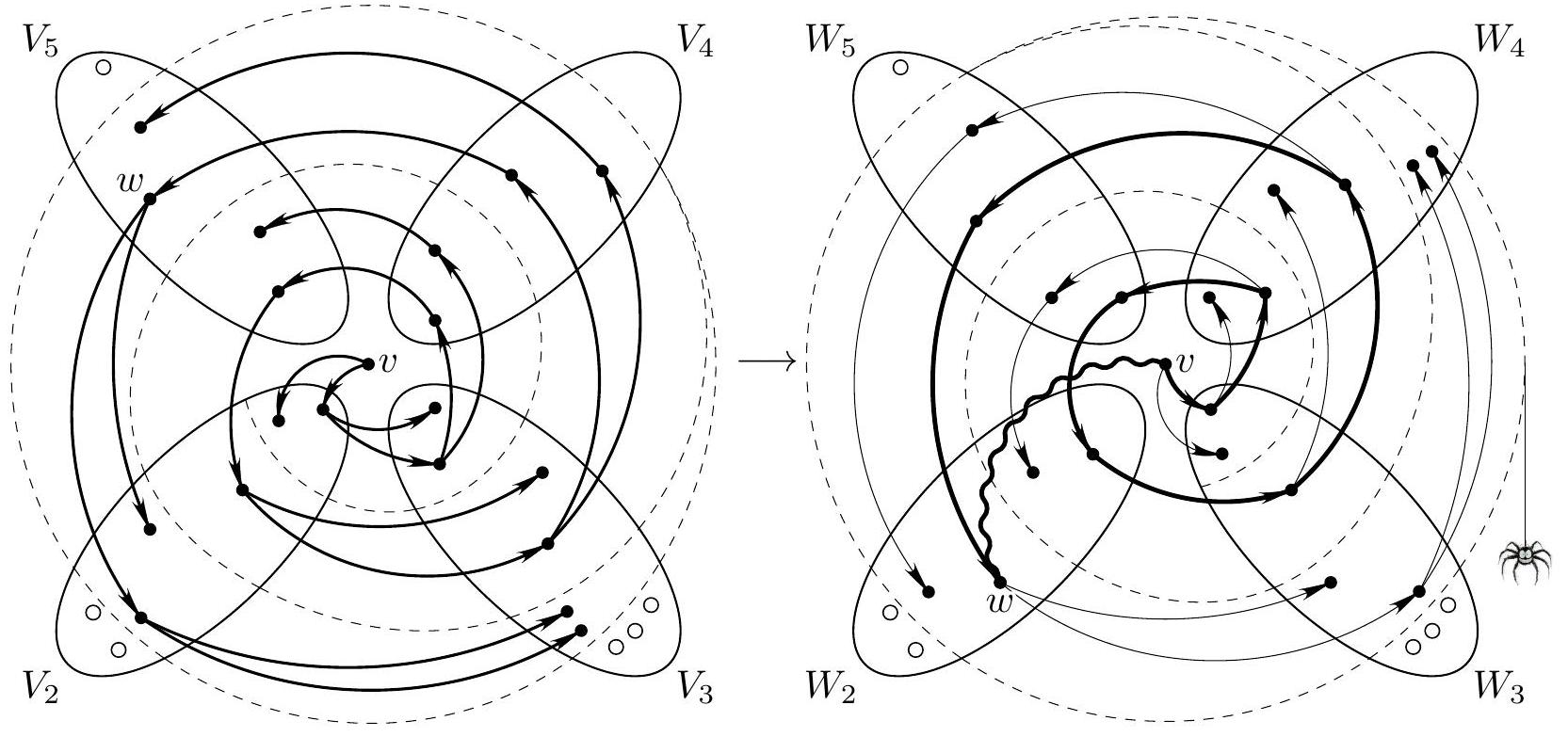
We draw a subgraph of as follows. Place in the center, and arrange the sets in counterclockwise circular order around it. For convenience, let . We will draw arrows to add direction to some edges of , and mark the vertices these arrows point to. First we draw arrows from to all its neighbors in , and mark all those neighbors. If some vertex with is already marked, we draw arrows from to all its neighbors in which are not marked yet, and we mark all of them. We proceed doing this as long as it is possible. The process of marking is exemplified in Figure 1.
Notice that by the rules of our process, in the final state, marked vertices in cannot have unmarked neighbors in . Moreover, is connected to all marked vertices by directed paths.
Now move each marked vertex to the next color class in circular order (see an example in Figure 3). In view of the arguments above, the obtained coloring is proper. Notice that has a neighbor , because otherwise would be a proper coloring lexicographically smaller than (1). If was unmarked, i.e., was an element of , then it would be marked at the beginning of the process and thus moved to , which did not happen. Therefore, is marked and .
Figure 1 Figure 2
Since is marked, there exists a directed path from to . This path moves through the sets in circular order, so the number of edges in it is divisible by and thus even. Closing this path by the edge , we get a colorful odd cycle, as required.
Proof of the claim. Let us choose a leximinimal coloring (1) of . For every set such that is odd and greater than , we will provide an odd cycle visiting exactly those color classes whose indices are listed in the set . This property ensures that we have different cycles for different choices of , and it proves the claim because there are choices for the set .
Let , and let be the induced subgraph of on the vertex set . We also have the induced coloring of with colors; this coloring is of course proper. Notice further that the induced coloring is leximinimal: if we had a lexicographically smaller coloring of , then these classes, together the original color classes for , would provide a proper coloring which is lexicographically smaller than (1). Hence Lemma 1, applied to the subgraph and its leximinimal coloring , provides an odd cycle that visits exactly those color classes that are listed in the set .
---
Alternative solution.
We provide a different proof of the claim from the previous solution.
We say that a graph is critical if deleting any vertex from the graph decreases the graph's chromatic number. Obviously every graph contains a critical induced subgraph with the same chromatic number.
Lemma 2. Suppose that is a critical graph with chromatic number . Then every vertex of is contained in at least unsociable groups.
Proof. For every set , denote by the number of neighbors of in the set .
Since is critical, there exists a proper coloring of with colors, so there exists a proper coloring of such that . Among such colorings, take one for which the sequence is lexicographically minimal. Clearly, for every ; otherwise would be a proper coloring of with colors.
We claim that for every with being even, contains an unsociable group so that the set of its members' colors is precisely . Since the number of such sets is , this proves the lemma. Denote the elements of by in increasing order. For brevity, let . Denote by the set of neighbors of in .
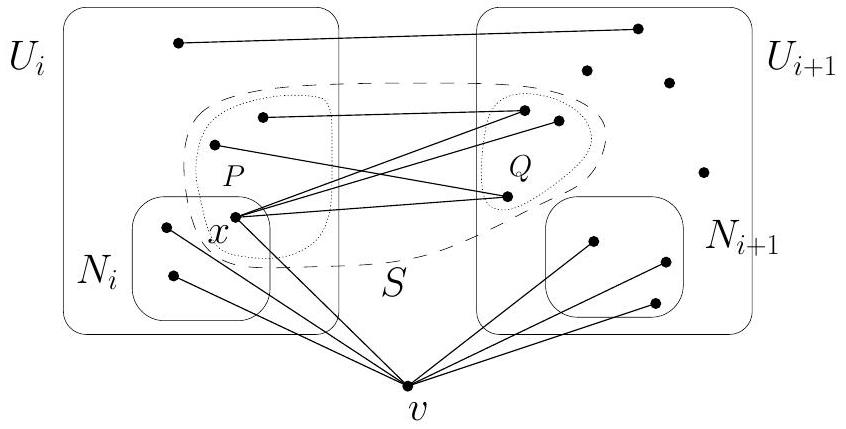
We show that for every and , the subgraph induced by contains a path that connects with another point in . For the sake of contradiction, suppose that no such path exists. Let be the set of vertices that lie in the connected component of in the subgraph induced by , and let , and (see Figure 3). Since is separated from , the sets and are disjoint. So, if we re-color by replacing and by and , respectively, we obtain a proper coloring such that is decreased and only is increased. That contradicts the lexicographical minimality of .
Figure 3
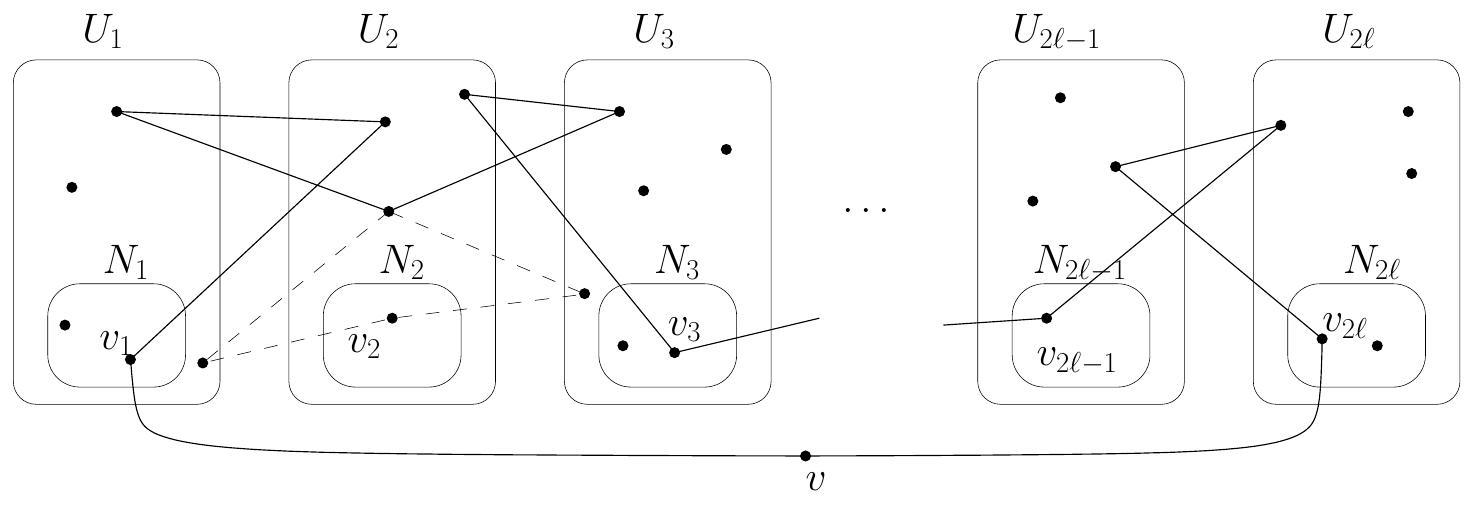
Next, we build a path through as follows. Let the starting point of the path be an arbitrary vertex in the set . For , if the vertex is already defined, connect to some vertex in in the subgraph induced by , and add these edges to the path. Denote the new endpoint of the path by ; by the construction we have again, so the process can be continued. At the end we have a path that starts at and ends at some . Moreover, all edges in this path connect vertices in neighboring classes: if a vertex of the path lies in , then the next vertex lies in or . Notice that the path is not necessary simple, so take a minimal subpath of it. The minimal subpath is simple and connects the same endpoints and . The property that every edge steps to a neighboring color class (i.e., from to or ) is preserved. So the resulting path also visits all of , and its length must be odd. Closing the path with the edges and we obtain the desired odd cycle (see Figure 4).
Figure 4
Now we prove the claim by induction on . The base case holds by applying Lemma 2 to a critical subgraph. For the induction step, let be a critical -chromatic subgraph of , and let be an arbitrary vertex of . By Lemma 2, has at least unsociable groups containing . On the other hand, the graph has chromatic number , so it contains at least unsociable groups by the induction hypothesis. Altogether, this gives distinct unsociable groups in (and thus in ).
Claim. Let be a graph with chromatic number . Then contains at least unsociable groups.
Recall that the chromatic number of is the least such that a proper coloring exists. In view of , the claim implies the problem statement.
Let be a graph with chromatic number . We say that a proper coloring (1) of is leximinimal, if the -tuple is lexicographically minimal; in other words, the following conditions are satisfied: the number is minimal; the number is minimal, subject to the previously chosen value of ; ; the number is minimal, subject to the previously chosen values of .
The following lemma is the core of the proof.
Lemma 1. Suppose that is a graph with odd chromatic number , and let (1) be one of its leximinimal colorings. Then contains an odd cycle which visits all color classes .
Proof of Lemma 1. Let us call a cycle colorful if it visits all color classes.
Due to the definition of the chromatic number, is nonempty. Choose an arbitrary vertex . We construct a colorful odd cycle that has only one vertex in , and this vertex is .
We draw a subgraph of as follows. Place in the center, and arrange the sets in counterclockwise circular order around it. For convenience, let . We will draw arrows to add direction to some edges of , and mark the vertices these arrows point to. First we draw arrows from to all its neighbors in , and mark all those neighbors. If some vertex with is already marked, we draw arrows from to all its neighbors in which are not marked yet, and we mark all of them. We proceed doing this as long as it is possible. The process of marking is exemplified in Figure 1.
Notice that by the rules of our process, in the final state, marked vertices in cannot have unmarked neighbors in . Moreover, is connected to all marked vertices by directed paths.
Now move each marked vertex to the next color class in circular order (see an example in Figure 3). In view of the arguments above, the obtained coloring is proper. Notice that has a neighbor , because otherwise would be a proper coloring lexicographically smaller than (1). If was unmarked, i.e., was an element of , then it would be marked at the beginning of the process and thus moved to , which did not happen. Therefore, is marked and .
Figure 1 Figure 2
Since is marked, there exists a directed path from to . This path moves through the sets in circular order, so the number of edges in it is divisible by and thus even. Closing this path by the edge , we get a colorful odd cycle, as required.
Proof of the claim. Let us choose a leximinimal coloring (1) of . For every set such that is odd and greater than , we will provide an odd cycle visiting exactly those color classes whose indices are listed in the set . This property ensures that we have different cycles for different choices of , and it proves the claim because there are choices for the set .
Let , and let be the induced subgraph of on the vertex set . We also have the induced coloring of with colors; this coloring is of course proper. Notice further that the induced coloring is leximinimal: if we had a lexicographically smaller coloring of , then these classes, together the original color classes for , would provide a proper coloring which is lexicographically smaller than (1). Hence Lemma 1, applied to the subgraph and its leximinimal coloring , provides an odd cycle that visits exactly those color classes that are listed in the set .
---
Alternative solution.
We provide a different proof of the claim from the previous solution.
We say that a graph is critical if deleting any vertex from the graph decreases the graph's chromatic number. Obviously every graph contains a critical induced subgraph with the same chromatic number.
Lemma 2. Suppose that is a critical graph with chromatic number . Then every vertex of is contained in at least unsociable groups.
Proof. For every set , denote by the number of neighbors of in the set .
Since is critical, there exists a proper coloring of with colors, so there exists a proper coloring of such that . Among such colorings, take one for which the sequence is lexicographically minimal. Clearly, for every ; otherwise would be a proper coloring of with colors.
We claim that for every with being even, contains an unsociable group so that the set of its members' colors is precisely . Since the number of such sets is , this proves the lemma. Denote the elements of by in increasing order. For brevity, let . Denote by the set of neighbors of in .
We show that for every and , the subgraph induced by contains a path that connects with another point in . For the sake of contradiction, suppose that no such path exists. Let be the set of vertices that lie in the connected component of in the subgraph induced by , and let , and (see Figure 3). Since is separated from , the sets and are disjoint. So, if we re-color by replacing and by and , respectively, we obtain a proper coloring such that is decreased and only is increased. That contradicts the lexicographical minimality of .
Figure 3
Next, we build a path through as follows. Let the starting point of the path be an arbitrary vertex in the set . For , if the vertex is already defined, connect to some vertex in in the subgraph induced by , and add these edges to the path. Denote the new endpoint of the path by ; by the construction we have again, so the process can be continued. At the end we have a path that starts at and ends at some . Moreover, all edges in this path connect vertices in neighboring classes: if a vertex of the path lies in , then the next vertex lies in or . Notice that the path is not necessary simple, so take a minimal subpath of it. The minimal subpath is simple and connects the same endpoints and . The property that every edge steps to a neighboring color class (i.e., from to or ) is preserved. So the resulting path also visits all of , and its length must be odd. Closing the path with the edges and we obtain the desired odd cycle (see Figure 4).
Figure 4
Now we prove the claim by induction on . The base case holds by applying Lemma 2 to a critical subgraph. For the induction step, let be a critical -chromatic subgraph of , and let be an arbitrary vertex of . By Lemma 2, has at least unsociable groups containing . On the other hand, the graph has chromatic number , so it contains at least unsociable groups by the induction hypothesis. Altogether, this gives distinct unsociable groups in (and thus in ).
Techniques
Graph TheoryColoring schemes, extremal argumentsInduction / smoothing