Browse · MathNet
Print49th International Mathematical Olympiad Spain
geometry
Problem
There is given a convex quadrilateral . Prove that there exists a point inside the quadrilateral such that
Solution
if and only if the diagonals and are perpendicular.
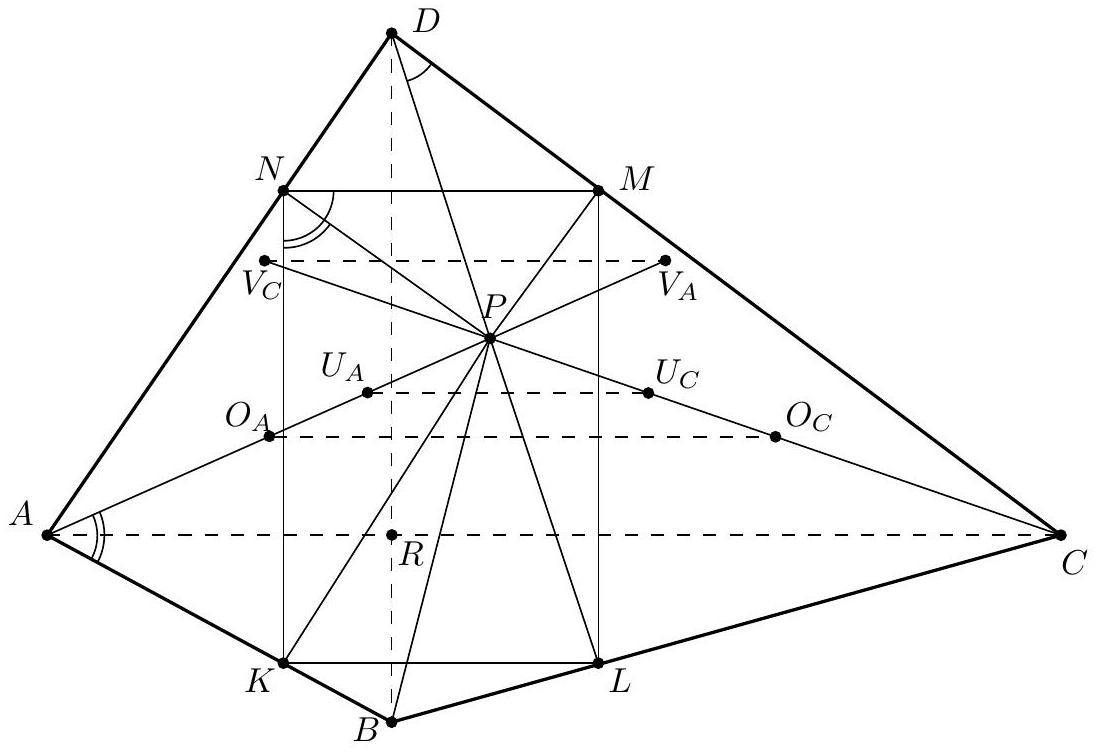
For a point in which satisfies (1), let be the feet of perpendiculars from to lines , respectively. Note that are interior to the sides as all angles in (1) are acute. The cyclic quadrilaterals and give Analogously, and . Hence the equalities (1) imply , so that is a rectangle. The converse also holds true, provided that are interior to sides .
i. Suppose that there exists a point in such that is a rectangle. We show that and are parallel to the respective sides of . Let and be the circumcentres of the cyclic quadrilaterals and . Line is the common perpendicular bisector of and , therefore is parallel to and . On the other hand, is the midline in the triangle that is parallel to . Therefore the diagonal is parallel to the sides and of the rectangle. Likewise, is parallel to and . Hence and are perpendicular.
ii. Suppose that and are perpendicular and meet at . If is a rhombus, can be chosen to be its centre. So assume that is not a rhombus, and let without loss of generality. Denote by and the circumcentres of the triangles and , respectively. Let and be the diameters through and of the two circumcircles. Since is an altitude in triangle , lines and are isogonal conjugates, i.e. . Now implies that ray lies in . Similarly, ray lies in . Both diameters and intersect as the angles at and of both triangles are acute. Also is parallel to as it is the perpendicular bisector of . Hence is parallel to , too. We infer that and intersect at a point inside triangle , hence inside . Construct points and in the same way as in the introduction. It follows from the previous paragraph that are interior to the respective sides. Now is a midline in triangle again. Therefore lines and are parallel. The cyclic quadrilateral yields . Since , as specified above, we obtain . Because is perpendicular to , it follows that is perpendicular to , hence parallel to . Likewise, is parallel to . Consider the two homotheties with centres and which transform triangles and into triangles and , respectively. The images of points and are and , respectively. Since and are parallel to , the two ratios of homothety are the same, equal to . It is now straightforward that . Hence and are parallel to , implying that is a rectangle and completing the proof.
Solution 2:
For a point distinct from , let circles () and () intersect again at ( if the circles are tangent). Next, let circles () and () intersect again at . We show that if lies in and satisfies (1) then and intersect at and are perpendicular; the converse is also true. It is convenient to use directed angles. Let denote the angle of counterclockwise rotation that makes line parallel to line . Recall that four noncollinear points are concyclic if and only if . The definitions of points and imply Observe that the whole construction is reversible. One may start with point , define as the second intersection of circles () and (), and then define as the second intersection of circles () and (). The equalities above will still hold true. Assume in addition that is interior to . Then
i. Suppose that lies in and satisfies (1). Then and similarly . It follows that is the common point of lines and , and that these lines are perpendicular.
ii. Suppose that and are perpendicular and intersect at . We show that the point defined by the reverse construction (starting with and ending with ) lies in . This is enough to finish the solution, because then the angle equalities above will imply (1). One can assume that , the second common point of circles () and (), lies in . Then in fact lies in triangle as angles and are obtuse. Hence is obtuse, too, so that and are outside circle () ( and are acute). Now implies and . Hence and are outside circle (). In conclusion, the second common point of circles () and () lies on their and . We can assume that lies in . Since point lies in triangle , and hence in . The proof is complete.
For a point in which satisfies (1), let be the feet of perpendiculars from to lines , respectively. Note that are interior to the sides as all angles in (1) are acute. The cyclic quadrilaterals and give Analogously, and . Hence the equalities (1) imply , so that is a rectangle. The converse also holds true, provided that are interior to sides .
i. Suppose that there exists a point in such that is a rectangle. We show that and are parallel to the respective sides of . Let and be the circumcentres of the cyclic quadrilaterals and . Line is the common perpendicular bisector of and , therefore is parallel to and . On the other hand, is the midline in the triangle that is parallel to . Therefore the diagonal is parallel to the sides and of the rectangle. Likewise, is parallel to and . Hence and are perpendicular.
ii. Suppose that and are perpendicular and meet at . If is a rhombus, can be chosen to be its centre. So assume that is not a rhombus, and let without loss of generality. Denote by and the circumcentres of the triangles and , respectively. Let and be the diameters through and of the two circumcircles. Since is an altitude in triangle , lines and are isogonal conjugates, i.e. . Now implies that ray lies in . Similarly, ray lies in . Both diameters and intersect as the angles at and of both triangles are acute. Also is parallel to as it is the perpendicular bisector of . Hence is parallel to , too. We infer that and intersect at a point inside triangle , hence inside . Construct points and in the same way as in the introduction. It follows from the previous paragraph that are interior to the respective sides. Now is a midline in triangle again. Therefore lines and are parallel. The cyclic quadrilateral yields . Since , as specified above, we obtain . Because is perpendicular to , it follows that is perpendicular to , hence parallel to . Likewise, is parallel to . Consider the two homotheties with centres and which transform triangles and into triangles and , respectively. The images of points and are and , respectively. Since and are parallel to , the two ratios of homothety are the same, equal to . It is now straightforward that . Hence and are parallel to , implying that is a rectangle and completing the proof.
Solution 2:
For a point distinct from , let circles () and () intersect again at ( if the circles are tangent). Next, let circles () and () intersect again at . We show that if lies in and satisfies (1) then and intersect at and are perpendicular; the converse is also true. It is convenient to use directed angles. Let denote the angle of counterclockwise rotation that makes line parallel to line . Recall that four noncollinear points are concyclic if and only if . The definitions of points and imply Observe that the whole construction is reversible. One may start with point , define as the second intersection of circles () and (), and then define as the second intersection of circles () and (). The equalities above will still hold true. Assume in addition that is interior to . Then
i. Suppose that lies in and satisfies (1). Then and similarly . It follows that is the common point of lines and , and that these lines are perpendicular.
ii. Suppose that and are perpendicular and intersect at . We show that the point defined by the reverse construction (starting with and ending with ) lies in . This is enough to finish the solution, because then the angle equalities above will imply (1). One can assume that , the second common point of circles () and (), lies in . Then in fact lies in triangle as angles and are obtuse. Hence is obtuse, too, so that and are outside circle () ( and are acute). Now implies and . Hence and are outside circle (). In conclusion, the second common point of circles () and () lies on their and . We can assume that lies in . Since point lies in triangle , and hence in . The proof is complete.
Techniques
Quadrilaterals with perpendicular diagonalsCyclic quadrilateralsTriangle centers: centroid, incenter, circumcenter, orthocenter, Euler line, nine-point circleHomothetyAngle chasingConstructions and loci