Browse · MathNet
PrintEstonian Mathematical Olympiad
Estonia counting and probability
Problem
On a plane, 5 points are chosen arbitrarily. Find the largest possible number of distinct right triangles with all vertices in the chosen points.
Solution
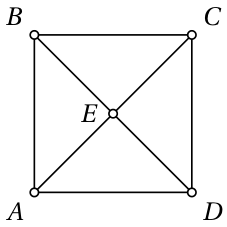
A square and its centre determine 8 distinct right triangles: , , , , , , , .
Fig. 48
We show that more than 8 right triangles is impossible. Firstly, note that among any 5 points, one can choose 4 points that are vertices of a rectangle in at most one way. Indeed, suppose that this can be done in two different ways. Then these two quadruples of points have 3 points in common. But 3 vertices of a rectangle (even parallelogram) uniquely determine the last vertex.
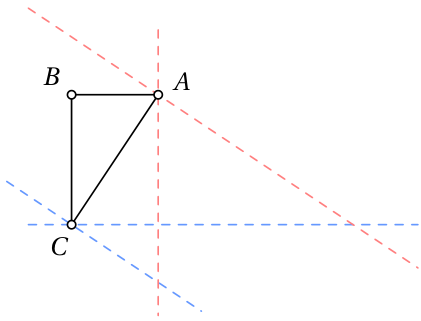
Secondly, note that a quadrangle whose every three vertices form a right triangle is a rectangle. Indeed, these four triangles must have right angle at distinct vertices, otherwise three points would lie on a line. Now if , , are the vertices of a right triangle with right angle at then the remaining vertex must be located in such a way that some triangle could have right triangle at and some triangle could have right angle at . Hence must lie on a line passing through and perpendicular to either or , and also on a line passing through and perpendicular to either or (in Fig. 49, these lines are drawn using dashes of distinct colours).
Fig. 49
As lines perpendicular to do not meet, must lie on the line passing through perpendicular to or on the line passing through perpendicular to . If lies on both these lines, is a rectangle. Hence consider the case with lying on exactly one of these lines. W.l.o.g., let lie on the line passing through perpendicular to and on the line passing through perpendicular to . But then is not a right triangle. Hence the only possibility for is such that is a rectangle.
Let now 5 points be chosen on a plane. Let us count right triangles with vertices in the chosen points by quadrangles, among the vertices of which the vertices of the triangle are. As there are 5 possibilities to extract 4 points out of the given 5 points and, by the above, at most one of the obtained quadruples enable 4 right triangles and the others consequently enable at most 3 right triangles, we can have at most right triangles. But each of these right triangles is counted twice as the fourth vertex can be either of the two remaining points. Hence there are at most 8 distinct right triangles.
---
Alternative solution.
As in Solution 1, we show that it is possible to find 8 right triangles.
Now we prove that more than 8 right triangles is impossible. Suppose the opposite, i.e., there can be 9 right triangles. As there are triples of chosen points in total, at most one triple does not determine a right triangle. Let and be chosen points at maximal distance from each other (if there are several pairs of points with this property, take any of them). By choice, can only be the hypotenuse of a right triangle. Hence at least two of the remaining three chosen points must lie on the circle with diameter ; let these points be and . At least one of and must be a right triangle. As all vertices of this triangle lie on the circle with diameter , two vertices of this triangle must be the endpoints of another diameter of this circle. These points can only be and . Therefore also is a line segment of maximal length and can only be the hypotenuse of a right triangle.
If the last chosen point also lies on the circle with diameter then and are not right triangles because no pair of vertices can be the endpoints of a diameter of this circle. But if does not lie on this circle then and are not right angles, implying that and cannot be right triangles. The contradiction shows that there cannot be 9 right triangles.
Fig. 48
We show that more than 8 right triangles is impossible. Firstly, note that among any 5 points, one can choose 4 points that are vertices of a rectangle in at most one way. Indeed, suppose that this can be done in two different ways. Then these two quadruples of points have 3 points in common. But 3 vertices of a rectangle (even parallelogram) uniquely determine the last vertex.
Secondly, note that a quadrangle whose every three vertices form a right triangle is a rectangle. Indeed, these four triangles must have right angle at distinct vertices, otherwise three points would lie on a line. Now if , , are the vertices of a right triangle with right angle at then the remaining vertex must be located in such a way that some triangle could have right triangle at and some triangle could have right angle at . Hence must lie on a line passing through and perpendicular to either or , and also on a line passing through and perpendicular to either or (in Fig. 49, these lines are drawn using dashes of distinct colours).
Fig. 49
As lines perpendicular to do not meet, must lie on the line passing through perpendicular to or on the line passing through perpendicular to . If lies on both these lines, is a rectangle. Hence consider the case with lying on exactly one of these lines. W.l.o.g., let lie on the line passing through perpendicular to and on the line passing through perpendicular to . But then is not a right triangle. Hence the only possibility for is such that is a rectangle.
Let now 5 points be chosen on a plane. Let us count right triangles with vertices in the chosen points by quadrangles, among the vertices of which the vertices of the triangle are. As there are 5 possibilities to extract 4 points out of the given 5 points and, by the above, at most one of the obtained quadruples enable 4 right triangles and the others consequently enable at most 3 right triangles, we can have at most right triangles. But each of these right triangles is counted twice as the fourth vertex can be either of the two remaining points. Hence there are at most 8 distinct right triangles.
---
Alternative solution.
As in Solution 1, we show that it is possible to find 8 right triangles.
Now we prove that more than 8 right triangles is impossible. Suppose the opposite, i.e., there can be 9 right triangles. As there are triples of chosen points in total, at most one triple does not determine a right triangle. Let and be chosen points at maximal distance from each other (if there are several pairs of points with this property, take any of them). By choice, can only be the hypotenuse of a right triangle. Hence at least two of the remaining three chosen points must lie on the circle with diameter ; let these points be and . At least one of and must be a right triangle. As all vertices of this triangle lie on the circle with diameter , two vertices of this triangle must be the endpoints of another diameter of this circle. These points can only be and . Therefore also is a line segment of maximal length and can only be the hypotenuse of a right triangle.
If the last chosen point also lies on the circle with diameter then and are not right triangles because no pair of vertices can be the endpoints of a diameter of this circle. But if does not lie on this circle then and are not right angles, implying that and cannot be right triangles. The contradiction shows that there cannot be 9 right triangles.
Final answer
8
Techniques
Counting two waysColoring schemes, extremal argumentsConstructions and lociInscribed/circumscribed quadrilaterals