Browse · MathNet
PrintEighteenth STARS OF MATHEMATICS Competition
Romania geometry
Problem
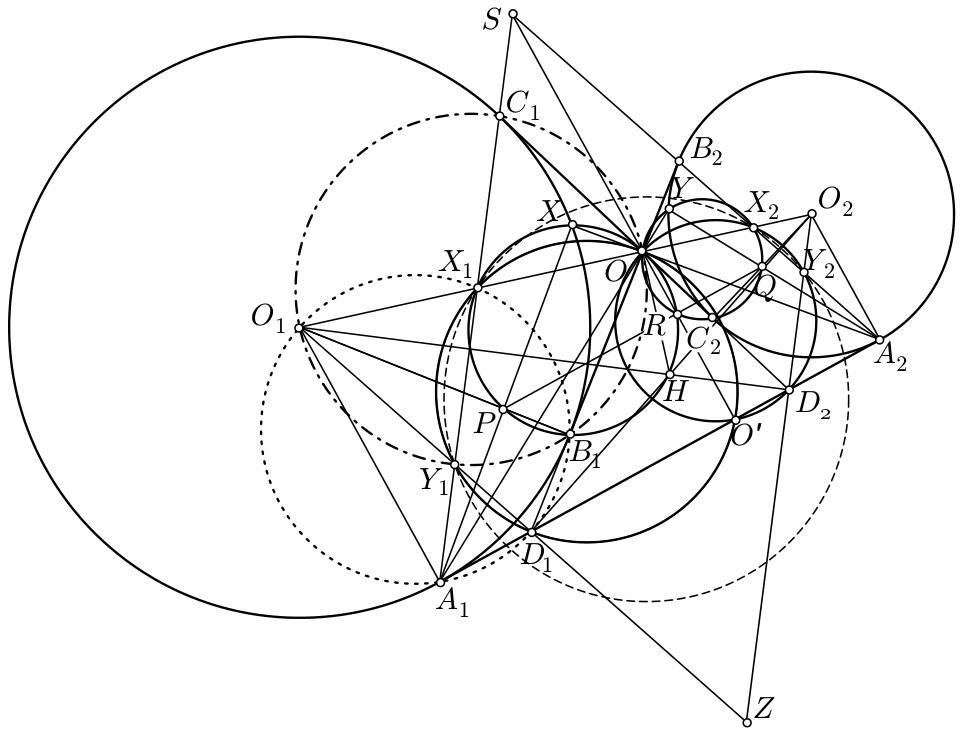
Let and be external circles in the plane, centred at and , respectively. One of their external tangents touches at and at . One of their internal tangents touches at and at , and the other touches at and at . Let and cross at . Let be the point where crosses and , and let be the point where crosses and . The perpendicular at to crosses the line at , and the perpendicular at to crosses the line at . Prove that and are parallel.
Solution
Since the angles and are both right, the circles and cross again at a point on , and is perpendicular to . Letting and cross at , the conclusion then follows at once from the two facts below: (1) lies on ; and (2) is perpendicular to .
To prove (1), invert from with power . Under this inversion, and correspond to one another, and so do the points in each of the pairs , , and .
Clearly, lies on the circle , so this latter is mapped to . Similarly, the circle (through ) is mapped to . Consequently, is mapped to . This establishes (1).
To prove (2), let cross and at and , respectively; let cross and at and , respectively; and let cross at , and cross at . The argument hinges on the following two facts: (3) and both lie on the circle on diameter ; similarly, and both lie on the circle on diameter ; and (4) all lie on a circle . Assume (3) and (4) to establish (2) as follows: , i.e., , is the radical axis of and , and , i.e., , is the radical axis of and . Hence is the radical centre of the three circles. As such, lies on the radical axis of and . These two circles cross again at the orthogonal projection of on , i.e., on , and is their radical axis. Consequently, lies on and (2) follows.
We now turn to prove (3) and (4). To prove (3) only and are dealt with. It is sufficient to show that the angles and are both right. To prove that the angle is right, we show that lies on the circle on diameter . Clearly, and both lie on this circle, so it is sufficient to show that . Now, , since (they both are radii of ). On the other hand, and are reflexions of one another in , so . Consequently, , as desired. The proof that the angle is right is quite similar: This time we show that lies on the circle on diameter . Clearly, and both lie on this circle, so it is sufficient to show that . Notice that and are reflexions of one another in , to write . Refer now again to , to write and conclude that . This establishes (3).
Finally, proving (4) requires more work. We will show that . Clearly, , so it is sufficient to prove that Deal with each angle in the right-hand member separately. By (3), , and an obvious angle chase yields . Hence . To deal with , let and cross at . By (3), the angles and are both right, so is cyclic, and hence . Thus, () now reads Our purpose now is to replace by a more tractable angle. To this end, notice that is the internal angle bisectrix of , and is the internal angle bisectrix of , so and are perpendicular; that is, is the -altitude of the triangle . Similarly, is the -altitude of the triangle , so it crosses at the orthocentre of this triangle. On the other hand, and are clearly the internal angle bisectrices of the triangle at and , respectively. Hence is the internal angle bisectrix of . As such, it is perpendicular to external bisectrix of this angle. Recalling that is the orthocentre of the triangle , it follows that is the -altitude of this triangle. Hence , and (*) now reads To prove this, split . The angle is right, by (3). As such, , since is perpendicular to . Split further , to write . By (3), , so , as desired. This establishes (4) and completes the proof.
To prove (1), invert from with power . Under this inversion, and correspond to one another, and so do the points in each of the pairs , , and .
Clearly, lies on the circle , so this latter is mapped to . Similarly, the circle (through ) is mapped to . Consequently, is mapped to . This establishes (1).
To prove (2), let cross and at and , respectively; let cross and at and , respectively; and let cross at , and cross at . The argument hinges on the following two facts: (3) and both lie on the circle on diameter ; similarly, and both lie on the circle on diameter ; and (4) all lie on a circle . Assume (3) and (4) to establish (2) as follows: , i.e., , is the radical axis of and , and , i.e., , is the radical axis of and . Hence is the radical centre of the three circles. As such, lies on the radical axis of and . These two circles cross again at the orthogonal projection of on , i.e., on , and is their radical axis. Consequently, lies on and (2) follows.
We now turn to prove (3) and (4). To prove (3) only and are dealt with. It is sufficient to show that the angles and are both right. To prove that the angle is right, we show that lies on the circle on diameter . Clearly, and both lie on this circle, so it is sufficient to show that . Now, , since (they both are radii of ). On the other hand, and are reflexions of one another in , so . Consequently, , as desired. The proof that the angle is right is quite similar: This time we show that lies on the circle on diameter . Clearly, and both lie on this circle, so it is sufficient to show that . Notice that and are reflexions of one another in , to write . Refer now again to , to write and conclude that . This establishes (3).
Finally, proving (4) requires more work. We will show that . Clearly, , so it is sufficient to prove that Deal with each angle in the right-hand member separately. By (3), , and an obvious angle chase yields . Hence . To deal with , let and cross at . By (3), the angles and are both right, so is cyclic, and hence . Thus, () now reads Our purpose now is to replace by a more tractable angle. To this end, notice that is the internal angle bisectrix of , and is the internal angle bisectrix of , so and are perpendicular; that is, is the -altitude of the triangle . Similarly, is the -altitude of the triangle , so it crosses at the orthocentre of this triangle. On the other hand, and are clearly the internal angle bisectrices of the triangle at and , respectively. Hence is the internal angle bisectrix of . As such, it is perpendicular to external bisectrix of this angle. Recalling that is the orthocentre of the triangle , it follows that is the -altitude of this triangle. Hence , and (*) now reads To prove this, split . The angle is right, by (3). As such, , since is perpendicular to . Split further , to write . By (3), , so , as desired. This establishes (4) and completes the proof.
Techniques
TangentsRadical axis theoremInversionAngle chasingTriangle centers: centroid, incenter, circumcenter, orthocenter, Euler line, nine-point circle