Browse · MathNet
PrintEstonian Math Competitions
Estonia counting and probability
Problem
Xavier and Olivier are playing tic-tac-toe in the rectangular grid of size with modified rules. On every move, a player chooses an empty square and writes his token into it. Players take turns alternately, with Xavier starting. The player who is the first to occupy any three squares that either are all in the same row or column or lie in pairwise distinct rows and columns wins. Does either of the players have a winning strategy and if yes then who?
Solution
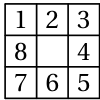
Note that every two unit squares uniquely determine a unit square that constitutes a winning triple together with the given two squares. Label all unit squares except the middle square clockwise with numbers 1 through 8 (Fig. 1); let Xavier initially play into the middle square and if Olivier then moves into the square No. then let Xavier make his second move into the square No. (square No. 1 if ; all possible positions after Xavier's second move, modulo rotation of the table, are depicted in Figures 2 and 3). In order to prevent loss of the game, Olivier must occupy the unit square that constitutes a winning triple together with the two squares occupied by Xavier. Let Xavier then move into the square that constitutes a winning triple together with the two squares previously occupied by Olivier (all possible positions after Xavier's third move are depicted in Figures 4 and 5). Then Olivier can't win on his next move. But the three squares occupied by Xavier contain three pairs, out of which only one pair has its corresponding winning third square occupied by Olivier. Thus Olivier can't block them all, whence Xavier can win on his next move.
Final answer
Xavier
Techniques
Games / greedy algorithms