Browse · MathNet
PrintEstonian Mathematical Olympiad
Estonia geometry
Problem
In an acute triangle , the extension of the altitude over intersects the circumcircle at . The midpoint of is . The circumcircles of and intersect at . The foot of the altitude drawn from to is . Prove that .
Solution
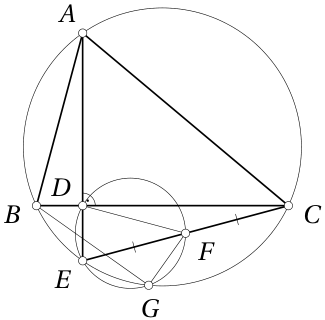
We first show that (Fig. 17). For this we notice that as the midpoint of the hypothenuse in is also its circumcenter, so . Together with being cyclic, we get Thus
Fig. 17 Fig. 18
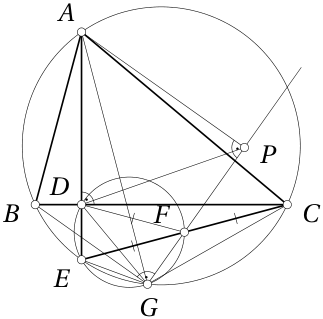
Let and be the intersections of with and with the circumcircle of , respectively (Fig. 18). As , we have that is a diameter of the circumcircle of . Then also , from which . Now as a cyclic quadrilateral with two parallel sides must be an isosceles trapezium. Combining this with , we get , so . From and the parallel lines we get equal triangles and , from which . Thus is a midline of , from which is the midpoint of . In conclusion is the circumcenter of the right-angled triangle , which finishes the proof.
---
Alternative solution.
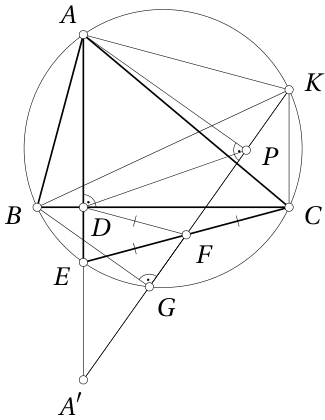
Let be the reflection of over and let be a diameter of the circumcircle of . First, we will show that lies on (Fig. 19). As and , we have . Also Thus , from which . Therefore is a parallelogram. As the intersection of the diagonals of a parallelogram divides both of its diagonals in half and is the midpoint of , it must also be the midpoint of , so are indeed collinear.
Fig. 19
Now we show that also lies on . For this, let be the second intersection of and the circumcircle of (Fig. 20). Notice that is a midline of , so . Therefore which shows that lies on the circumcircle of , meaning that . We have shown that lies on , which also contains . Thus is a right triangle, whose circumcenter is the midpoint of . Therefore , as desired.
---
Alternative solution.
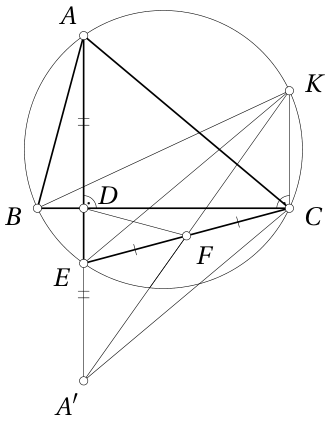
Like in Solution 1, we show that and . Since also (Fig. 21), we have . From this so the right triangles and are similar. Therefore
Fig. 21
On the other hand, we have the equalities from which it follows that the triangles and are similar. Thus
From (7) and (8) we get or Notice also that there must exist a spiral similarity at between the similar triangles and . Hence and are also similar, implying As , the right hand sides of (9) and (10) are equal. So the left hand sides must be equal as well, i.e., . As , triangles and must also be similar. Therefore Combining (7) and (11) gives , as desired.
Fig. 17 Fig. 18
Let and be the intersections of with and with the circumcircle of , respectively (Fig. 18). As , we have that is a diameter of the circumcircle of . Then also , from which . Now as a cyclic quadrilateral with two parallel sides must be an isosceles trapezium. Combining this with , we get , so . From and the parallel lines we get equal triangles and , from which . Thus is a midline of , from which is the midpoint of . In conclusion is the circumcenter of the right-angled triangle , which finishes the proof.
---
Alternative solution.
Let be the reflection of over and let be a diameter of the circumcircle of . First, we will show that lies on (Fig. 19). As and , we have . Also Thus , from which . Therefore is a parallelogram. As the intersection of the diagonals of a parallelogram divides both of its diagonals in half and is the midpoint of , it must also be the midpoint of , so are indeed collinear.
Fig. 19
Now we show that also lies on . For this, let be the second intersection of and the circumcircle of (Fig. 20). Notice that is a midline of , so . Therefore which shows that lies on the circumcircle of , meaning that . We have shown that lies on , which also contains . Thus is a right triangle, whose circumcenter is the midpoint of . Therefore , as desired.
---
Alternative solution.
Like in Solution 1, we show that and . Since also (Fig. 21), we have . From this so the right triangles and are similar. Therefore
Fig. 21
On the other hand, we have the equalities from which it follows that the triangles and are similar. Thus
From (7) and (8) we get or Notice also that there must exist a spiral similarity at between the similar triangles and . Hence and are also similar, implying As , the right hand sides of (9) and (10) are equal. So the left hand sides must be equal as well, i.e., . As , triangles and must also be similar. Therefore Combining (7) and (11) gives , as desired.
Techniques
Cyclic quadrilateralsSpiral similarityAngle chasing