Browse · MathNet
PrintVIII OBM
Brazil geometry
Problem
The Poincaré plane is a half-plane bounded by a line . The lines are taken to be (1) the half-lines perpendicular to , and (2) the semicircles with center on . Show that given any line and any point not on , there are infinitely many lines through which do not intersect . Show that if is a triangle, then the sum of its angles lies in the interval .
Solution
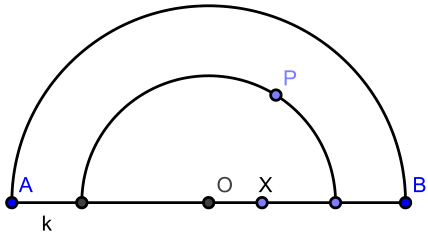
For the first part there are three cases to consider: a semicircle and inside it, a semicircle and outside it, and a perpendicular half-line. The diagram above shows the first case. Take to have radius . The semicircle through with the same center as does not intersect . Suppose its radius is . Now take a semicircle through with center such that . Then its radius , and , so the semicircle lies entirely inside . Thus we have an infinity of possible semicircles through .
An exactly similar argument works for outside .
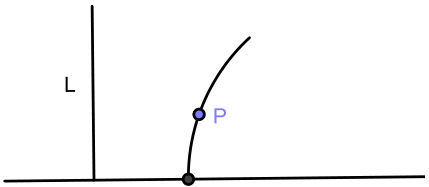
For the third case, just take the center sufficiently far from on the same side of as .
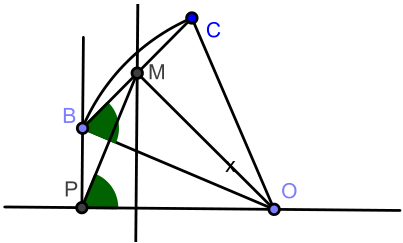
On to the second part. Step 1 is to show that if we fix and allow to vary along a line , then increases as moves down ( is confined to the line and ). In fact, if is the midpoint of then belongs to the line parallel to and passes through a point whose distance to is half the distance from to . Moreover, the quadrilateral is cyclic, so , and decreases as moves down. This means that increases as moves down.
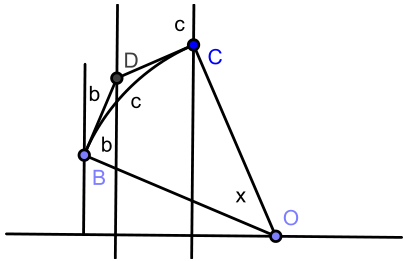
Step 2 is to show that . Let the tangents to the arc passing through and intersect in . So and, by looking at the internal angles of the quadrilateral , .
Now consider the special case where is a straight line. Using the previous results one can show by some angle chasing that the sum of the angles in the triangle is . Finally, use this special case to deduce the other cases (by dividing the general triangle into two parts which fall into the special case).
An exactly similar argument works for outside .
For the third case, just take the center sufficiently far from on the same side of as .
On to the second part. Step 1 is to show that if we fix and allow to vary along a line , then increases as moves down ( is confined to the line and ). In fact, if is the midpoint of then belongs to the line parallel to and passes through a point whose distance to is half the distance from to . Moreover, the quadrilateral is cyclic, so , and decreases as moves down. This means that increases as moves down.
Step 2 is to show that . Let the tangents to the arc passing through and intersect in . So and, by looking at the internal angles of the quadrilateral , .
Now consider the special case where is a straight line. Using the previous results one can show by some angle chasing that the sum of the angles in the triangle is . Finally, use this special case to deduce the other cases (by dividing the general triangle into two parts which fall into the special case).
Techniques
Hyperbolic GeometryTangentsCyclic quadrilateralsAngle chasing