Browse · MathNet
Print49th Mathematical Olympiad in Ukraine
Ukraine counting and probability
Problem
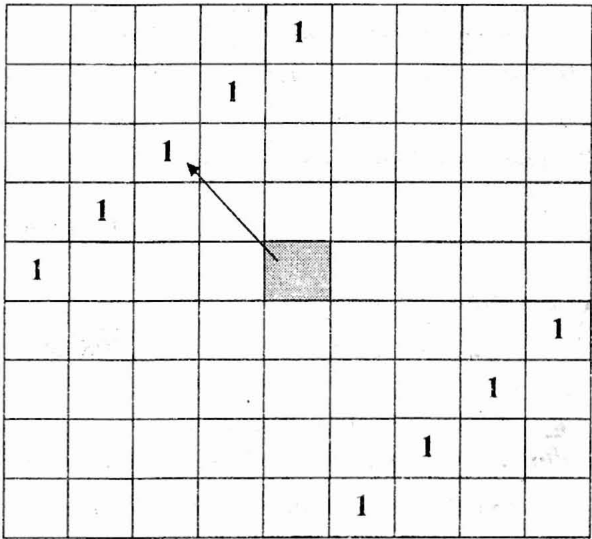
Let's call the filling of the square which is divided into unit squares "correct" if it is filled with numbers in such a way that each of these numbers appears in every row and every column. Let's consider the distance from the central square to the nearest square with number «1» (by the distance we mean the least number of moves of the king to get to the square). What is the maximum value the distance can have?
Solution
The square with number «1» which is the nearest to the center is located on the longest diagonal. The distance to the border is , therefore the distance to the nearest square is . Let us show that this distance is the shortest possible. By condition the distance between two squares is determined by the minimum difference between horizontal and vertical lines of squares' location. Let us assess the distance from the nearest number «1» to the center. Note that in upper and lower horizontals there are numbers «1», because each row on the square has exactly one number «1». Analogously in left and right verticals there are no more than numbers «1». Therefore there is at least one number «1» in the central square . And the distance to each square of this "big" square to the center is not more than . Our solution is complete.
Final answer
502
Techniques
Pigeonhole principleColoring schemes, extremal arguments