Browse · MathNet
Print2023 Chinese IMO National Team Selection Test
China 2023 number theory
Problem
(1) Given coprime positive integers . Prove: There exist real numbers such that for any positive integer , it holds that
(2) Prove: there exists a positive integer , such that for any prime , the following proposition holds: If the positive integers satisfy that is not divisible by , then there exist at least elements in the set such that Here, represents the greatest integer not exceeding , and represents the fractional part of .
(2) Prove: there exists a positive integer , such that for any prime , the following proposition holds: If the positive integers satisfy that is not divisible by , then there exist at least elements in the set such that Here, represents the greatest integer not exceeding , and represents the fractional part of .
Solution
(1) When is large, we expect that the summation in (i) is very close to the following integral: Hence, we will prove the inequality (i) for To do this, we divide the summation and integral into several segments, and it suffices to prove that is less than or equal to . If , each term in (ii) is not greater than 1, so the total sum is not greater than . We now assume . For each , we divide the discussion into two cases: (a) If there exists a such that or is discontinuous on . There are at most such . Moreover, since the product always takes values in , the contribution of each corresponding term in () is at most . (b) If there exists a such that or is continuous on . Let (), then or . Let and .
The corresponding term in (ii) is then Combining the discussions in (a) and (b), we know that the summation in (ii) (when ) is less than or equal to This completes the proof of (1).
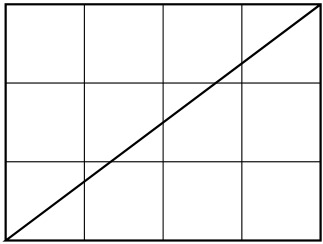
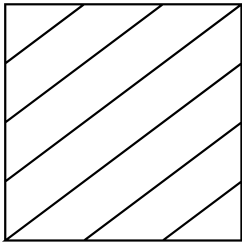
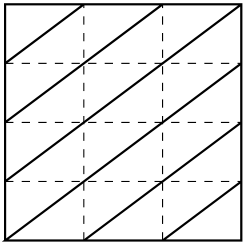
(2) Step 1: A refined estimation of (1). We first calculate the value of . Intuitively, this corresponds to integrating along the diagonal of the grid, as shown in the left figure (). Since the function inside the integral actually only depends on the small square where the diagonal lies, we can translate the diagonal to a small square, as shown in the middle figure (here, the small square is appropriately enlarged). However, this small square can also be divided into rectangular blocks such that the path of integration exactly follows the diagonal, as shown in the right figure. This essentially corresponds to partitioning the integral into integrals from to (). Note that inside each small square, and are both continuous.
We calculate specifically: where each term on the right side of (iii) equals Regarding the preceding summation in (iii), note that when takes values from , the pairs of numbers exactly cover all the points in the set From this, we know that Combining the above results, we obtain That is, Note that when is coprime to both and , since , the sum corresponding to and the sum corresponding to add up to . Therefore, the inequality holds when are taken as negative integers coprime to .
Step 2: Transform the problem into a summation similar to (1). Let be a sufficiently large prime number (e.g., ). The congruence symbol used below denotes congruence modulo . Let , and represent , and respectively, and let be chosen such that . For , let It is easy to see that is an integer and , i.e., . Moreover, is equivalent to or 1. Let , and be the number of occurrences of 0, 1, 2, and 3 respectively among . We need to prove that .
If exactly out of are not multiples of , then . We have the following results: If , then . If , then . If , then . Without loss of generality, we assume that . In this case, , and . We can consider as a random variable, and the estimation of will be related to the variance of the sum . Specifically, we consider the sum of squares: On the other hand, For any , let's define the function . In particular, Now, let's consider the sum of six terms . Since , the desired inequality holds if we have .
Step 3:* Translating into estimates for . We define an equivalence relation if there exists such that and . In this case, Thus, the value of the function depends only on the equivalence class of . In particular, combining with the calculation in Step 1 (), we have To obtain a more accurate estimation of the values of , we introduce additional considerations. For any , let denote the modular inverse of modulo . Consider the residues modulo of the set . By the pigeonhole principle, there exist two residues whose difference is less than or equal to . Therefore, there exist such that , i.e., . (Here, we assume , and we also assume that and are coprime; otherwise, we can replace them with and .) For , let be one of the pairs that satisfy the above condition. If there are multiple choices, we can select any of them, and let . In this case, we have and according to Equation (*), we have: Let , and let . As long as (there exists a choice of ) , we have The condition ensures that in the set , For each pair , since , we know that , which implies . We call a pair “good” if there exist such that . In this case, if is not a good pair, then . If among the six pairs , , there are either 0 or 1 good pairs, then . Therefore, assuming there are at least two good pairs, we know that implies that the four numbers are in a (simple) proportion. For example: If and , then the four numbers are proportional to . If and , then the four numbers are proportional to . In conclusion, there exists such that and , . In this case, we have , which allows us to choose . We still focus on the value of , and there are two simple proportions satisfying : The four numbers form the “Golden Ratio 1” of . Let , , , . In this case, is equivalent to . Among the values , such satisfying are counted as . The four numbers form the “Golden Ratio 2” of . Let , , , . In this case, is equivalent to . Among the values , such satisfying are counted as . Assuming does not correspond to the two golden ratios mentioned above, we will prove that . Let's consider the signs of . If there are three positive and one negative (or three negative and one positive) numbers, without loss of generality, let and . In this case, among the six terms in , there are three positive and three negative terms. Specifically, for , and . Therefore, . Assuming that consist of two positive and two negative numbers, let and . If there exists , without loss of generality, let , . Let and (where and are coprime). In this case, The last step of the above derivation assumes that , which would lead to negations or the four numbers forming a golden ratio. Additionally, when , we have . In any case, we have . If there exists , without loss of generality, let , . Let and (where and are coprime). In this case, The last step of the above derivation assumes that , which would lead to negations or the four numbers forming a golden ratio. Additionally, when , we have respectively. In any case, we have . If each , then the four negative terms in are all greater than or equal to , and the two positive terms are both greater than . Therefore, we still have . In conclusion, we have , and thus the conclusion of the problem is established.
The corresponding term in (ii) is then Combining the discussions in (a) and (b), we know that the summation in (ii) (when ) is less than or equal to This completes the proof of (1).
(2) Step 1: A refined estimation of (1). We first calculate the value of . Intuitively, this corresponds to integrating along the diagonal of the grid, as shown in the left figure (). Since the function inside the integral actually only depends on the small square where the diagonal lies, we can translate the diagonal to a small square, as shown in the middle figure (here, the small square is appropriately enlarged). However, this small square can also be divided into rectangular blocks such that the path of integration exactly follows the diagonal, as shown in the right figure. This essentially corresponds to partitioning the integral into integrals from to (). Note that inside each small square, and are both continuous.
We calculate specifically: where each term on the right side of (iii) equals Regarding the preceding summation in (iii), note that when takes values from , the pairs of numbers exactly cover all the points in the set From this, we know that Combining the above results, we obtain That is, Note that when is coprime to both and , since , the sum corresponding to and the sum corresponding to add up to . Therefore, the inequality holds when are taken as negative integers coprime to .
Step 2: Transform the problem into a summation similar to (1). Let be a sufficiently large prime number (e.g., ). The congruence symbol used below denotes congruence modulo . Let , and represent , and respectively, and let be chosen such that . For , let It is easy to see that is an integer and , i.e., . Moreover, is equivalent to or 1. Let , and be the number of occurrences of 0, 1, 2, and 3 respectively among . We need to prove that .
If exactly out of are not multiples of , then . We have the following results: If , then . If , then . If , then . Without loss of generality, we assume that . In this case, , and . We can consider as a random variable, and the estimation of will be related to the variance of the sum . Specifically, we consider the sum of squares: On the other hand, For any , let's define the function . In particular, Now, let's consider the sum of six terms . Since , the desired inequality holds if we have .
Step 3:* Translating into estimates for . We define an equivalence relation if there exists such that and . In this case, Thus, the value of the function depends only on the equivalence class of . In particular, combining with the calculation in Step 1 (), we have To obtain a more accurate estimation of the values of , we introduce additional considerations. For any , let denote the modular inverse of modulo . Consider the residues modulo of the set . By the pigeonhole principle, there exist two residues whose difference is less than or equal to . Therefore, there exist such that , i.e., . (Here, we assume , and we also assume that and are coprime; otherwise, we can replace them with and .) For , let be one of the pairs that satisfy the above condition. If there are multiple choices, we can select any of them, and let . In this case, we have and according to Equation (*), we have: Let , and let . As long as (there exists a choice of ) , we have The condition ensures that in the set , For each pair , since , we know that , which implies . We call a pair “good” if there exist such that . In this case, if is not a good pair, then . If among the six pairs , , there are either 0 or 1 good pairs, then . Therefore, assuming there are at least two good pairs, we know that implies that the four numbers are in a (simple) proportion. For example: If and , then the four numbers are proportional to . If and , then the four numbers are proportional to . In conclusion, there exists such that and , . In this case, we have , which allows us to choose . We still focus on the value of , and there are two simple proportions satisfying : The four numbers form the “Golden Ratio 1” of . Let , , , . In this case, is equivalent to . Among the values , such satisfying are counted as . The four numbers form the “Golden Ratio 2” of . Let , , , . In this case, is equivalent to . Among the values , such satisfying are counted as . Assuming does not correspond to the two golden ratios mentioned above, we will prove that . Let's consider the signs of . If there are three positive and one negative (or three negative and one positive) numbers, without loss of generality, let and . In this case, among the six terms in , there are three positive and three negative terms. Specifically, for , and . Therefore, . Assuming that consist of two positive and two negative numbers, let and . If there exists , without loss of generality, let , . Let and (where and are coprime). In this case, The last step of the above derivation assumes that , which would lead to negations or the four numbers forming a golden ratio. Additionally, when , we have . In any case, we have . If there exists , without loss of generality, let , . Let and (where and are coprime). In this case, The last step of the above derivation assumes that , which would lead to negations or the four numbers forming a golden ratio. Additionally, when , we have respectively. In any case, we have . If each , then the four negative terms in are all greater than or equal to , and the two positive terms are both greater than . Therefore, we still have . In conclusion, we have , and thus the conclusion of the problem is established.
Techniques
Inverses mod nGreatest common divisors (gcd)Pigeonhole principleCounting two waysSums and products