Browse · MathNet
Print49th International Mathematical Olympiad Spain
geometry
Problem
In the plane we consider rectangles whose sides are parallel to the coordinate axes and have positive length. Such a rectangle will be called a box. Two boxes intersect if they have a common point in their interior or on their boundary. Find the largest for which there exist boxes such that and intersect if and only if .
Solution
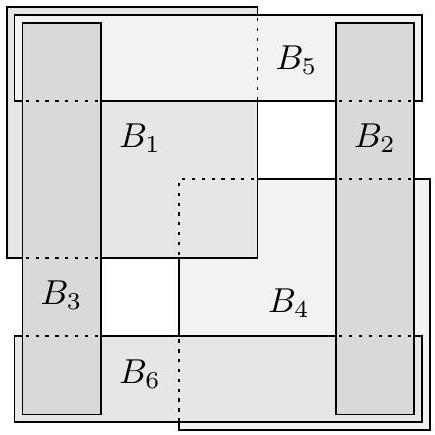
The maximum number of such boxes is . One example is shown in the figure.
Now we show that is the maximum. Suppose that boxes satisfy the condition. Let the closed intervals and be the projections of onto the - and -axis, for .
If and intersect, with a common point , then and . So the intersections and are nonempty. Conversely, if and for some real numbers , then is a common point of and . Putting it around, and are disjoint if and only if their projections on at least one coordinate axis are disjoint.
For brevity we call two boxes or intervals adjacent if their indices differ by modulo , and nonadjacent otherwise.
The adjacent boxes and do not intersect for each . Hence or is a pair of disjoint intervals, . So there are at least pairs of disjoint intervals among .
Next, every two nonadjacent boxes intersect, hence their projections on both axes intersect, too. Then the claim below shows that at most pairs among are disjoint, and the same holds for . Consequently , as stated. Thus we are left with the claim and its justification.
Claim. Let be intervals on a straight line such that every two nonadjacent intervals intersect. Then and are disjoint for at most three values of .
Proof. Denote . Let be the rightmost among the left endpoints of , and let be the leftmost among their right endpoints. Assume that without loss of generality.
If then for all . Every contains , and thus no disjoint pair exists.
If then for some such that , hence and are disjoint. Now intersects all remaining intervals except possibly and , so and can be disjoint only if or . Suppose by symmetry that ; then . Since each of the intervals intersects , we have for . Therefore , in particular . Similarly, all intersect , so that as . This leaves , and as the only candidates for disjoint interval pairs, as desired.
Now we show that is the maximum. Suppose that boxes satisfy the condition. Let the closed intervals and be the projections of onto the - and -axis, for .
If and intersect, with a common point , then and . So the intersections and are nonempty. Conversely, if and for some real numbers , then is a common point of and . Putting it around, and are disjoint if and only if their projections on at least one coordinate axis are disjoint.
For brevity we call two boxes or intervals adjacent if their indices differ by modulo , and nonadjacent otherwise.
The adjacent boxes and do not intersect for each . Hence or is a pair of disjoint intervals, . So there are at least pairs of disjoint intervals among .
Next, every two nonadjacent boxes intersect, hence their projections on both axes intersect, too. Then the claim below shows that at most pairs among are disjoint, and the same holds for . Consequently , as stated. Thus we are left with the claim and its justification.
Claim. Let be intervals on a straight line such that every two nonadjacent intervals intersect. Then and are disjoint for at most three values of .
Proof. Denote . Let be the rightmost among the left endpoints of , and let be the leftmost among their right endpoints. Assume that without loss of generality.
If then for all . Every contains , and thus no disjoint pair exists.
If then for some such that , hence and are disjoint. Now intersects all remaining intervals except possibly and , so and can be disjoint only if or . Suppose by symmetry that ; then . Since each of the intervals intersects , we have for . Therefore , in particular . Similarly, all intersect , so that as . This leaves , and as the only candidates for disjoint interval pairs, as desired.
Final answer
6
Techniques
Helly's theoremCartesian coordinatesColoring schemes, extremal arguments