Browse · MathNet
PrintInternational Mathematical Olympiad
China geometry
Problem
A convex hexagon is given in which any two opposite sides have the following property: the distance between their midpoints is times the sum of their lengths. Prove that all the angles of the hexagon are equal. (A convex hexagon has three pairs of opposite sides: and , and , and .)
Solution
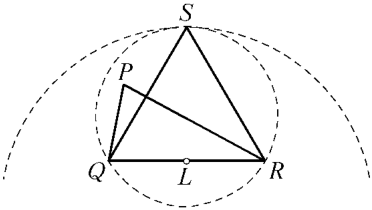
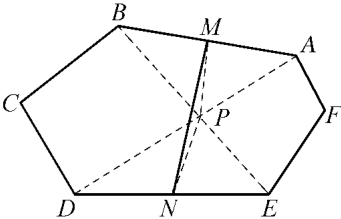
Proof I We first prove the following lemma. Lemma Consider a triangle with . Let be the midpoint of . Then . The equality holds if and only if the triangle is equilateral. Proof of the lemma Let be the point such that the triangle is equilateral, where the points and lie in the same half-plane bounded by the line . Then the point lies inside the circumcircle (including the circumference of the circle) of the triangle , which lies inside the circle with center and radius . This completes the proof of the lemma. The main diagonals of a convex hexagon form a triangle though the Thus we may choose two of these three diagonals that form an angle greater than or equal to . Without loss of generality, we may assume that the diagonals and of the given hexagon satisfy , where is the intersection of these two diagonals. Then, using the lemma, we obtain where and are the midpoints of and respectively. Thus it follows from the lemma that the triangles and are equilateral. Therefore the diagonal forms an angle greater than or equal to with one of the diagonals and . Without loss of generality, we may assume that , where is the intersection of and . Arguing in the same way as above, we infer that the triangles and are equilateral. This implies that , where is the intersection of and . Using the same argument as above for the third time, we obtain that the triangles and are equilateral. This completes the proof.
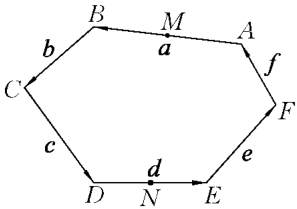
Proof II Let be the given hexagon and let , , ..., . Let and be the midpoints of the sides and respectively. We have Thus we obtain From the given property, we have Set , , . From ① and ②, we obtain Similarly, we see that Note that By adding up the last three inequalities, we obtain or . Thus and the equality holds in every inequality above. Hence we conclude that Suppose that is the triangle such that , , . We may assume , without loss of generality. Let be the midpoint of . Then . It follows from the lemma in Proof I that the triangle is equilateral. Thus we have .
Proof II Let be the given hexagon and let , , ..., . Let and be the midpoints of the sides and respectively. We have Thus we obtain From the given property, we have Set , , . From ① and ②, we obtain Similarly, we see that Note that By adding up the last three inequalities, we obtain or . Thus and the equality holds in every inequality above. Hence we conclude that Suppose that is the triangle such that , , . We may assume , without loss of generality. Let be the midpoint of . Then . It follows from the lemma in Proof I that the triangle is equilateral. Thus we have .
Techniques
VectorsAngle chasingTriangle inequalitiesTriangle inequalities