Browse · MathNet
Print74th NMO Selection Tests for JBMO
Romania counting and probability
Problem
An -type tiles triangle, where , is formed by the cells of a array which are situated below its diagonals. For instance, a 3-type tiles triangle is the following: 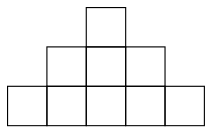 Determine the maximal length of a sequence with pairwise distinct cells in an -type tiles triangle, such that, beginning with the second one, any cell of the sequence has a common side with the previous one.
Solution
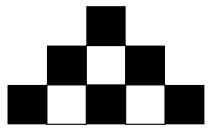
We alternately color (as a chessboard) the cells of an -type tiles triangle, as below: We have black cells and white cells. In any sequence of cells with the required propriety, their color alternates, hence its length cannot exceed . Therefore, we infer that the maximal length of such a sequence is .
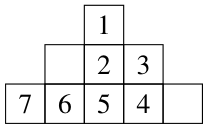
To complete the solution, we now provide an example of a sequence in an -type tiles triangle which satisfies the required condition and has length . We consider a sequence of cells which begins with the top cell. At each step, we choose the cell below the last cell chosen in the previous step, together with a maximum length sequence of cells situated on the same line, up to one of its ends. For instance, for a 3-type tiles triangle the following succession is a solution: The length of a sequence as we described before is: .
Therefore, the answer is .
To complete the solution, we now provide an example of a sequence in an -type tiles triangle which satisfies the required condition and has length . We consider a sequence of cells which begins with the top cell. At each step, we choose the cell below the last cell chosen in the previous step, together with a maximum length sequence of cells situated on the same line, up to one of its ends. For instance, for a 3-type tiles triangle the following succession is a solution: The length of a sequence as we described before is: .
Therefore, the answer is .
Final answer
n^2 - n + 1
Techniques
Coloring schemes, extremal argumentsInvariants / monovariants