Browse · MathNet
PrintFirst Round of the 73rd Czech and Slovak Mathematical Olympiad (take-home part)
Czech Republic counting and probability
Problem
Ten boys and ten girls met at a party. Assume that every girl likes exactly boys and every boy likes exactly girls. Is it always possible to find a couple where both the partners like each other? Solve the problem for:
a) ,
b) .
a) ,
b) .
Solution
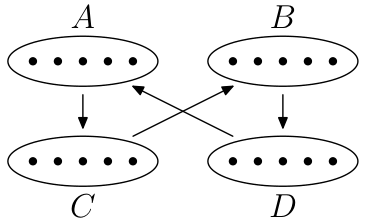
a) For , it may happen that there are no such couples, with one counterexample given as follows. Split the boys into two disjoint quintuples and the girls into two disjoint quintuples . Consider the configuration where every boy from likes all the girls in , every boy in likes all the girls in , every girl in likes all the boys in and every girl in likes all the boys in . Then every boy likes 5 girls, every girl likes 5 boys, but there is clearly no couple where both partners like each other.
b) For , such a couple must exist: there are in total couples (boy, girl) where the boy likes the girl and, by symmetry, 60 couples where the girl likes the boy. These two sets of couples can't possibly be disjoint, since there are couples in total and , so there must be a couple where both the partners like each other.
b) For , such a couple must exist: there are in total couples (boy, girl) where the boy likes the girl and, by symmetry, 60 couples where the girl likes the boy. These two sets of couples can't possibly be disjoint, since there are couples in total and , so there must be a couple where both the partners like each other.
Final answer
a) No. b) Yes.
Techniques
Pigeonhole principleCounting two ways