Browse · MathNet
PrintAustrian Mathematical Olympiad
Austria geometry
Problem
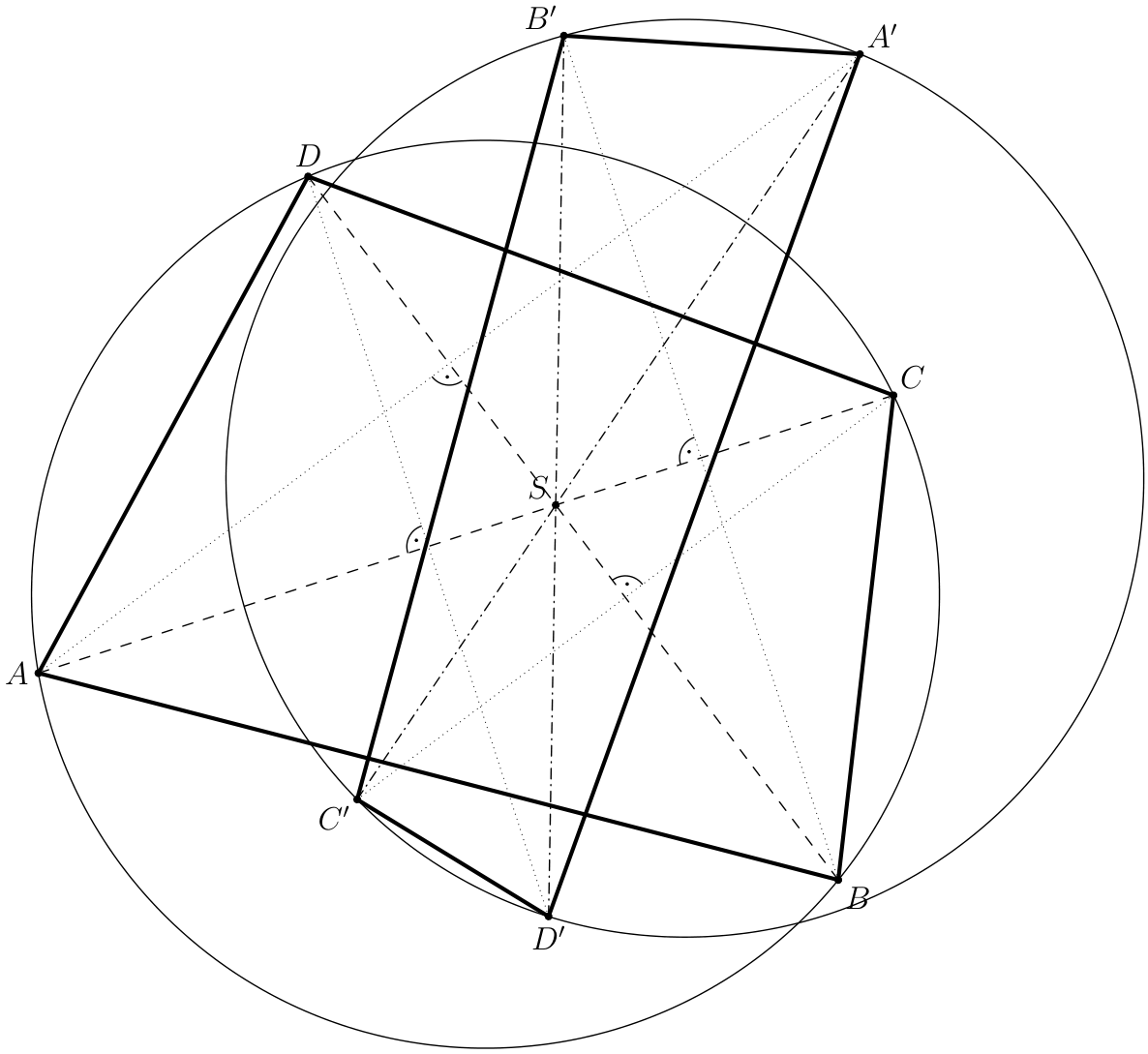
Let be an inscribed convex quadrilateral with diagonals and . Each of the four vertices is reflected on the diagonal it does not lie on. Prove that the resulting four points lie on a common circle or a common line.
a. Investigate when the four resulting points lie on a common line and give a simple equivalent condition for the quadrilateral .
b. Prove that in all other cases, the four resulting points lie on a common circle.
a. Investigate when the four resulting points lie on a common line and give a simple equivalent condition for the quadrilateral .
b. Prove that in all other cases, the four resulting points lie on a common circle.
Solution
a. We denote the reflections of , , and with , , resp. and we denote the intersection of the diagonals with . Since the points and are reflected in the same line and the point remains invariant under this reflection, the whole line becomes after reflection in . Analogously, the line becomes after reflection in . If we denote the smaller angle between the two diagonals by , these two actions on the lines correspond to a rotation of the line with center in direction with rotation angle and a rotation of the line with center in direction with rotation angle . Therefore, the angle between the lines and is the angle . This has to be a multiple of , so that the original angle has to be or . The first case is not possible since the points of the inscribed quadrilateral cannot lie on a line. We obtain that the four new points lie on a line if and only if the diagonals of the given inscribed quadrilateral make an angle of .
Figure 3: Problem 17
b. Since the reflections do not only preserve the collinearity of and , but also the position of between the two points and the distances to the two points, we want to use the power of with respect to the circle .
Because of the reflections, we have
and since is an inscribed quadrilateral, we have Therefore, we obtain Since the two lines and do not coincide in this case, we can apply the properties of the power of a point in reverse, and we get that , , and lie on a circle.
Figure 3: Problem 17
b. Since the reflections do not only preserve the collinearity of and , but also the position of between the two points and the distances to the two points, we want to use the power of with respect to the circle .
Because of the reflections, we have
and since is an inscribed quadrilateral, we have Therefore, we obtain Since the two lines and do not coincide in this case, we can apply the properties of the power of a point in reverse, and we get that , , and lie on a circle.
Final answer
The four reflected points are collinear if and only if the angle between the diagonals is sixty degrees; in all other cases the four points are concyclic.
Techniques
Cyclic quadrilateralsInscribed/circumscribed quadrilateralsRotationRadical axis theoremAngle chasing