Browse · MathNet
PrintEstonian Mathematical Olympiad
Estonia geometry
Problem
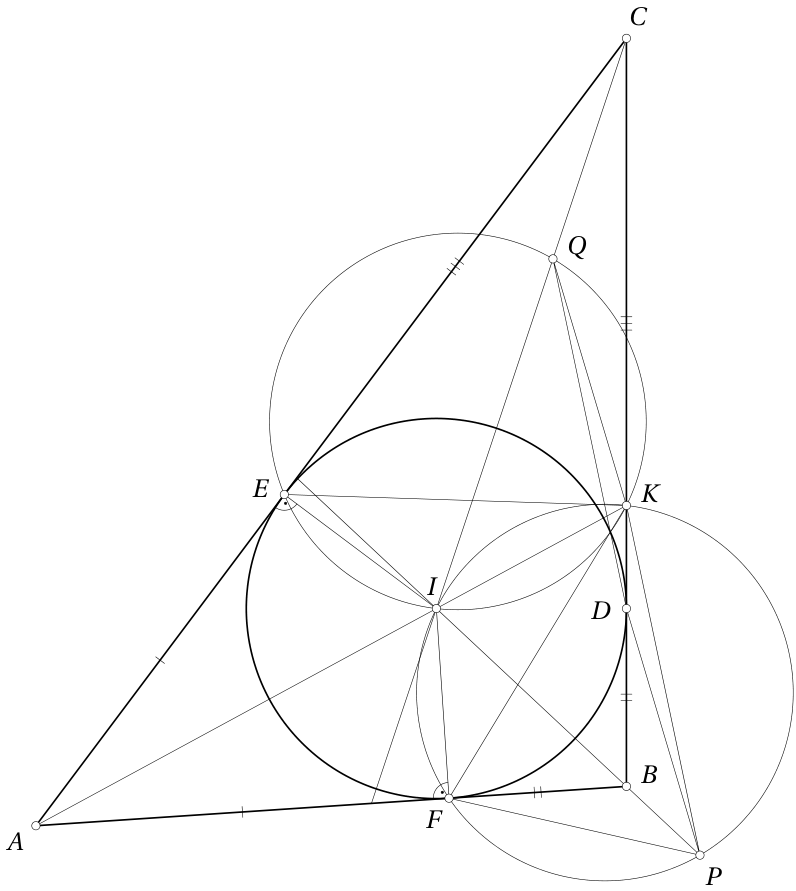
A triangle with and an obtuse angle at vertex is given. The incircle of the triangle with incentre touches the sides , and at points , and , respectively. The line intersects the side at point . The ray intersects the circumcircle of the triangle at point (), whereas the ray intersects the circumcircle of the triangle at point (). Prove that the line bisects the line segment .
Solution
Fig. 52 Solution: Let , , ; then . By the two tangents theorem, we have (Fig. 52), and because , the triangles and are equal. Thus also .
On the other hand, , implying that . This shows that the angles inscribed on equal chords and of the circumcircles of the triangles and are equal. Consequently, these circles have equal radii and angles inscribed on equal chords of these circles are always equal.
From the triangle , we obtain and . Thus angles inscribed on the chords and of the circumcircles of the triangles and are equal, which implies . By the two tangents theorem, we also have . As , the triangles and are equal. Hence also . Altogether, we obtain .
Analogously, we get . Hence the quadrilateral is a parallelogram and its diagonals and bisect each other.
On the other hand, , implying that . This shows that the angles inscribed on equal chords and of the circumcircles of the triangles and are equal. Consequently, these circles have equal radii and angles inscribed on equal chords of these circles are always equal.
From the triangle , we obtain and . Thus angles inscribed on the chords and of the circumcircles of the triangles and are equal, which implies . By the two tangents theorem, we also have . As , the triangles and are equal. Hence also . Altogether, we obtain .
Analogously, we get . Hence the quadrilateral is a parallelogram and its diagonals and bisect each other.
Techniques
Triangle centers: centroid, incenter, circumcenter, orthocenter, Euler line, nine-point circleTangentsAngle chasing