Browse · MathNet
PrintIreland
Ireland geometry
Problem
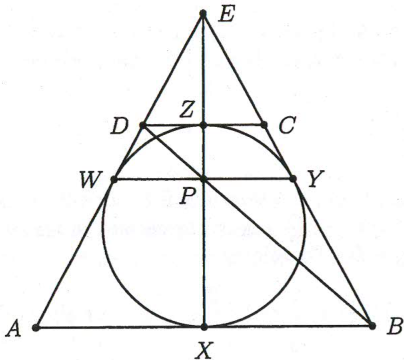
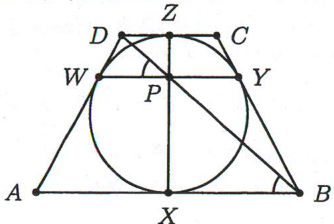
is a trapezium, in which a circle can be inscribed, with parallel to and equal to but not parallel to . The inscribed circle touches , , and at , , and respectively. and intersect at . Prove that the diagonals of pass through .
Solution
Let be the intersection point of the lines and . As , the triangle is isosceles with axis of symmetry the line through and . In particular, , , are collinear iff , , are collinear.
According to the converse of Menelaus' Theorem for the triangle , the three points , , are collinear iff
But this equation is true as the triangles and are similar.
---
Alternative solution.
Note that implies that the line through and is an axis of symmetry for the trapezium . In particular, , , are collinear iff , , are collinear.
Because the three lines , and are parallel, it follows that
As and , we obtain hence , i.e. , , are collinear.
According to the converse of Menelaus' Theorem for the triangle , the three points , , are collinear iff
But this equation is true as the triangles and are similar.
---
Alternative solution.
Note that implies that the line through and is an axis of symmetry for the trapezium . In particular, , , are collinear iff , , are collinear.
Because the three lines , and are parallel, it follows that
As and , we obtain hence , i.e. , , are collinear.
Techniques
TangentsMenelaus' theoremInscribed/circumscribed quadrilateralsTrigonometryAngle chasing