Browse · MATH
Printjmc
algebra senior
Problem
The graph of is an ellipse, although its axes are not parallel to the coordinate axes. Two horizontal lines and two vertical lines lie tangent to the ellipse, forming a rectangle, as shown: 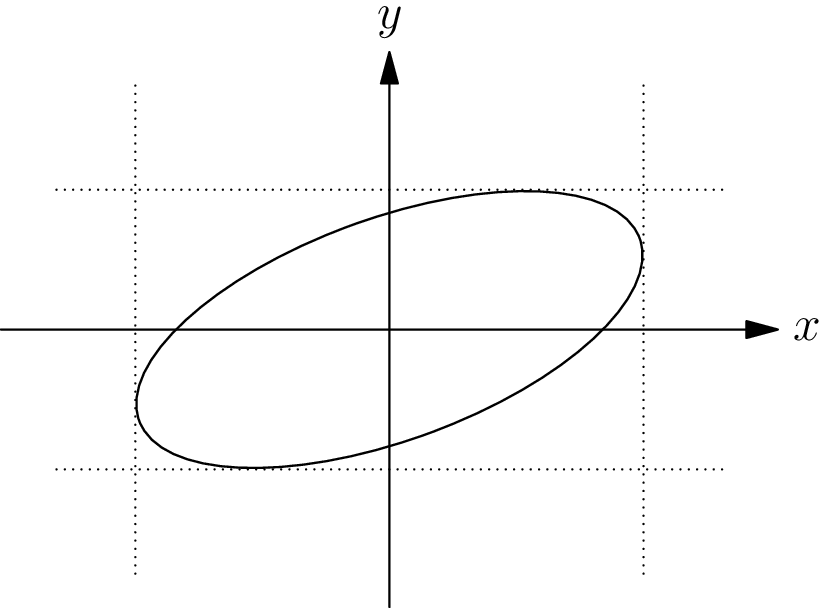 What is the area of the rectangle?
Solution
The two vertical lines have equations of the form and where and are the least and greatest possible coordinates for a point on the ellipse. Similarly, the horizontal lines have equations of the form and where and are the least and greatest possible coordinates for a point on the ellipse. Therefore, we want to find the range of possible and coordinates over all points on the ellipse.
Subtracting from both sides, we can write the equation of the ellipse as a quadratic with as the variable: For a point to lie on the ellipse, this equation must have a real solution for Therefore, the discriminant of the quadratic must be nonnegative: or Solving for gives Therefore, the equations of the two horizontal lines are and
We can do the same, with the roles of the variables reversed, to find all possible values for We write the equation of the ellipse as a quadratic in , giving The discriminant of this equation must be nonnegative, so we have or Solving for gives Therefore, the equations of the two vertical lines are and
It follows that the side lengths of the rectangle are and so the area of the rectangle is
Subtracting from both sides, we can write the equation of the ellipse as a quadratic with as the variable: For a point to lie on the ellipse, this equation must have a real solution for Therefore, the discriminant of the quadratic must be nonnegative: or Solving for gives Therefore, the equations of the two horizontal lines are and
We can do the same, with the roles of the variables reversed, to find all possible values for We write the equation of the ellipse as a quadratic in , giving The discriminant of this equation must be nonnegative, so we have or Solving for gives Therefore, the equations of the two vertical lines are and
It follows that the side lengths of the rectangle are and so the area of the rectangle is
Final answer
10\sqrt3