Browse · MathNet
PrintXVIII-th Macedonian mathematical Olympiad
North Macedonia counting and probability
Problem
We define a grid of type , in the following way: we put squares horizontally, one next to each other, then we put squares horizontally under the first squares. We repeat the procedure until we get a grid of squares having squares in the first row, in the second, in the -th row, so that in the end squares are formed. The rows are left-aligned, as in the example. We fill out this grid with the numbers from 1 to in such a way that the numbers form an increasing sequence in each row (from the leftmost square to rightmost square) and in each column (from the uppermost square to the lowermost square). An example for such a grid of type (5,4,2,1) filled out in one possible way is: 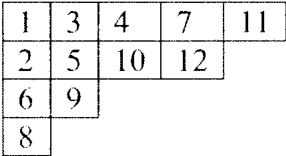
Find the number of possibilities to fill out a grid of type (4,3,2)!
Find the number of possibilities to fill out a grid of type (4,3,2)!
Solution
We define a function on the -tuples in the following way: for the -tuples for which it does not hold that: If , then it holds that The function is well-defined. We will show that is the number of grids of type . It is clear that conditions (1) and (4) must be fulfilled for the required grid (a row of squares can be filled in a unique way with numbers such that they form an increasing sequence ). Condition (2) is also clear. To show that a grid of type satisfies condition (3), we consider the number . That number has to be the last number in one of the rows, so if we delete the square having number , we get a grid with numbers that fulfills the conditions of the problem. It can happen that several rows may have the same number of squares so that the number can be in the last row in the rightmost square. If, for example, , then since . Therefore in condition (3) all expressions appear, which are zero if the above condition holds. We use the previously-defined function to get the number of grids of type . $$
Final answer
168
Techniques
Recursion, bijection