Browse · MathNet
PrintIMO Problem Shortlist
geometry
Problem
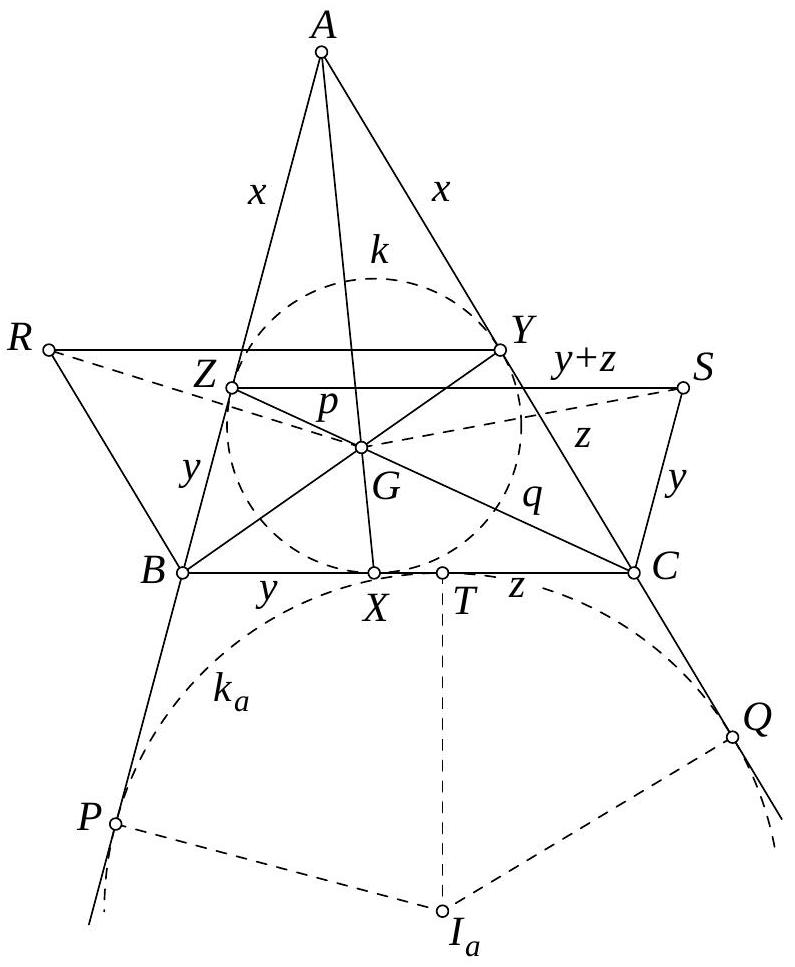
Let be a triangle. The incircle of touches the sides and at the points and , respectively. Let be the point where the lines and meet, and let and be points such that the two quadrilaterals and are parallelograms. Prove that .
Solution
Denote by the incircle and by the excircle opposite to of triangle . Let and touch the side at the points and , respectively, let touch the lines and at the points and , respectively. We use several times the fact that opposing sides of a parallelogram are of equal length, that points of contact of the excircle and incircle to a side of a triangle lie symmetric with respect to the midpoint of this side and that segments on two tangents to a circle defined by the points of contact and their point of intersection have the same length. So we conclude So for each of the points , their distances to equal the length of a tangent segment from this point to . It is well-known, that all points with this property lie on the line , which is the radical axis of and . Similar arguments yield that is the radical axis of and . So the point of intersection of and , which is by definition, is the radical center of and , from which the claim follows immediately.
---
Alternative solution.
Denote , , , , . Several lengthy calculations (Menelaos' theorem in triangle , law of Cosines in triangles and and Stewart's theorem in triangle ) give four equations for and in terms of , and that can be resolved for . The result is symmetric in and , so . More in detail this means: The line intersects the sides of triangle , so Menelaos' theorem yields , hence Since we only want to show that the term for is symmetric in and , we abbreviate terms that are symmetric in and by capital letters, starting with . So (1) implies Now the law of Cosines in triangle yields We use this result to apply the law of Cosines in triangle : Now in triangle the segment is a cevian, so with Stewart's theorem we have , hence Replacing the 's and 's herein by (2) and (3) yields a term that is symmetric in and , indeed.
---
Alternative solution.
Denote , , , , . Several lengthy calculations (Menelaos' theorem in triangle , law of Cosines in triangles and and Stewart's theorem in triangle ) give four equations for and in terms of , and that can be resolved for . The result is symmetric in and , so . More in detail this means: The line intersects the sides of triangle , so Menelaos' theorem yields , hence Since we only want to show that the term for is symmetric in and , we abbreviate terms that are symmetric in and by capital letters, starting with . So (1) implies Now the law of Cosines in triangle yields We use this result to apply the law of Cosines in triangle : Now in triangle the segment is a cevian, so with Stewart's theorem we have , hence Replacing the 's and 's herein by (2) and (3) yields a term that is symmetric in and , indeed.
Techniques
TangentsRadical axis theoremMenelaus' theoremTriangle trigonometryTriangle centers: centroid, incenter, circumcenter, orthocenter, Euler line, nine-point circle