Browse · MATH
Printjmc
geometry senior
Problem
By joining alternate vertices of a regular hexagon with edges inches long, two equilateral triangles are formed, as shown. What is the area, in square inches, of the region that is common to the two triangles? Express your answer in simplest radical form. 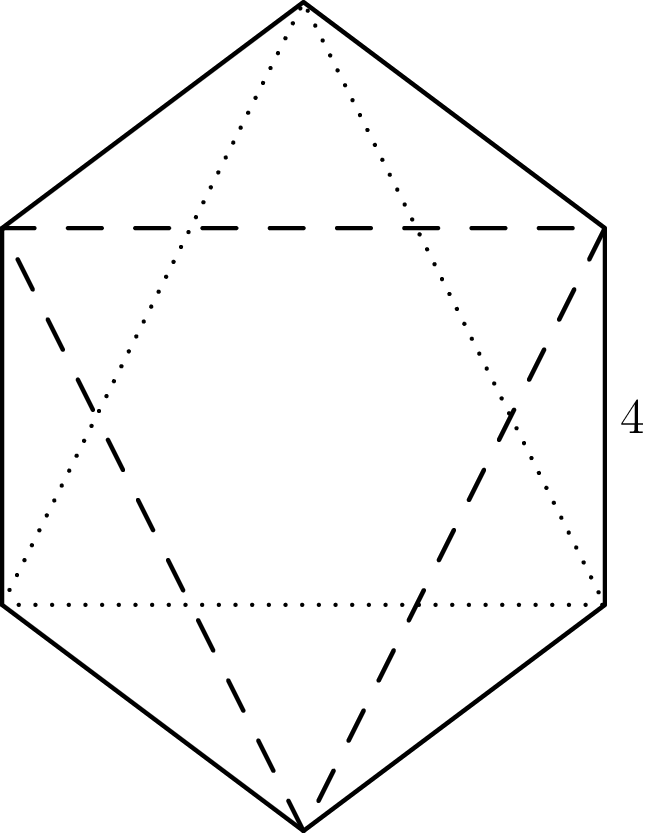
Solution
The two triangles make a smaller hexagon inside the large hexagon with the same center. Draw six lines from the center to each of the vertices of the small hexagon. Both triangles are now divided into congruent equilateral triangles, with the smaller hexagon region taking of the triangle.
The triangle is of the larger hexagon, so the smaller hexagon is of the larger hexagon.
We now find the area of the large hexagon. By drawing six lines from the center to each of the vertices, we divide the hexagon into six equilateral triangles with side length . The area of an equilateral triangle with side length is , so the area of each triangle is . Therefore, the area of the large hexagon is . The area of the smaller hexagon, which is the region common to the two triangles, is .
The triangle is of the larger hexagon, so the smaller hexagon is of the larger hexagon.
We now find the area of the large hexagon. By drawing six lines from the center to each of the vertices, we divide the hexagon into six equilateral triangles with side length . The area of an equilateral triangle with side length is , so the area of each triangle is . Therefore, the area of the large hexagon is . The area of the smaller hexagon, which is the region common to the two triangles, is .
Final answer
8\sqrt{3} \text { square inches}