Browse · MathNet
PrintEstonian Mathematical Olympiad
Estonia geometry
Problem
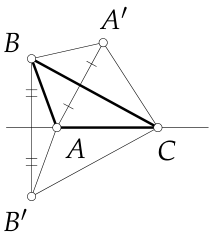
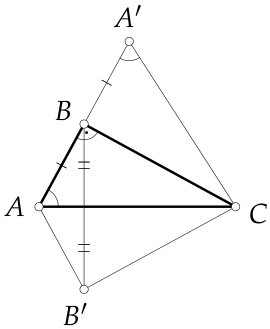
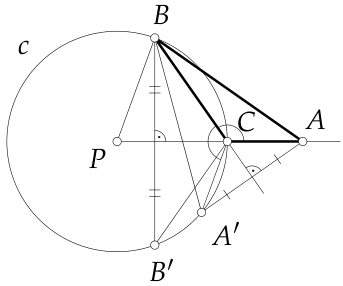
Let be the result of reflection of vertex of triangle through line and let be the result of reflection of vertex through line . Given that , can the largest angle of triangle be located: a) At vertex ; b) At vertex ; c) At vertex ?
Solution
Fig. 18 Fig. 19 Fig. 20
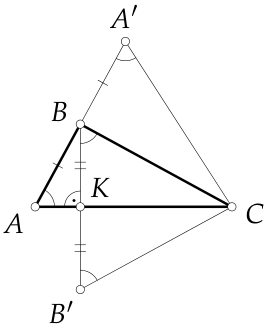
Solution: Let the foot of the altitude drawn from vertex of triangle be . By symmetry, and .
a) By assumptions, (Fig. 18). As the angle at vertex of triangle is right, . If the largest angle of triangle were at vertex , the triangle would have to be acute. This would mean that would lie on line segment , whence . Consequently, the largest angle of triangle cannot be at vertex .
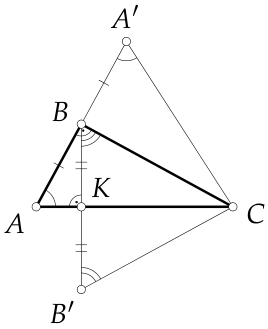
b) If the angle at vertex of triangle is right then it is the largest angle of the triangle (Fig. 19). Triangles and are similar, whence and .
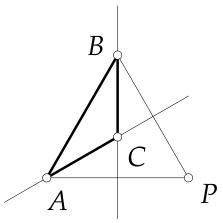
c) Let be an equilateral triangle with midpoint (Fig. 20). Obviously is the reflection of through line , as well as the reflection of through line . Hence defining fulfills the conditions of the problem. The angle at vertex of triangle has size , whence it must be the largest.
---
Alternative solution.
a) By symmetry, . Hence the assumptions imply . Suppose that the largest angle of the triangle is at the vertex . Then the angle at the vertex must be acute, implying that points and lie at the same side of the line . Now implies that lies on the circumcircle of the triangle (Fig. 21). Hence is the perpendicular bisector of the chord of the circumcircle of the triangle , meaning that it passes through the circumcentre of the triangle . Consequently, is the diameter of the circumcircle of the triangle . Hence the triangle has right angle at the vertex which contradicts the assumption that the largest angle is at the vertex .
Fig. 21 Fig. 22 Fig. 23
b) If the angle at vertex of triangle is right then it is the largest angle of the triangle (Fig. 22). By symmetry, . Hence points , and are concyclic, whereby and lie on the same side from line . Consequently .
c) Choose points and on a circle with centre in such a way that . Let be the reflection of through line . Let be a point on circle such that (Fig. 23). This choice is possible as moving with point along the longer arc of circle gives rise to all values of below , but . Let now be the reflection of through line . As , point lies on line , i.e., lines and coincide. The conditions of the problem are met, since both and are angles inscribed in circle subtended by equal chords.
Solution: Let the foot of the altitude drawn from vertex of triangle be . By symmetry, and .
a) By assumptions, (Fig. 18). As the angle at vertex of triangle is right, . If the largest angle of triangle were at vertex , the triangle would have to be acute. This would mean that would lie on line segment , whence . Consequently, the largest angle of triangle cannot be at vertex .
b) If the angle at vertex of triangle is right then it is the largest angle of the triangle (Fig. 19). Triangles and are similar, whence and .
c) Let be an equilateral triangle with midpoint (Fig. 20). Obviously is the reflection of through line , as well as the reflection of through line . Hence defining fulfills the conditions of the problem. The angle at vertex of triangle has size , whence it must be the largest.
---
Alternative solution.
a) By symmetry, . Hence the assumptions imply . Suppose that the largest angle of the triangle is at the vertex . Then the angle at the vertex must be acute, implying that points and lie at the same side of the line . Now implies that lies on the circumcircle of the triangle (Fig. 21). Hence is the perpendicular bisector of the chord of the circumcircle of the triangle , meaning that it passes through the circumcentre of the triangle . Consequently, is the diameter of the circumcircle of the triangle . Hence the triangle has right angle at the vertex which contradicts the assumption that the largest angle is at the vertex .
Fig. 21 Fig. 22 Fig. 23
b) If the angle at vertex of triangle is right then it is the largest angle of the triangle (Fig. 22). By symmetry, . Hence points , and are concyclic, whereby and lie on the same side from line . Consequently .
c) Choose points and on a circle with centre in such a way that . Let be the reflection of through line . Let be a point on circle such that (Fig. 23). This choice is possible as moving with point along the longer arc of circle gives rise to all values of below , but . Let now be the reflection of through line . As , point lies on line , i.e., lines and coincide. The conditions of the problem are met, since both and are angles inscribed in circle subtended by equal chords.
Final answer
a) No; b) Yes; c) Yes
Techniques
Angle chasingCyclic quadrilateralsTriangle centers: centroid, incenter, circumcenter, orthocenter, Euler line, nine-point circleConstructions and loci