Browse · MathNet
Print2025 International Mathematical Olympiad China National Team Selection Test
China 2025 geometry
Problem
Given a circle and two points outside . A quadrilateral inscribed in is called "good" if one pair of opposite sides intersects at and the other pair intersects at . Assume that at least one good quadrilateral exists. Prove that there exists a good quadrilateral such that every other good quadrilateral has area smaller than .
Solution
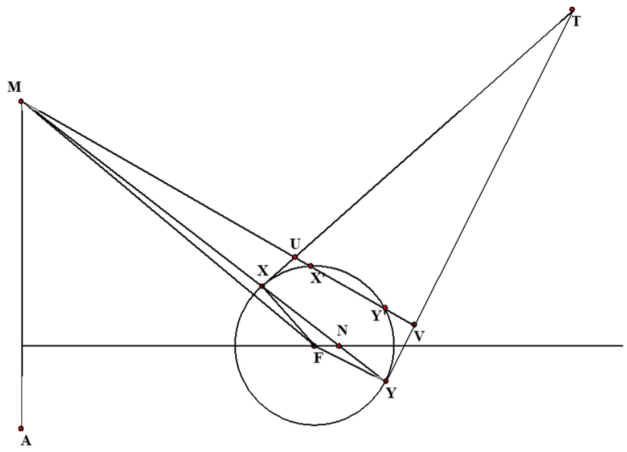
Let be the center of . For any good quadrilateral (where and meet at , and and meet at ), let the diagonals and intersect at . By Brocard's theorem, form an orthocentric system, so is a fixed point. The existence of a good quadrilateral implies that are pairwise distinct. By polar line properties, the polar line of with respect to is the line . Since lies inside , is disjoint from . Let and be the midpoints of diagonals and , respectively. We have: (where denotes the signed area of triangle , and similarly for others) which shows that the area of the good quadrilateral equals four times the area of triangle . Thus, the problem reduces to proving that the maximum area of triangle exists and is achieved uniquely. Let be the midpoint of . By properties of the Newton line, are collinear. Let be the circle with diameter . Then and lie on . Conversely, if a line through intersects at and , and the lines and (if one of coincides with , replace the corresponding line with the line through perpendicular to ) intersect at and respectively, then the lines and meet at , and the lines and meet at . By polar line properties, and lie on , the polar of with respect to . Since and , and are the midpoints of and respectively (even if or coincides with , the conclusion holds). By the Newton line property, passes through the midpoint of , so the midpoint of is also . By polar properties, . Moreover, and similarly, . Thus, , implying that and coincide with and (possibly in reverse order). Hence, the quadrilateral constructed this way is necessarily a good quadrilateral, and distinct unordered pairs correspond to distinct good quadrilaterals. The problem now reduces to proving: Among all lines through intersecting at and , there exists a unique line that maximizes the area of triangle . Let be the midpoint of (i.e., the center of ), and let be the line through perpendicular to . Let and be the projections of and onto . Then: Thus, the problem further reduces to proving that there exists a unique line through such that the projection of its chord with onto has maximal length. We first prove the following claim: If a line through intersects at and , and the segment meets at satisfying then is the desired line.
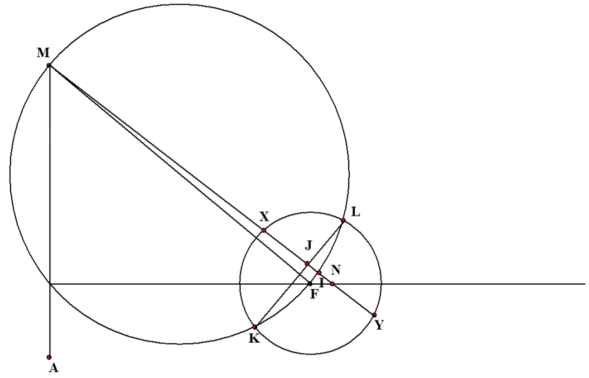
Indeed, let the tangents to at and meet at . Consider another line through intersecting at and . Suppose intersects segments and at and , respectively. It suffices to show that the projection of onto is shorter than that of , i.e., . Note that . By Menelaus' theorem, , so . The case where intersects the extensions of and is similar. Finally, we prove that a line satisfying exists and is unique. Existence suffices, as uniqueness would otherwise lead to a contradiction. Let be the circle with diameter , intersecting at and . Then and are tangent to . Let meet at . Then harmonically divides , i.e., . Thus, is equivalent to and being symmetric about the midpoint of . By the perpendicular bisector theorem, also lies on . The problem now reduces to showing there exists a unique line through intersecting , and at respectively, with . When ; when . By continuity, such an exists. This completes the proof.
Indeed, let the tangents to at and meet at . Consider another line through intersecting at and . Suppose intersects segments and at and , respectively. It suffices to show that the projection of onto is shorter than that of , i.e., . Note that . By Menelaus' theorem, , so . The case where intersects the extensions of and is similar. Finally, we prove that a line satisfying exists and is unique. Existence suffices, as uniqueness would otherwise lead to a contradiction. Let be the circle with diameter , intersecting at and . Then and are tangent to . Let meet at . Then harmonically divides , i.e., . Thus, is equivalent to and being symmetric about the midpoint of . By the perpendicular bisector theorem, also lies on . The problem now reduces to showing there exists a unique line through intersecting , and at respectively, with . When ; when . By continuity, such an exists. This completes the proof.
Techniques
Cyclic quadrilateralsBrocard point, symmediansPolar triangles, harmonic conjugatesMenelaus' theoremTangentsVectorsTrigonometry