Browse · MathNet
PrintBelarusian Mathematical Olympiad
Belarus counting and probability
Problem
The central area of a town has a form of the square, which is formed by tiles. To illuminate the area, one-lamp lampposts are used. The lampposts are placed at the corners of some tiles, including the boundary of the area. The lamp on a lamppost illuminates all tiles with a corner at the lamppost position, and only those.
Find the smallest number of the lampposts required to illuminate the whole area, even if one of the lamps should burn out.
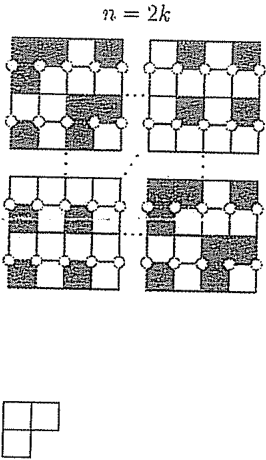
Find the smallest number of the lampposts required to illuminate the whole area, even if one of the lamps should burn out.
Solution
If the length of the town square is odd, i.e. , then from the solution of Problem D8 it follows that the minimal value of the required lampposts is equal to
Now let is even. We paint some tiles of the town square black (see Fig. 1).
Fig. 1 Fig. 2
Consider the tiles which form the painted "angle" (see Fig. 2). It is easy to see that to illuminate each of these tiles by at least two lamps we need at least three lampposts in total. From our coloring it follows that any lamp cannot illuminate two colored tiles if they are not adjacent (we call two tiles adjacent if they have either the common side or the common corner). Thus, the minimum value of the required lamppost is equal to , where is the number of the colored angles and is the number of the solitary colored tiles. Since and , we need at least lampposts.
On the other hand, if we place the lampposts as it is shown in Fig. 1 (the lampposts are indicated as uncolored circles), then any tile of the town square will be illuminated by two lamps. So, if , then lampposts are sufficient to illuminate the town square so that the problem condition holds.
Final answer
If n is even, n(n+1)/2 (equivalently 2k^2 + k for n = 2k). If n is odd, (n+1)^2/2 (equivalently 2(k+1)^2 for n = 2k + 1).
Techniques
Coloring schemes, extremal arguments