Browse · MathNet
PrintChina Southeastern Mathematical Olympiad
China counting and probability
Problem
Consider 12 figures on the clock face as 12 points. Color them in four colors: red, yellow, blue and green. Each color is used for three points. Configure convex quadrilaterals with vertices in these points, such that (1) there are no same color of vertices for each quadrilateral. (2) among any three of these quadrilaterals, there is a color of vertices such that the vertices of that color are different.
Find the largest number of . (posed by Tao Pingsheng)
Find the largest number of . (posed by Tao Pingsheng)
Solution
We use to represent these four colors, respectively, and the points in the same color by lower letters as and respectively.
Now consider color . If, in quadrilaterals, the number of points in color are respectively, then . Suppose that . If , then . Consider these seven quadrilaterals (its color vertex is either or ), if the numbers of points in color are , respectively, then . By symmetricity, we may suppose that , then , that is, .
Consider these five quadrilaterals (its color point is either or , and its color point is either or ), if the numbers of points in color are , respectively, then . By symmetricity, we may suppose that , then , that is, .
Consider these four quadrilaterals, denoted as (its color point is either or , its color point is either or , and its color point is either or ). Since there are only three points in color , there are two quadrilaterals that have the same color point. Suppose that the same color point of is .
Then, in three quadrilaterals , whatever be the color of the vertex, there are repeated points, which contradicts condition (2). Hence, .
We show the maximal number by construction of these nine quadrilaterals.
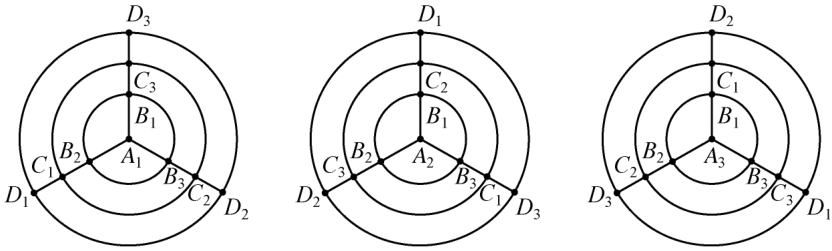
We draw three “concentric annulus” with four points on each radius representing four vertices and the color. So nine radii represent nine quadrilaterals, which satisfy condition (1).
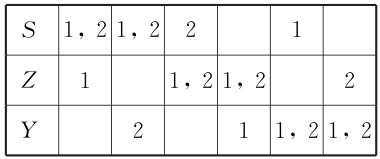
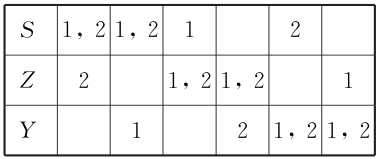
Next, we show that they also satisfy condition (2). Take any three radii (or three quadrilaterals). If these three radii come from a concentric annulus, for each color except , there are three points. If these three radii come from three concentric annuli, then for color , there are three points. If these three radii come from two concentric annuli, call these three figures Fig. 1, Fig. 2 and Fig. 3. The radius directions are called “up radius”, “left radius” and “right radius”, and denoted, respectively, by , and . If three radii have three directions, then there are three points of color in three quadrilaterals. If the three radii have only two directions, then there are all cases as shown in the tables below, where 1, 2 and 3 stand for Fig. 1, Fig. 2 and Fig. 3, respectively.
Here, the color in figure means that the three quadrilaterals have color with different figures.
C D
C
D
C
D
Thus, the maximal number of is 9.
Now consider color . If, in quadrilaterals, the number of points in color are respectively, then . Suppose that . If , then . Consider these seven quadrilaterals (its color vertex is either or ), if the numbers of points in color are , respectively, then . By symmetricity, we may suppose that , then , that is, .
Consider these five quadrilaterals (its color point is either or , and its color point is either or ), if the numbers of points in color are , respectively, then . By symmetricity, we may suppose that , then , that is, .
Consider these four quadrilaterals, denoted as (its color point is either or , its color point is either or , and its color point is either or ). Since there are only three points in color , there are two quadrilaterals that have the same color point. Suppose that the same color point of is .
Then, in three quadrilaterals , whatever be the color of the vertex, there are repeated points, which contradicts condition (2). Hence, .
We show the maximal number by construction of these nine quadrilaterals.
We draw three “concentric annulus” with four points on each radius representing four vertices and the color. So nine radii represent nine quadrilaterals, which satisfy condition (1).
Next, we show that they also satisfy condition (2). Take any three radii (or three quadrilaterals). If these three radii come from a concentric annulus, for each color except , there are three points. If these three radii come from three concentric annuli, then for color , there are three points. If these three radii come from two concentric annuli, call these three figures Fig. 1, Fig. 2 and Fig. 3. The radius directions are called “up radius”, “left radius” and “right radius”, and denoted, respectively, by , and . If three radii have three directions, then there are three points of color in three quadrilaterals. If the three radii have only two directions, then there are all cases as shown in the tables below, where 1, 2 and 3 stand for Fig. 1, Fig. 2 and Fig. 3, respectively.
Here, the color in figure means that the three quadrilaterals have color with different figures.
C D
| S | 1, 3 | 1, 3 | 1 | 3 | ||
|---|---|---|---|---|---|---|
| Z | 3 | 1, 3 | 1, 3 | 1 | ||
| Y | 1 | 3 | 1, 3 |
| S | 1, 3 | 1, 3 | 3 | 1 | ||
|---|---|---|---|---|---|---|
| Z | 1 | 1, 3 | 1, 3 | 3 | ||
| Y | 3 | 1 | 1, 3 |
| S | 2, 3 | 2, 3 | 3 | 2 | ||
|---|---|---|---|---|---|---|
| Z | 2 | 2, 3 | 2, 3 | 3 | ||
| Y | 3 | 2 | 2, 3 |
| S | 2, 3 | 2, 3 | 2 | 3 | ||
|---|---|---|---|---|---|---|
| Z | 3 | 2, 3 | 2, 3 | 2 | ||
| Y | 2 | 3 | 2, 3 |
Thus, the maximal number of is 9.
Final answer
9
Techniques
Pigeonhole principleColoring schemes, extremal arguments