Browse · MathNet
PrintIMO 2006 Shortlisted Problems
2006 geometry
Problem
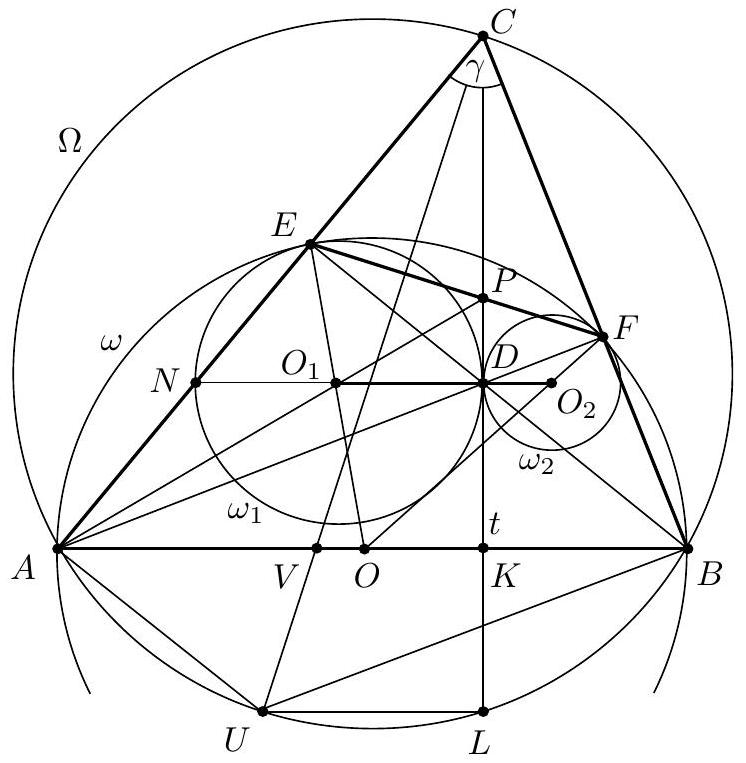
Circles and with centres and are externally tangent at point and internally tangent to a circle at points and , respectively. Line is the common tangent of and at . Let be the diameter of perpendicular to , so that , and are on the same side of . Prove that lines , , and are concurrent.
(Brasil)
(Brasil)
Solution
Point is the centre of a homothety which takes circle to circle . The radii and of these circles are parallel as both are perpendicular to line . Also, and are on the same side of line , hence takes to . Consequently, points , and are collinear. Likewise, points , and are collinear as well. Let lines and intersect at . Since and are altitudes in triangle , their common point is the orthocentre of this triangle. So is perpendicular to , implying that lies on line . Note that triangle is acute-angled. We mention the well-known fact that triangles and are similar in ratio , where . In addition, points , , and lie on the circle with diameter . Let be the common point of lines and . We are going to prove that lies on line . Denote by the second common point of circle and ; this is the point of diametrically opposite to . By Menelaus' theorem for triangle , points , and are collinear if and only if Because , this reduces to . Let line meet at . Then , so it suffices to show that To verify (1), consider the circumcircle of triangle . Draw its diameter through , and let meet at . Extend to meet at . Since is parallel to , we have . On the other hand , and , as stated above. So reflection in the bisector of followed by a homothety with centre and ratio takes triangle to triangle . Consequently, this transformation takes to , which implies . Next, we have , because is the orthocentre of triangle . Hence . Finally, because is parallel to . Relation (1) follows, proving that lies on line . By symmetry, also lies on line which completes the solution.
---
Alternative solution.
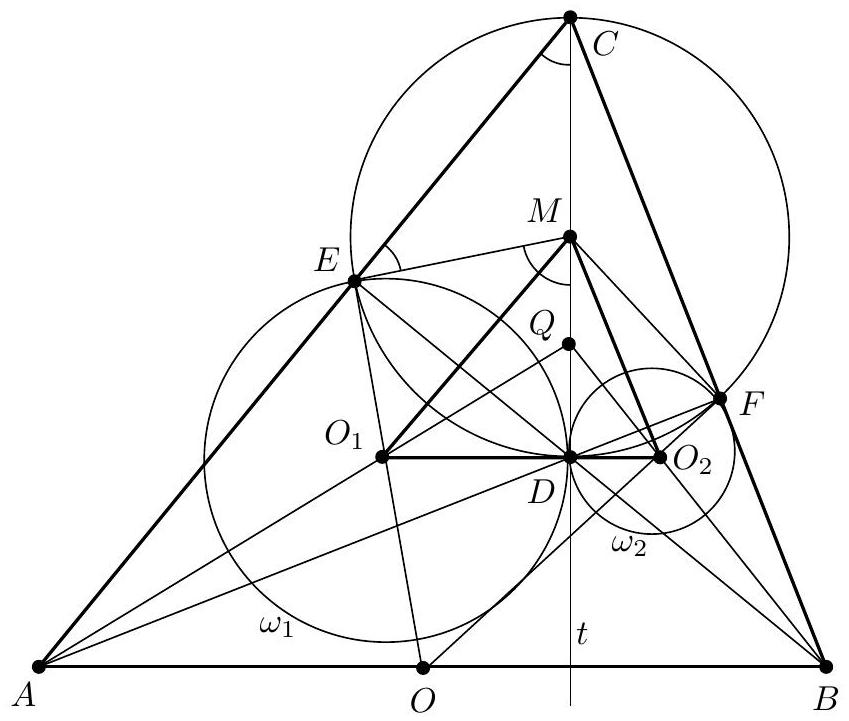
We proceed as in the first solution to define a triangle with orthocentre , in which and are altitudes. Denote by the midpoint of . The quadrilateral is inscribed in a circle with centre , hence . Consider triangles and . Lines and are parallel, both of them being perpendicular to line . Next, is the line of centres of circles ( ) and whose common chord is . Hence bisects which is the external angle at in the isosceles triangle . It follows that , so that is parallel to . Likewise, is parallel to . Thus the respective sides of triangles and are parallel; in addition, these triangles are not congruent. Hence there is a homothety taking to . The lines , and are concurrent at the centre of this homothety. Finally, apply Pappus' theorem to the triples of collinear points and . The theorem implies that the points , and are collinear. In other words, line passes through the common point of , and .
---
Alternative solution.
We proceed as in the first solution to define a triangle with orthocentre , in which and are altitudes. Denote by the midpoint of . The quadrilateral is inscribed in a circle with centre , hence . Consider triangles and . Lines and are parallel, both of them being perpendicular to line . Next, is the line of centres of circles ( ) and whose common chord is . Hence bisects which is the external angle at in the isosceles triangle . It follows that , so that is parallel to . Likewise, is parallel to . Thus the respective sides of triangles and are parallel; in addition, these triangles are not congruent. Hence there is a homothety taking to . The lines , and are concurrent at the centre of this homothety. Finally, apply Pappus' theorem to the triples of collinear points and . The theorem implies that the points , and are collinear. In other words, line passes through the common point of , and .
Techniques
TangentsHomothetyMenelaus' theoremPappus theoremTriangle centers: centroid, incenter, circumcenter, orthocenter, Euler line, nine-point circleCyclic quadrilateralsAngle chasing