Browse · MathNet
PrintFinal Round of National Olympiad
Estonia geometry
Problem
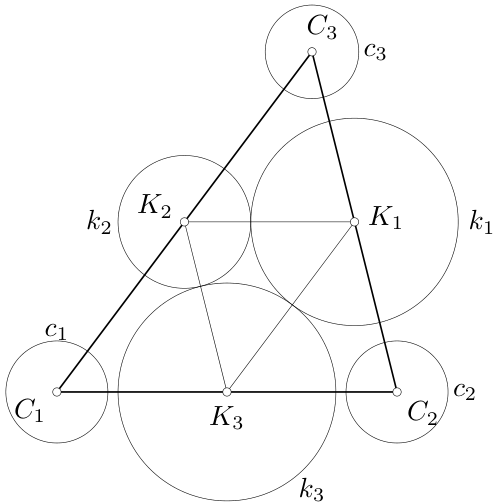
The midpoints of sides , and of a triangle are , and , respectively. The centers of circles , and are , and , respectively, and the centers of circles , , are , , , respectively. No two of the given six circles intersect in two points nor are they inside each other. Circles , and touch each other externally.
i) Prove that the sum of the radii of circles , and does not exceed one quarter of the perimeter of the triangle .
ii) Prove that if the sum of the radii of circles , and equals one quarter of the perimeter of the triangle then the triangle is equilateral.
i) Prove that the sum of the radii of circles , and does not exceed one quarter of the perimeter of the triangle .
ii) Prove that if the sum of the radii of circles , and equals one quarter of the perimeter of the triangle then the triangle is equilateral.
Solution
Let the radii of the circles , , be , , , and the radii of the circles , , be , , , respectively (Fig. 28). By assumptions, which sum up to . The assumptions also imply inequalities which sum up to .
i) Altogether, we obtain the inequality , which implies as desired.
Figure 28
ii) Suppose that . Then all inequalities above must hold as equalities. The equalities imply , analogously . Denoting , we get where summing side-by-side gives , i.e., . Analogously, . Thus all sides of the triangle have length .
i) Altogether, we obtain the inequality , which implies as desired.
Figure 28
ii) Suppose that . Then all inequalities above must hold as equalities. The equalities imply , analogously . Denoting , we get where summing side-by-side gives , i.e., . Analogously, . Thus all sides of the triangle have length .
Techniques
TrianglesTangentsDistance chasingOptimization in geometry