Browse · MathNet
PrintAustria 2010
Austria 2010 geometry
Problem
On a circular billiard table, a ball is reflected from a cushion as if it were being reflected from the tangent of the circle in the point of reflection. A regular hexagon is drawn on a circular billiard table with its vertices on the circle. A ball (in the form of a point) is placed on a side of the hexagon (not in one of the vertices). Determine a periodic path that the ball can take from this point with exactly four different points of reflection on the circle. In how many directions can the ball be brought onto such a path?
Solution
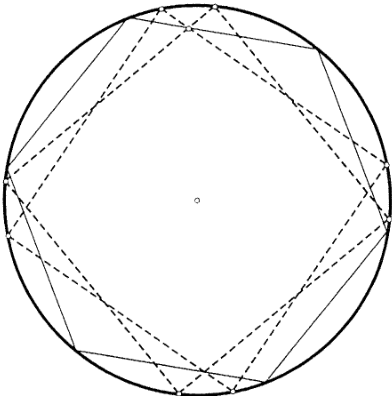
Whenever a ball is reflected on the perimeter of the circular cushion, the incoming and outgoing angles to the radius must be equal. This means that the incoming and outgoing chords of the circle on the path on the ball must be of equal length. The periodic path must therefore be a regular polygon, and since it must have four corners, it must be a square. In order to find a path through a given point, we can determine any square inscribed in the circle, and rotate it around the mid-point of the circle, such that it passes through the given starting point. This is certainly possible for all points on the hexagon, since the minimum distance of a point of the square from the mid-point of the circle is equal to times the radius, but the minimum distance of a point of the hexagon from the mid-point is times the radius, which is certainly larger.
In fact, rotating in such a way yields two possible positions for the squares, and since the ball can be started in either orientation of either square, there exist a total of 4 directions fulfilling the requirements. qed
In fact, rotating in such a way yields two possible positions for the squares, and since the ball can be started in either orientation of either square, there exist a total of 4 directions fulfilling the requirements. qed
Final answer
4
Techniques
TangentsInscribed/circumscribed quadrilateralsRotationConstructions and loci