Browse · MathNet
PrintInternational Mathematical Olympiad Shortlisted Problems
counting and probability
Problem
Let be an integer. Consider all circular arrangements of the numbers ; the rotations of an arrangement are considered to be equal. A circular arrangement is called beautiful if, for any four distinct numbers with , the chord joining numbers and does not intersect the chord joining numbers and . Let be the number of beautiful arrangements of . Let be the number of pairs ( ) of positive integers such that and . Prove that
Solution
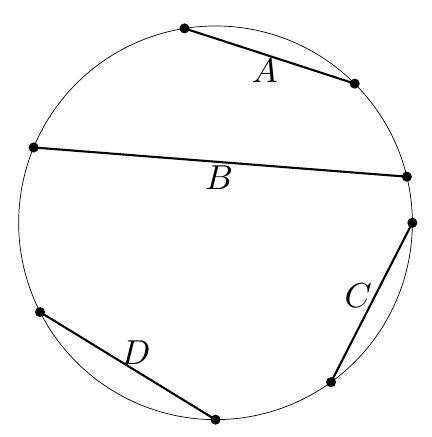
Given a circular arrangement of , we define a -chord to be a (possibly degenerate) chord whose (possibly equal) endpoints add up to . We say that three chords of a circle are aligned if one of them separates the other two. Say that chords are aligned if any three of them are aligned. For instance, in Figure 1, , and are aligned, while , and are not.
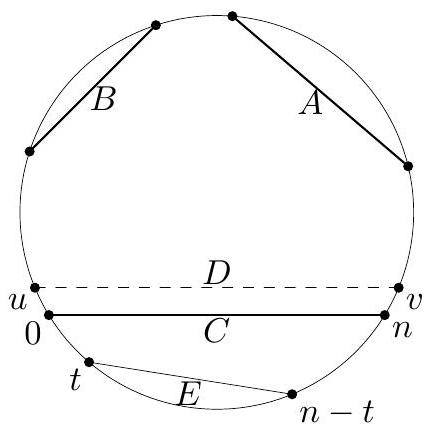
Figure 1 Figure 2
Claim. In a beautiful arrangement, the -chords are aligned for any integer .
Proof. We proceed by induction. For the statement is trivial. Now let , and proceed by contradiction. Consider a beautiful arrangement where the three -chords are not aligned. If is not among the endpoints of , and , then by deleting from we obtain a beautiful arrangement of , where , and are aligned by the induction hypothesis. Similarly, if 0 is not among these endpoints, then deleting 0 and decreasing all the numbers by 1 gives a beautiful arrangement where , and are aligned. Therefore both 0 and are among the endpoints of these segments. If and are their respective partners, we have . Thus 0 and are the endpoints of one of the chords; say it is .
Let be the chord formed by the numbers and which are adjacent to 0 and and on the same side of as and , as shown in Figure 2. Set . If we had , the -chords , , and would not be aligned in the beautiful arrangement , contradicting the induction hypothesis. If , then the -chord from 0 to cannot intersect , so the chord separates and . The chord from to does not intersect , so and are on the same side of . But then the chords , and are not aligned in , a contradiction. Finally, the case is equivalent to the case via the beauty-preserving relabelling for , which sends -chords to -chords. This proves the Claim.
Having established the Claim, we prove the desired result by induction. The case is trivial. Now assume that . Let be a beautiful arrangement of and delete to obtain the beautiful arrangement of . The -chords of are aligned, and they contain every point except 0. Say is of Type 1 if 0 lies between two of these -chords, and it is of Type 2 otherwise; i.e., if 0 is aligned with these -chords. We will show that each Type 1 arrangement of arises from a unique arrangement of , and each Type 2 arrangement of arises from exactly two beautiful arrangements of .
If is of Type 1, let 0 lie between chords and . Since the chord from 0 to must be aligned with and in must be on the other arc between and . Therefore can be recovered uniquely from . In the other direction, if is of Type 1 and we insert as above, then we claim the resulting arrangement is beautiful. For , the -chords of are also -chords of , so they are aligned. Finally, for , notice that the -chords of are parallel by construction, so there is an antisymmetry axis such that is symmetric to with respect to for all . If we had two -chords which intersect, then their reflections across would be two -chords which intersect, where , a contradiction.
If is of Type 2, there are two possible positions for in , on either side of 0. As above, we check that both positions lead to beautiful arrangements of .
Hence if we let be the number of beautiful arrangements of , and let be the number of beautiful arrangements of of Type 2, we have It then remains to show that is the number of pairs of positive integers with and . Since , this number equals .
To prove this, consider a Type 2 beautiful arrangement of . Label the positions clockwise around the circle, so that number 0 is in position 0. Let be the number in position ; note that is a permutation of . Let be the position such that .
Since the -chords are aligned with 0, and every point is in an -chord, these chords are all parallel and Similarly, since the -chords are aligned and every point is in an -chord, these chords are also parallel and Therefore for all ; and since , we get Recall that this is an equality modulo . Since is a permutation, we must have . Hence .
To prove equality, it remains to observe that the labeling (1) is beautiful. To see this, consider four numbers on the circle with . Their positions around the circle satisfy , which means that the chord from to and the chord from to are parallel. Thus (1) is beautiful, and by construction it has Type 2. The desired result follows.
---
Alternative solution.
Notice that there are exactly irreducible fractions in whose denominator is at most , since the pair with and corresponds to the fraction . Write for .
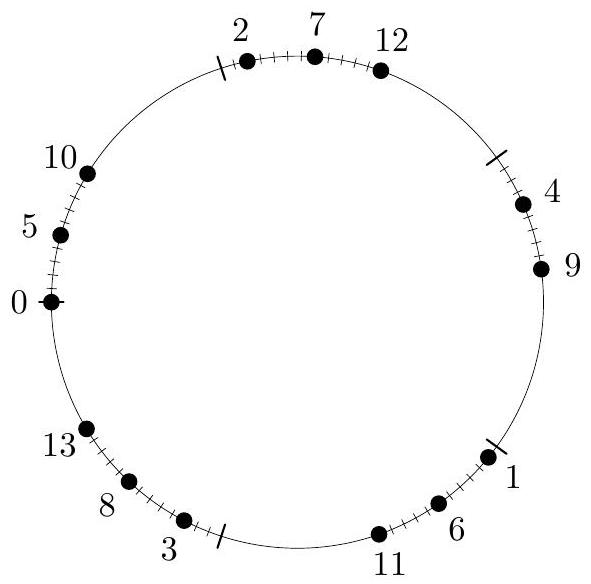
We begin by constructing beautiful arrangements. Take any which is not one of the above fractions. Consider a circle of perimeter 1. Successively mark points where 0 is arbitrary, and the clockwise distance from to is . The point will be at clockwise distance from 0, where denotes the fractional part of . Call such a circular arrangement cyclic and denote it by . If the clockwise order of the points is the same in and , we regard them as the same circular arrangement. Figure 3 shows the cyclic arrangement of where is very small.
Figure 3
If satisfy , then , so the chord from to is parallel to the chord from to in . Hence in a cyclic arrangement all -chords are parallel. In particular every cyclic arrangement is beautiful.
Next we show that there are exactly distinct cyclic arrangements. To see this, let us see how changes as we increase from 0 to 1. The order of points and changes precisely when we cross a value such that ; this can only happen if is one of the fractions . Therefore there are at most different cyclic arrangements.
To show they are all distinct, recall that and let be a very small number. In the arrangement , point lands at . Therefore the points are grouped into clusters next to the points of the circle. The cluster following contains the numbers congruent to modulo , listed clockwise in increasing order. It follows that the first number after 0 in is , and the first number after 0 which is less than is , which uniquely determines . In this way we can recover from the cyclic arrangement. Note also that is not the trivial arrangement where we list in order clockwise. It follows that the cyclic arrangements are distinct.
Let us record an observation which will be useful later: Indeed, we already observed that is the first number after 0 in . Similarly we see that is the last number before 0 in .
Finally, we show that any beautiful arrangement of is cyclic by induction on . For the result is clear. Now assume that all beautiful arrangements of are cyclic, and consider a beautiful arrangement of . The subarrangement of obtained by deleting is cyclic; say .
Let be between the consecutive fractions among the irreducible fractions of denominator at most . There is at most one fraction in , since for .
Case 1. There is no fraction with denominator between and .
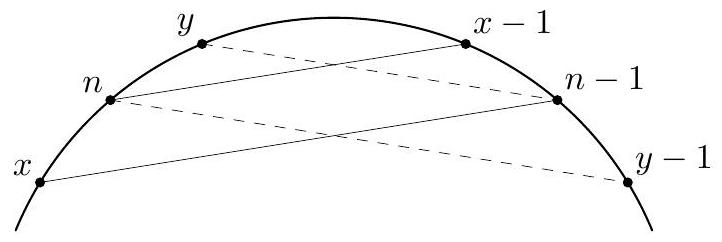
In this case the only cyclic arrangement extending is . We know that and can only differ in the position of . Assume is immediately after and before in . Since the neighbors of 0 are and by (2), we have .
Figure 4
In the chord from to is parallel and adjacent to the chord from to , so is between and in clockwise order, as shown in Figure 4. Similarly, is between and . Therefore , and occur in this order in and hence in (possibly with or ).
Now, may only differ from in the location of . In , since the chord from to and the chord from to do not intersect, is between and . Similarly, is between and . Then must be between and and . Therefore is cyclic as desired.
Case 2. There is exactly one with .
In this case there exist two cyclic arrangements and of the numbers extending , where and . In is the only number between and by (2). For the same reason, is between and 0 in , and between 0 and in .
Letting and , the argument of Case 1 tells us that must be between and in . Therefore must equal or , and therefore it is cyclic.
This concludes the proof that every beautiful arrangement is cyclic. It follows that there are exactly beautiful arrangements of as we wished to show.
Figure 1 Figure 2
Claim. In a beautiful arrangement, the -chords are aligned for any integer .
Proof. We proceed by induction. For the statement is trivial. Now let , and proceed by contradiction. Consider a beautiful arrangement where the three -chords are not aligned. If is not among the endpoints of , and , then by deleting from we obtain a beautiful arrangement of , where , and are aligned by the induction hypothesis. Similarly, if 0 is not among these endpoints, then deleting 0 and decreasing all the numbers by 1 gives a beautiful arrangement where , and are aligned. Therefore both 0 and are among the endpoints of these segments. If and are their respective partners, we have . Thus 0 and are the endpoints of one of the chords; say it is .
Let be the chord formed by the numbers and which are adjacent to 0 and and on the same side of as and , as shown in Figure 2. Set . If we had , the -chords , , and would not be aligned in the beautiful arrangement , contradicting the induction hypothesis. If , then the -chord from 0 to cannot intersect , so the chord separates and . The chord from to does not intersect , so and are on the same side of . But then the chords , and are not aligned in , a contradiction. Finally, the case is equivalent to the case via the beauty-preserving relabelling for , which sends -chords to -chords. This proves the Claim.
Having established the Claim, we prove the desired result by induction. The case is trivial. Now assume that . Let be a beautiful arrangement of and delete to obtain the beautiful arrangement of . The -chords of are aligned, and they contain every point except 0. Say is of Type 1 if 0 lies between two of these -chords, and it is of Type 2 otherwise; i.e., if 0 is aligned with these -chords. We will show that each Type 1 arrangement of arises from a unique arrangement of , and each Type 2 arrangement of arises from exactly two beautiful arrangements of .
If is of Type 1, let 0 lie between chords and . Since the chord from 0 to must be aligned with and in must be on the other arc between and . Therefore can be recovered uniquely from . In the other direction, if is of Type 1 and we insert as above, then we claim the resulting arrangement is beautiful. For , the -chords of are also -chords of , so they are aligned. Finally, for , notice that the -chords of are parallel by construction, so there is an antisymmetry axis such that is symmetric to with respect to for all . If we had two -chords which intersect, then their reflections across would be two -chords which intersect, where , a contradiction.
If is of Type 2, there are two possible positions for in , on either side of 0. As above, we check that both positions lead to beautiful arrangements of .
Hence if we let be the number of beautiful arrangements of , and let be the number of beautiful arrangements of of Type 2, we have It then remains to show that is the number of pairs of positive integers with and . Since , this number equals .
To prove this, consider a Type 2 beautiful arrangement of . Label the positions clockwise around the circle, so that number 0 is in position 0. Let be the number in position ; note that is a permutation of . Let be the position such that .
Since the -chords are aligned with 0, and every point is in an -chord, these chords are all parallel and Similarly, since the -chords are aligned and every point is in an -chord, these chords are also parallel and Therefore for all ; and since , we get Recall that this is an equality modulo . Since is a permutation, we must have . Hence .
To prove equality, it remains to observe that the labeling (1) is beautiful. To see this, consider four numbers on the circle with . Their positions around the circle satisfy , which means that the chord from to and the chord from to are parallel. Thus (1) is beautiful, and by construction it has Type 2. The desired result follows.
---
Alternative solution.
Notice that there are exactly irreducible fractions in whose denominator is at most , since the pair with and corresponds to the fraction . Write for .
We begin by constructing beautiful arrangements. Take any which is not one of the above fractions. Consider a circle of perimeter 1. Successively mark points where 0 is arbitrary, and the clockwise distance from to is . The point will be at clockwise distance from 0, where denotes the fractional part of . Call such a circular arrangement cyclic and denote it by . If the clockwise order of the points is the same in and , we regard them as the same circular arrangement. Figure 3 shows the cyclic arrangement of where is very small.
Figure 3
If satisfy , then , so the chord from to is parallel to the chord from to in . Hence in a cyclic arrangement all -chords are parallel. In particular every cyclic arrangement is beautiful.
Next we show that there are exactly distinct cyclic arrangements. To see this, let us see how changes as we increase from 0 to 1. The order of points and changes precisely when we cross a value such that ; this can only happen if is one of the fractions . Therefore there are at most different cyclic arrangements.
To show they are all distinct, recall that and let be a very small number. In the arrangement , point lands at . Therefore the points are grouped into clusters next to the points of the circle. The cluster following contains the numbers congruent to modulo , listed clockwise in increasing order. It follows that the first number after 0 in is , and the first number after 0 which is less than is , which uniquely determines . In this way we can recover from the cyclic arrangement. Note also that is not the trivial arrangement where we list in order clockwise. It follows that the cyclic arrangements are distinct.
Let us record an observation which will be useful later: Indeed, we already observed that is the first number after 0 in . Similarly we see that is the last number before 0 in .
Finally, we show that any beautiful arrangement of is cyclic by induction on . For the result is clear. Now assume that all beautiful arrangements of are cyclic, and consider a beautiful arrangement of . The subarrangement of obtained by deleting is cyclic; say .
Let be between the consecutive fractions among the irreducible fractions of denominator at most . There is at most one fraction in , since for .
Case 1. There is no fraction with denominator between and .
In this case the only cyclic arrangement extending is . We know that and can only differ in the position of . Assume is immediately after and before in . Since the neighbors of 0 are and by (2), we have .
Figure 4
In the chord from to is parallel and adjacent to the chord from to , so is between and in clockwise order, as shown in Figure 4. Similarly, is between and . Therefore , and occur in this order in and hence in (possibly with or ).
Now, may only differ from in the location of . In , since the chord from to and the chord from to do not intersect, is between and . Similarly, is between and . Then must be between and and . Therefore is cyclic as desired.
Case 2. There is exactly one with .
In this case there exist two cyclic arrangements and of the numbers extending , where and . In is the only number between and by (2). For the same reason, is between and 0 in , and between 0 and in .
Letting and , the argument of Case 1 tells us that must be between and in . Therefore must equal or , and therefore it is cyclic.
This concludes the proof that every beautiful arrangement is cyclic. It follows that there are exactly beautiful arrangements of as we wished to show.
Final answer
M = N + 1
Techniques
Enumeration with symmetryRecursion, bijectionInduction / smoothingφ (Euler's totient)Inverses mod nConstructions and loci