Browse · MathNet
Print15th Czech-Polish-Slovak Mathematics Competition
Czech Republic counting and probability
Problem
A family of sets is called perfect if the following condition holds: For every triple of sets , at least one of the sets is empty. Show that if is a perfect family consisting of some subsets of a given finite set , then .
Solution
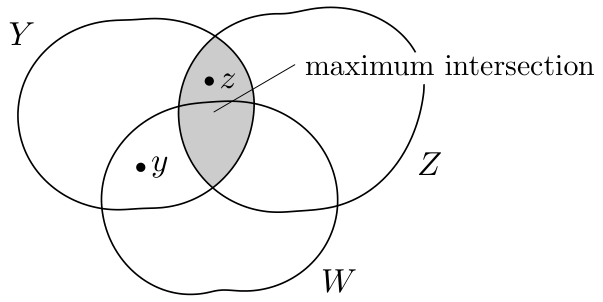
We proceed by induction with respect to . If , that is, , then there exists only one subset of and clearly . In the following, let us suppose the statement is true for all sets of cardinality less than for a given . Let be any set with and be a perfect family of its subsets. We shall show that . If , the claim is obviously true. If , consider all the pairs of distinct sets from . Since the number of such pairs is finite and nonzero, there is a pair , , with intersection of maximum cardinality, that is, and the intersection of any two distinct sets from has at most elements. Since the sets and are distinct, at least one of them must contain an element which is not contained in the other. Without the loss of generality let be nonempty and take any element . In the case is the only set containing , all the sets from the system are subsets of . Clearly , as a subsystem of a perfect system, is perfect as well. Applying the induction hypothesis on and , we get and we are done.
Fig. 2
In the other case, there is at least one set with , (Fig. 2). Due to the choice of the pair , the set can not contain the whole intersection (otherwise we would have ). Let . We have which is in contradiction with the property of the perfect system for , and . So this case is not possible and the induction step is concluded.
---
Alternative solution.
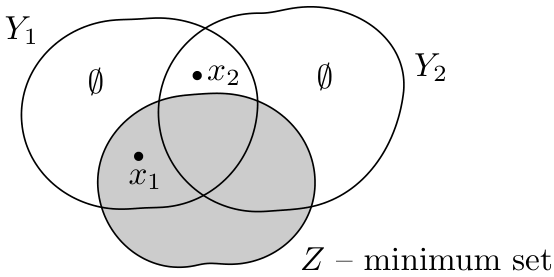
Again, we proceed by induction with respect to , with the claim being trivial when . Suppose is a perfect family of subsets of a finite set , and let be a member of of the minimum cardinality among the nonempty ones (if there is no such set, then and we are done). The first observation is that if and are two nonempty members of that satisfy (possibly or ), then in fact . Suppose otherwise that there exist two such nonempty sets with . Without the loss of generality, suppose that there exists an element . As , we have that (Fig. 3). Since is of minimum cardinality and is nonempty, we have that . As (due to ), we infer that also is nonempty, and hence there exists an element . Now observe that This contradicts the definition of a perfect family for , and .
Fig. 3
Define a family of subsets of as follows: Clearly, is a perfect family of subsets of a strictly smaller set, so from the induction hypothesis we infer that . Moreover, from the observation of the previous paragraph we infer that sets are pairwise different for all with , and hence (the additive +1 comes from possibly having the empty set in ). Concluding,
Fig. 2
In the other case, there is at least one set with , (Fig. 2). Due to the choice of the pair , the set can not contain the whole intersection (otherwise we would have ). Let . We have which is in contradiction with the property of the perfect system for , and . So this case is not possible and the induction step is concluded.
---
Alternative solution.
Again, we proceed by induction with respect to , with the claim being trivial when . Suppose is a perfect family of subsets of a finite set , and let be a member of of the minimum cardinality among the nonempty ones (if there is no such set, then and we are done). The first observation is that if and are two nonempty members of that satisfy (possibly or ), then in fact . Suppose otherwise that there exist two such nonempty sets with . Without the loss of generality, suppose that there exists an element . As , we have that (Fig. 3). Since is of minimum cardinality and is nonempty, we have that . As (due to ), we infer that also is nonempty, and hence there exists an element . Now observe that This contradicts the definition of a perfect family for , and .
Fig. 3
Define a family of subsets of as follows: Clearly, is a perfect family of subsets of a strictly smaller set, so from the induction hypothesis we infer that . Moreover, from the observation of the previous paragraph we infer that sets are pairwise different for all with , and hence (the additive +1 comes from possibly having the empty set in ). Concluding,
Techniques
Coloring schemes, extremal argumentsInduction / smoothing