Browse · MathNet
PrintProblems from Ukrainian Authors
Ukraine geometry
Problem
Circles and intersect at the points and . Suppose and are parallel diameters of the circles and respectively. Moreover, none of the points coincides with or , and the points are located on the circles in the following order: on and on . Lines and intersect at point and lines and intersect at . Prove that, regardless of the choice of parallel diameters and , all the lines intersect at one point or are parallel. (Nazar Serdiuk)
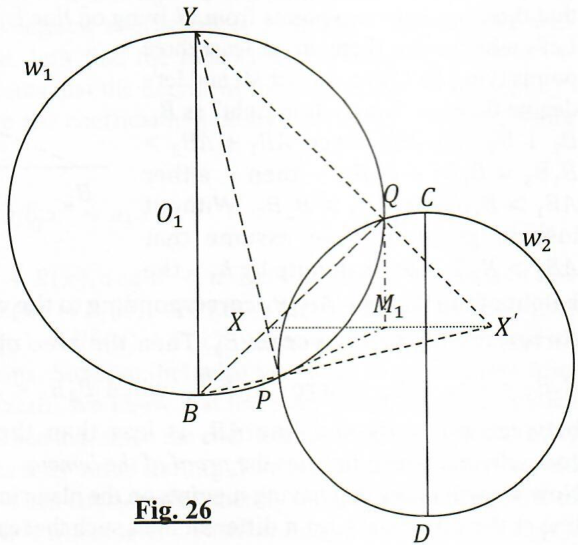 Fig. 26
Solution
Let be the center of circle and as on Fig. 26. Since and , then and are heights of the triangle , and is the orthocenter. Then is also a height in the triangle, therefore and . This implies that triangles and have the same angles, so there is a rotation and homothety that transform triangle into . The center of transformations is at , the rotation is by and the homothety coefficient is .
Denote by the midpoint of . The segments and are medians of the triangles and respectively, therefore , that is, is tangent to . Similarly, we get that is tangent to as well. Consequently, is the intersection of tangents to drawn from and that are not dependent on the choice of points and . Note that the length of the segment
does not depend on and as well, because the length of diameter and the angle are constant.
Analogously, we construct the point for the circle . Assume that (the case when will be considered further). We will show that point is fixed, which implies that all the lines intersect at one point regardless of the choice of diameters and .
Note that and are parallel since both are perpendicular to , that is why The points and as well as the ratio are fixed, therefore is also fixed.
The lines and are parallel and do not coincide if and only if segments and are equal and parallel. These properties hold as well with different choices of the diameters and . Hence, if and are parallel it will imply that is parallel to for all other initializations of diameters and .
The lines and coincide if and only if . In this case one may consider another initialization of the diameters and , that will determine in which of two cases considered above we are. Note, that the initial line satisfies both of the considered cases.
Denote by the midpoint of . The segments and are medians of the triangles and respectively, therefore , that is, is tangent to . Similarly, we get that is tangent to as well. Consequently, is the intersection of tangents to drawn from and that are not dependent on the choice of points and . Note that the length of the segment
does not depend on and as well, because the length of diameter and the angle are constant.
Analogously, we construct the point for the circle . Assume that (the case when will be considered further). We will show that point is fixed, which implies that all the lines intersect at one point regardless of the choice of diameters and .
Note that and are parallel since both are perpendicular to , that is why The points and as well as the ratio are fixed, therefore is also fixed.
The lines and are parallel and do not coincide if and only if segments and are equal and parallel. These properties hold as well with different choices of the diameters and . Hence, if and are parallel it will imply that is parallel to for all other initializations of diameters and .
The lines and coincide if and only if . In this case one may consider another initialization of the diameters and , that will determine in which of two cases considered above we are. Note, that the initial line satisfies both of the considered cases.
Techniques
Triangle centers: centroid, incenter, circumcenter, orthocenter, Euler line, nine-point circleTangentsRotationHomothetySpiral similarityAngle chasing