Browse · MathNet
PrintArgentine National Olympiad 2015
Argentina 2015 counting and probability
Problem
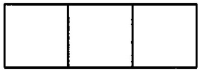
Felipe tells Roberto that he managed to place 1226 triminos on a certain grid square so that they do not have common points, not even vertices. Without knowing the dimensions of , Roberto answers, "If what you say is true then one can place 1250 triminos on your square, under the same conditions." Is Roberto right?
Solution
Yes, Roberto is right. To prove this, we first show that the least for which 1226 triminos can be placed on an square without common points (including vertices) is . Next, take a square. In its first row one can place 25 triminos without point in common; they leave uncovered the 24 cells whose position numbers are divisible by 4. Do the same with all odd-numbered rows 1, 3, 5, ..., 99, of which there are 50. This arrangement of triminos satisfies the conditions and, clearly, any greater grid square can accommodate 1250 trimino too.
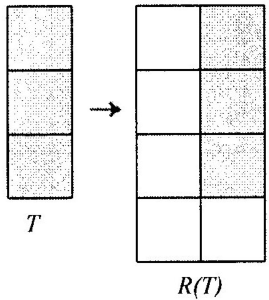
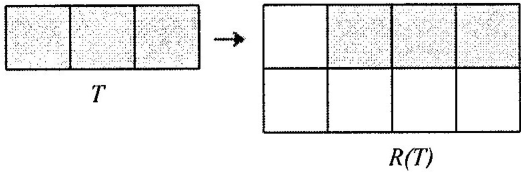
So let be an square containing 1226 triminos without common points (including vertices). Extend to an square by adjoining an additional bottom row and additional leftmost column, with cells in each of them. To each trimino add 5 cells to the left and under it so that and these 5 cells form a rectangle with dimensions . The definition of is illustrated in the figures, for horizontal and vertical triminos.
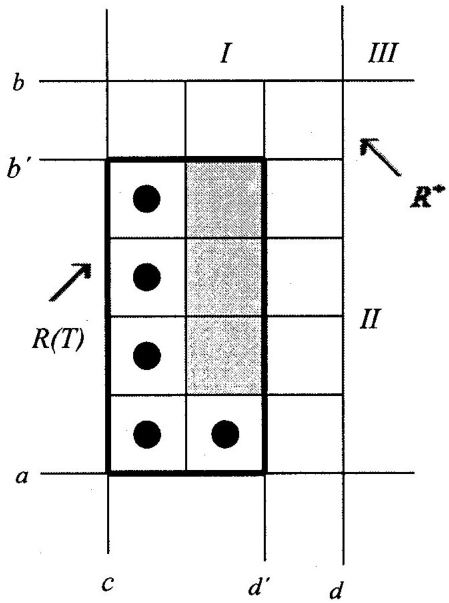
The rectangles defined in this way may stick out of but are contained in the bigger square . The point of the construction is that the rectangles do not overlap, i.e., no two of them have cells in common. Indeed, let and be arbitrary triminos. By symmetry assume that is vertical. Enclose it in a rectangle as shown in the figure.
Note that by hypothesis this rectangle contains no cell of the trimino . The cells marked with form the rectangle together with . Denote by the top right cell in ; it is also the top right cell of . Suppose that is under line . Then so is the entire rectangle by its definition, hence does not overlap with . The same follows if is to the left of line . Suppose that is in region I, i.e., between the lines and above line . Then the entire is above . This is clear if is horizontal. And if is vertical then having cells under mean having cells in which is forbidden. So indeed the whole of is above , implying that is above line . Then does not overlap again. The case where is in region II is analogous; here is to the right of line and is to the right of line . Finally the case of in region III is obvious.
In summary, we obtain 1226 non-overlapping rectangles in the square . By area considerations then and so . It follows that , as stated, so the starting discussion completes the proof.
So let be an square containing 1226 triminos without common points (including vertices). Extend to an square by adjoining an additional bottom row and additional leftmost column, with cells in each of them. To each trimino add 5 cells to the left and under it so that and these 5 cells form a rectangle with dimensions . The definition of is illustrated in the figures, for horizontal and vertical triminos.
The rectangles defined in this way may stick out of but are contained in the bigger square . The point of the construction is that the rectangles do not overlap, i.e., no two of them have cells in common. Indeed, let and be arbitrary triminos. By symmetry assume that is vertical. Enclose it in a rectangle as shown in the figure.
Note that by hypothesis this rectangle contains no cell of the trimino . The cells marked with form the rectangle together with . Denote by the top right cell in ; it is also the top right cell of . Suppose that is under line . Then so is the entire rectangle by its definition, hence does not overlap with . The same follows if is to the left of line . Suppose that is in region I, i.e., between the lines and above line . Then the entire is above . This is clear if is horizontal. And if is vertical then having cells under mean having cells in which is forbidden. So indeed the whole of is above , implying that is above line . Then does not overlap again. The case where is in region II is analogous; here is to the right of line and is to the right of line . Finally the case of in region III is obvious.
In summary, we obtain 1226 non-overlapping rectangles in the square . By area considerations then and so . It follows that , as stated, so the starting discussion completes the proof.
Final answer
Yes
Techniques
Coloring schemes, extremal argumentsOptimization in geometryConstructions and loci