Browse · MathNet
PrintBaltic Way shortlist
Baltic Way geometry
Problem
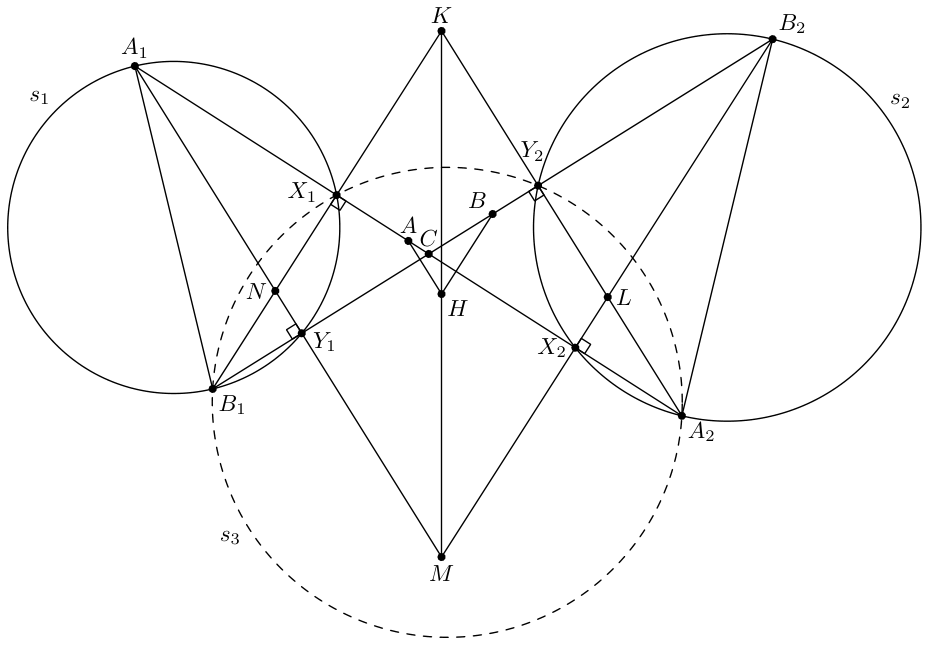
Given two circles on the plane do not intersect. We choose diameters and of these circles such that the segments and intersect. Let and be the midpoints of segments and , be its intersection point. Prove that the orthocenter of the triangle belongs to the fixed line that does not depend on the choice of the diameters.
Solution
Prove that the orthocenter of belongs to their radical axis. Denote the circles by and . Let the line intersect circles and second time in points and respectively, and the line intersect the circles second time in points and . The lines and are parallel (because both of them are orthogonal to ), analogously and are parallel. Hence these four lines form a parallelogram (see fig.). It is clear that perpendiculars from the point to the line and from the point to the line lay on the midlines of this parallelogram. Therefore is the center of parallelogram and coincide with the midpoint of segment . In order to prove that lies on the radical axis of and it is sufficient to show that both points and belong to that radical axis. The points and lie on the circle with diameter . The line is radical axis of and , and the line is radical axis of and . Therefore is radical center of these three circles and hence lies on the radical axis of and . Analogously lies on the radical axis of and .
Techniques
Triangle centers: centroid, incenter, circumcenter, orthocenter, Euler line, nine-point circleRadical axis theoremAngle chasing