Browse · MathNet
PrintEstonian Mathematical Olympiad
Estonia counting and probability
Problem
A rectangular grid is divided by two perpendicular straight lines into four smaller rectangles with integral side lengths. It is possible to remove one among these four rectangles in such a way that the remaining figure can be exactly covered by rectangles of size and . Prove that it is possible to exactly cover one among these four smaller rectangles by rectangles of size and . (By exact covering we mean covering without gaps, overlaps and overflows.)
Solution
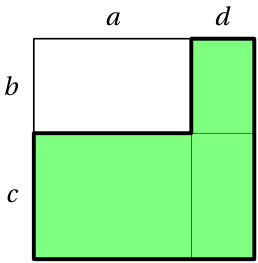
Call a figure coverable if it can be exactly covered by rectangles of size and . Let the original rectangle be of size and let the figure remaining after cutting out the upper left corner of size be coverable (Fig. 52). This would be impossible if or , whence we can assume in the rest that and . Coverability implies that . Also one can notice that a rectangle of integral side lengths where and is coverable if and only if . Indeed, rectangles of size and are obviously coverable, Fig. 52
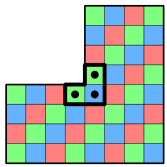
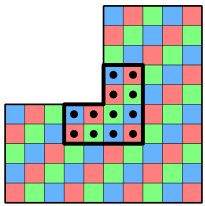
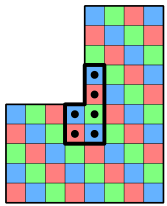
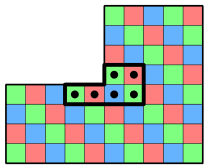
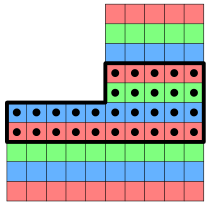
whereas rectangles of size can be divided into rectangles of size ja , both of which are coverable by the above; the symmetric case is analogous. Since , at least one of and must be even. We show next that at least one of and must be divisible by 3. For that, suppose the contrary, i.e., none of and being divisible by 3. If either or then or , respectively, because . Since 3 is prime, we obtain a contradiction. Hence and . Thus either or , as well as either or . If either or then color the squares of the figure by the rising diagonals with 3 colors. If either and or and then color the squares of the figure by the falling diagonals with 3 colors. The area to be covered, except for the neighborhood of the meeting point of the cutting lines of the original rectangle that can be of four different shape (in Figures 53–56, this area is marked by bullets and framed with bold line), can be cut into strips of size and containing an equal amount of unit squares of each color. Hence the area that should be coverable by assumption contains different number of unit squares of different color, which is impossible as every and rectangle contains the same number of unit squares of each color. As we got a contradiction in every case, we have proven that at least one of and is divisible by 3. Fig. 53 Fig. 54 Fig. 55 Fig. 56 It remains to show that one of the small rectangles is coverable whenever one of and is divisible by 2 and also one of and is divisible by 3. The following table shows for each case which of the small rectangles is coverable:
One can show this by the following case study: If one of and is divisible by one of 2 and 3 and one of and is divisible by the other of 2 and 3 then the corresponding small rectangle is coverable. (Fills all squares outside the two long diagonals of the table.) If or then or is coverable, respectively, since and the other side length is long enough by divisibility. Similarly, if or then or is coverable, respectively. (Fills all squares of the main diagonal of the table.) If is divisible by one of 2 and 3 and is divisible by the other of 2 and 3 then, by , we must have . As (by divisibility) and , the rectangle is coverable. Similarly, if is divisible by one of 2 and 3 and is divisible by the other of 2 and 3 then is coverable. (Fills all squares of the secondary diagonal of the table.)
---
Alternative solution.
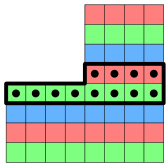
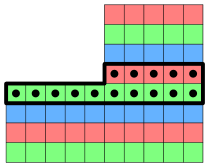
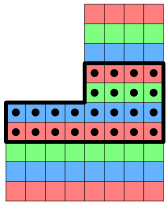
The central claim that neither nor can hold can be proven as follows. Color the grid by rows with three colors. Note that each rectangle of size or contains either exactly 2 unit squares of every color or 3 unit squares of each of some two colors and 0 squares of the third color. In both cases, the numbers of covered unit squares of all colors are congruent modulo 3. Thus if the figure obtained after cutting out the rectangle of size were coverable, the numbers of unit squares of all colors within this area should be congruent modulo 3. We can show that in no cases this is so. As the numbers of unit squares of all colors in 3 consecutive rows of equal length are equal, it suffices to consider the area in the middle that remains after repeatedly removing horizontal strips of width 3 from both top and bottom. If (Figures 57 and 58) then the numbers of unit squares of the three colors in the remaining area are , and 0. These numbers are incongruent modulo 3, regardless of the remainders of and . * If (Figures 59 and 60) then the numbers of unit squares of the three colors in the remaining area are , and . These numbers are also incongruent modulo 3, regardless of the remainders of and . Fig. 57 Fig. 58 Fig. 59 Fig. 60
whereas rectangles of size can be divided into rectangles of size ja , both of which are coverable by the above; the symmetric case is analogous. Since , at least one of and must be even. We show next that at least one of and must be divisible by 3. For that, suppose the contrary, i.e., none of and being divisible by 3. If either or then or , respectively, because . Since 3 is prime, we obtain a contradiction. Hence and . Thus either or , as well as either or . If either or then color the squares of the figure by the rising diagonals with 3 colors. If either and or and then color the squares of the figure by the falling diagonals with 3 colors. The area to be covered, except for the neighborhood of the meeting point of the cutting lines of the original rectangle that can be of four different shape (in Figures 53–56, this area is marked by bullets and framed with bold line), can be cut into strips of size and containing an equal amount of unit squares of each color. Hence the area that should be coverable by assumption contains different number of unit squares of different color, which is impossible as every and rectangle contains the same number of unit squares of each color. As we got a contradiction in every case, we have proven that at least one of and is divisible by 3. Fig. 53 Fig. 54 Fig. 55 Fig. 56 It remains to show that one of the small rectangles is coverable whenever one of and is divisible by 2 and also one of and is divisible by 3. The following table shows for each case which of the small rectangles is coverable:
| 3 \mid a | 3 \mid b | 3 \mid c | 3 \mid d | |
|---|---|---|---|---|
| 2 \mid a | a \times c | a \times b | a \times c | a \times c |
| 2 \mid b | a \times b | d \times b | d \times b | d \times b |
| 2 \mid c | a \times c | d \times b | d \times c | d \times c |
| 2 \mid d | a \times c | d \times b | d \times c | d \times c |
---
Alternative solution.
The central claim that neither nor can hold can be proven as follows. Color the grid by rows with three colors. Note that each rectangle of size or contains either exactly 2 unit squares of every color or 3 unit squares of each of some two colors and 0 squares of the third color. In both cases, the numbers of covered unit squares of all colors are congruent modulo 3. Thus if the figure obtained after cutting out the rectangle of size were coverable, the numbers of unit squares of all colors within this area should be congruent modulo 3. We can show that in no cases this is so. As the numbers of unit squares of all colors in 3 consecutive rows of equal length are equal, it suffices to consider the area in the middle that remains after repeatedly removing horizontal strips of width 3 from both top and bottom. If (Figures 57 and 58) then the numbers of unit squares of the three colors in the remaining area are , and 0. These numbers are incongruent modulo 3, regardless of the remainders of and . * If (Figures 59 and 60) then the numbers of unit squares of the three colors in the remaining area are , and . These numbers are also incongruent modulo 3, regardless of the remainders of and . Fig. 57 Fig. 58 Fig. 59 Fig. 60
Techniques
Coloring schemes, extremal argumentsInvariants / monovariantsDivisibility / FactorizationPrime numbersModular Arithmetic