Browse · MathNet
PrintNational Olympiad of Argentina
Argentina counting and probability
Problem
A cross is the shape obtained from a grid square upon removing the 4 corner unit squares. Every unit square of a table must be colored in one of 5 distinct colors so that the 5 unit squares of every cross contained in the table have different colors. In how many ways can this be done? Two colorings are different if there is a unit square colored with one color in one of them and with a different color in the other.
Solution
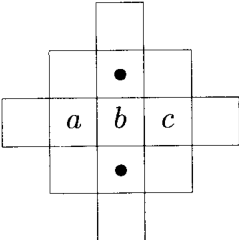
For an admissible coloring let the 13-cell shape shown in the figure be entirely inside the table. Observe that the central row of 5 represents all 5 colors, as well as the central column of 5. Assume on the contrary that the central row misses color 1. Since the crosses centered at a, b, c contain color 1, this color occurs 3 times in the union of the two rows of 3 above and under abc. This union is covered by the two crosses centered at the cells • adjacent to b. However these crosses combined represent each color at most twice. The claim is proven.
We argue for a general square where . Every 5 consecutive cells in rows 3, 4, ..., form the central row of 5 in a shape like above, so they represent all 5 colors. The same holds for every 5 consecutive cells in columns 3, 4, ..., . Hence the coloring of the rows and columns mentioned is periodic with period 5. Write for the cell in row and column , "cross " for the cross centered at and if has color . Note that any two adjacent cells not at the border of the table are contained in some cross, so they are colored differently.
Fix the colors of the first 5 cells in row 3 and the second cell in row 2. Cells have different colors, label them 1, 2, 3, 4, 5. The color of is not arbitrary: one infers from
cross that . Let , , the case , is analogous. We show that then the entire coloring is determined apart from the colors of 3 cells at each corner: the vertex cell and its two neighbors by side. Call the figure obtained by ignoring these 12 cells. The coloring of row 3 is determined: . By considering cross we find ; since and , it follows that , . The same argument for crosses and shows that , , , . The colors of 4 consecutive cells in row 4 are known now, from the second to the fifth, so row 4 has coloring . The remaining crosses centered in row 3 determine the colors in row 2 without its first and last cell: . After this consider the crosses centered at row 2 except and . They determine the colors in row 1 without its first two and last two cells: . Once the coloring of row 4 is known, we proceed analogously to rows to achieve the same. For the next-to-last row the colors are determined uniquely except for the first and the last cell. For the last row we use the crosses in row different from and . This yields the colors in row apart from the ones of the first two and the last two cells. Thus the coloring of figure is indeed completely determined. There remain the three cells at each corner. We infer from cross that , and the two possibilities for and are feasible as there are no more restrictions on their colors. Likewise there are 2 possibilities for the colors of the analogous pairs at the other three corners. As for the colors of the 4 vertex cells, there are no restrictions at all. Initially we fixed the colors of and which can be done in ways. Then there are 2 choices for the coloring of the pair and 2 choices for each analogous pair at the corners. Last, there are 5 choices for the color of each vertex cell. Every combination of the choices described yields a coloring with the stated property. Therefore the number of admissible colorings is .
We argue for a general square where . Every 5 consecutive cells in rows 3, 4, ..., form the central row of 5 in a shape like above, so they represent all 5 colors. The same holds for every 5 consecutive cells in columns 3, 4, ..., . Hence the coloring of the rows and columns mentioned is periodic with period 5. Write for the cell in row and column , "cross " for the cross centered at and if has color . Note that any two adjacent cells not at the border of the table are contained in some cross, so they are colored differently.
Fix the colors of the first 5 cells in row 3 and the second cell in row 2. Cells have different colors, label them 1, 2, 3, 4, 5. The color of is not arbitrary: one infers from
cross that . Let , , the case , is analogous. We show that then the entire coloring is determined apart from the colors of 3 cells at each corner: the vertex cell and its two neighbors by side. Call the figure obtained by ignoring these 12 cells. The coloring of row 3 is determined: . By considering cross we find ; since and , it follows that , . The same argument for crosses and shows that , , , . The colors of 4 consecutive cells in row 4 are known now, from the second to the fifth, so row 4 has coloring . The remaining crosses centered in row 3 determine the colors in row 2 without its first and last cell: . After this consider the crosses centered at row 2 except and . They determine the colors in row 1 without its first two and last two cells: . Once the coloring of row 4 is known, we proceed analogously to rows to achieve the same. For the next-to-last row the colors are determined uniquely except for the first and the last cell. For the last row we use the crosses in row different from and . This yields the colors in row apart from the ones of the first two and the last two cells. Thus the coloring of figure is indeed completely determined. There remain the three cells at each corner. We infer from cross that , and the two possibilities for and are feasible as there are no more restrictions on their colors. Likewise there are 2 possibilities for the colors of the analogous pairs at the other three corners. As for the colors of the 4 vertex cells, there are no restrictions at all. Initially we fixed the colors of and which can be done in ways. Then there are 2 choices for the coloring of the pair and 2 choices for each analogous pair at the corners. Last, there are 5 choices for the color of each vertex cell. Every combination of the choices described yields a coloring with the stated property. Therefore the number of admissible colorings is .
Final answer
2400000
Techniques
Coloring schemes, extremal argumentsRecursion, bijection