Browse · MathNet
PrintChina National Team Selection Test
China geometry
Problem
In a plane with cartesian coordinates, let and be two regions of convex polygon (including boundary and interior) whose vertices are all integer points (i.e., their coordinates are all integers) and . Prove that if is not empty and does not contain integer point, then is a non-degenerate convex quadrilateral. (posed by Qu Zhenhua)
Solution
Since the non-empty intersection of two convex closed polygons is a closed convex polygon or degenerated polygon, there are three possible cases.
(1) is a point. Then must be the vertex of or , contradicting the fact that contains no integer point.
(2) is a segment. Then must be the intersection of an edge of and an edge of , which contains the vertex of or , which is a contradiction.
(3) is a closed convex polygon. So, it remains to be shown that is a quadrilateral. First, we note that if has two adjacent edges on the edges of (or ), then the common vertex of these two edges must be the vertex of (or ), which is a contradiction. Thus, the boundary of is formed alternately by a part of an edge of and then a part of an edge of , and each vertex of is the intersect point of edges of and . Thus, the number of edges of is even. We see that if an edge of intersects an edge of , then must intersect another edge of , otherwise will contain an integer point. In the following, we show by contradiction that the number of edges of can be 6 or more. If has edges no less than 6, then suppose contains integer points except the vertices of .
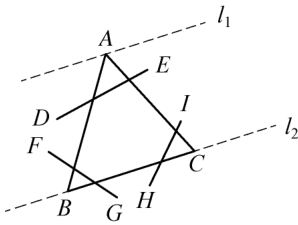
Case 1. If , then is an element integer triangle, or a parallelogram with area 1. So, can be located between two parallel lines . And there is no integer point in the open domain between and . At least three edges of are the edges of , because has at least six edges. (a) In case of being (See Fig. 6.1), , and are edges of . and may coincide with and , respectively. Lines , , and form a convex quadrilateral. Since line does not intersect segment , we see that the intersect point of line and or of line and is in . Thus, has integer vertex in , a contradiction.
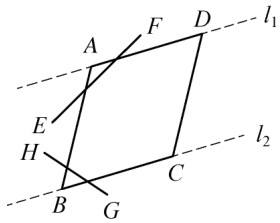
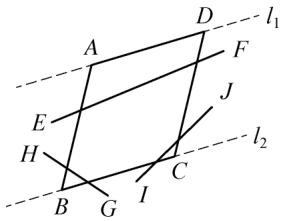
(b) In case of being a parallelogram . Let , and be three edges of (see Fig. 6.2). The intersection point of line and locates in . Let , and be three edges of (see Fig. 6.3), and there is no edge of on . Similar to the case of (a), we can see the intersection point of line and or of line and locates in , which is a contradiction.
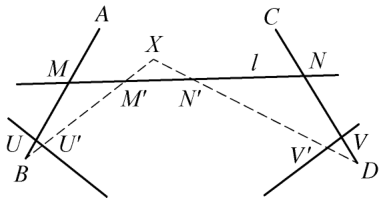
Case 2. . Consider integer point on other than the vertices. Since , there exists an edge of such that and are separated by line (denote by ) (see Fig. 6.4). Thus, is a part of boundary of . is on the edge of , is on the edge of . , and are on the same side of ( and may coincide, but and do not by the hypothesis that has at least six edges). Thus, there is another vertex of on , and there is another vertex of on .
Denote the convex hull of points and vertices of below by . Then and coincide below , and the part of up is . Comparing with , we see that , and the boundary of is the boundary of with , and replaced by , and , respectively. That is, and have the same number of edges, and the number of integer points of other than vertices is less than that of . By a finite procedure like this, we can obtain a convex polygon with no interior integer point. By Case 1, it is impossible. ☐
(1) is a point. Then must be the vertex of or , contradicting the fact that contains no integer point.
(2) is a segment. Then must be the intersection of an edge of and an edge of , which contains the vertex of or , which is a contradiction.
(3) is a closed convex polygon. So, it remains to be shown that is a quadrilateral. First, we note that if has two adjacent edges on the edges of (or ), then the common vertex of these two edges must be the vertex of (or ), which is a contradiction. Thus, the boundary of is formed alternately by a part of an edge of and then a part of an edge of , and each vertex of is the intersect point of edges of and . Thus, the number of edges of is even. We see that if an edge of intersects an edge of , then must intersect another edge of , otherwise will contain an integer point. In the following, we show by contradiction that the number of edges of can be 6 or more. If has edges no less than 6, then suppose contains integer points except the vertices of .
Case 1. If , then is an element integer triangle, or a parallelogram with area 1. So, can be located between two parallel lines . And there is no integer point in the open domain between and . At least three edges of are the edges of , because has at least six edges. (a) In case of being (See Fig. 6.1), , and are edges of . and may coincide with and , respectively. Lines , , and form a convex quadrilateral. Since line does not intersect segment , we see that the intersect point of line and or of line and is in . Thus, has integer vertex in , a contradiction.
(b) In case of being a parallelogram . Let , and be three edges of (see Fig. 6.2). The intersection point of line and locates in . Let , and be three edges of (see Fig. 6.3), and there is no edge of on . Similar to the case of (a), we can see the intersection point of line and or of line and locates in , which is a contradiction.
Case 2. . Consider integer point on other than the vertices. Since , there exists an edge of such that and are separated by line (denote by ) (see Fig. 6.4). Thus, is a part of boundary of . is on the edge of , is on the edge of . , and are on the same side of ( and may coincide, but and do not by the hypothesis that has at least six edges). Thus, there is another vertex of on , and there is another vertex of on .
Denote the convex hull of points and vertices of below by . Then and coincide below , and the part of up is . Comparing with , we see that , and the boundary of is the boundary of with , and replaced by , and , respectively. That is, and have the same number of edges, and the number of integer points of other than vertices is less than that of . By a finite procedure like this, we can obtain a convex polygon with no interior integer point. By Case 1, it is impossible. ☐
Techniques
Pick's theoremConvex hullsCartesian coordinates